
Obama Faces Renewed Political Backlash
Obama Faces Renewed Political Backlash as Critics Revisit His Presidential Legacy
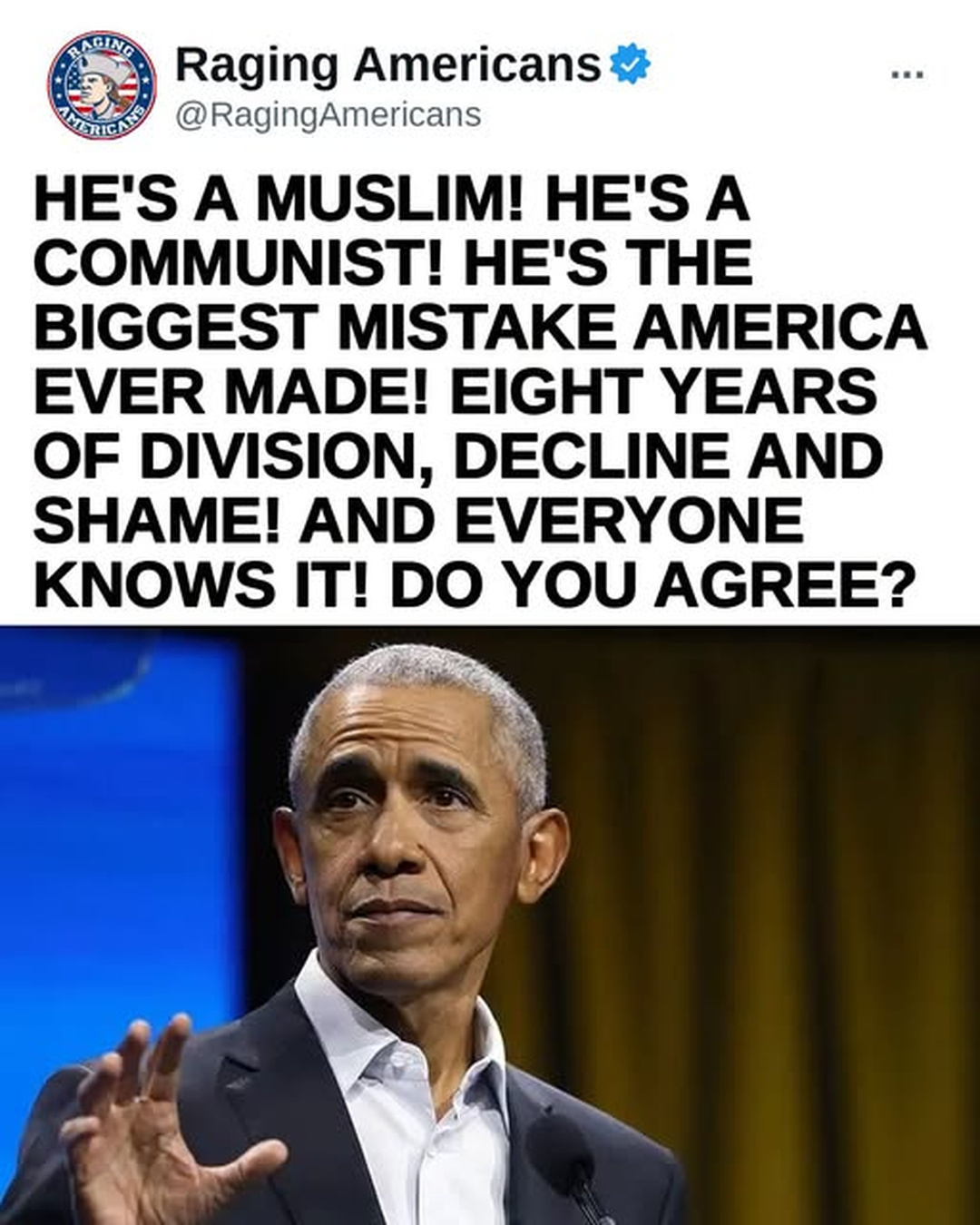


A political post attacking former President Barack Obama has reignited debate over his eight years in office, using sharp language to accuse him of deepening divisions and weakening America's national standing.
The post, shared by the social media account Raging Americans, describes Obama as a communist and calls his presidency one of the biggest mistakes in American history. These statements are political accusations, not established facts.
The message also criticizes Obama's religious identity, declaring that he is Muslim. However, Obama has publicly identified as a Christian, and there is no credible evidence supporting the post's religious allegation.
The wording reflects the confrontational tone that continues to characterize American political discourse, particularly among accounts that use provocative statements to challenge prominent figures from the opposing political camp.
Obama served as the 44th president of the United States from January 2009 until January 2017. His administration introduced major policy changes that continue to shape arguments about healthcare, immigration, the economy, and America's global role.
One of the most enduring controversies of Obama's presidency was the Affordable Care Act, commonly known as Obamacare. Supporters viewed it as a landmark healthcare reform, while opponents criticized its costs and government involvement.
His administration also faced criticism over immigration enforcement, economic recovery, and foreign policy decisions. Republicans frequently argued that his policies expanded federal power, while Democrats emphasized economic stabilization and expanded access to healthcare.
The 2008 financial crisis presented Obama with an immediate challenge when he entered office. His administration supported economic recovery measures, including financial-sector interventions and a stimulus package intended to prevent a deeper downturn.
Supporters credit those measures with helping stabilize the economy, while critics argue that the recovery was uneven and that many American families continued to struggle with stagnant wages and financial insecurity.
Foreign policy also remains central to debates over Obama's legacy. His administration pursued negotiations with Iran over its nuclear program, restored diplomatic relations with Cuba, and authorized military operations against extremist organizations.
Critics questioned several of those decisions, particularly the Iran nuclear agreement and the administration's response to instability in the Middle East. Supporters argued that diplomacy and international cooperation offered alternatives to prolonged military confrontation.
The post's reference to eight years of division reflects a broader partisan argument about Obama's impact on American society. Political polarization intensified during his presidency, although its causes extend beyond one administration or individual.
Race also became a significant subject of political debate during Obama's time in office. As the country's first Black president, he faced intense scrutiny, while discussions about racial inequality and discrimination remained prominent nationwide.
Obama's supporters argue that his presidency represented an important milestone in American history and expanded the sense of political possibility for many citizens. His critics maintain that his policies failed to unite the country.
The disagreement illustrates how presidential legacies are often interpreted differently depending on political affiliation, personal experience, and expectations about the federal government's responsibilities.
The label "communist" used in the viral post is a political characterization rather than a neutral description of Obama's economic system. His administration operated within the United States' capitalist economy.
Likewise, claims that Obama was America's biggest presidential mistake express an opinion rather than a measurable historical conclusion. Assessments of presidential performance typically consider economic indicators, legislation, international developments, and long-term consequences.
Social media has made it easier for politically charged messages to reach large audiences rapidly. Strong language and emotionally provocative claims can encourage engagement, even when posts provide little supporting evidence.
The image does not establish who originally wrote the quoted statement or whether Obama was responding to it. It presents an attack attributed to the account shown in the screenshot.
The post's closing question, asking readers whether they agree, invites followers to take sides in a continuing debate over Obama's record and the direction of American politics.
Reactions to such messages are likely to reflect the country's existing political divisions. Some readers may welcome the criticism, while others may challenge its language, factual accuracy, and portrayal of the former president.
Ultimately, Obama's legacy remains contested nearly a decade after he left office. His supporters and opponents continue to debate his achievements, shortcomings, and influence on the political landscape.
The broader question is whether Americans can evaluate presidential records through verifiable evidence and specific policy outcomes rather than relying exclusively on partisan labels, sweeping accusations, or emotionally charged social media posts.
Comments (0)
Loading comments...
May You Like

WWE BRONSON REED DEAD AT 38, STIMULANTS DETECTED, $10M INSURANCE PAYOUT FROZEN!


EAST COAST DISASTER—179 THOUSANDS OF HOMES AT RISK, CAUSING $50 BILLION IN DAMAGE!









Popular Posts




