
Obama Mocks Trump’s White House Renovations, Saying President Is Focused on Décor Instead of Americans’ Costs
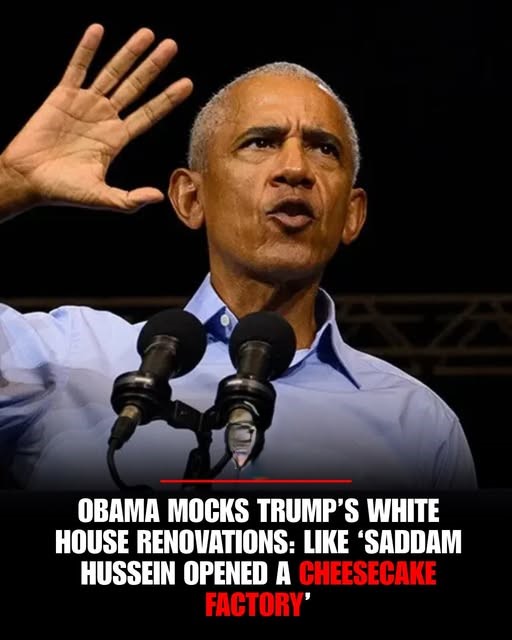
October 27, 2026 | Cleveland, Ohio, United States | Politics
Obama Turns White House Renovations Into a Campaign Issue
Former President Barack Obama has sharply criticized President Donald Trump’s White House renovation projects, arguing that the president appears more focused on decorating the executive mansion than addressing the economic pressures facing American families.
Obama made the remarks on October 24 during a Democratic campaign rally in Cleveland, Ohio, where he appeared in support of Senate candidate Sherrod Brown and gubernatorial candidate Amy Acton ahead of the November midterm elections.
“He should be on HGTV,” Obama joked, suggesting Trump’s attention to home renovations was misplaced. He then delivered a pointed comparison, saying the White House looked “like Saddam Hussein opened a Cheesecake Factory,” referring to the extensive gold-colored decorations associated with Trump’s redesign.
The comments drew laughter and applause from the audience, quickly becoming one of the rally’s most widely circulated moments. Beyond the joke about interior design, Obama’s message was political: he argued that the president should concentrate on lowering prices, improving access to health care, and making housing and utility bills more affordable.
Obama’s appearance marked a renewed effort to mobilize Democratic voters ahead of a consequential election. His criticism connected Trump’s highly visible renovation projects with broader questions about presidential priorities, public spending, and the administration’s response to household financial concerns.
Obama addresses supporters at a Cleveland campaign rally on October 24, 2026.
The Ballroom and Other White House Changes
Obama singled out several projects associated with Trump’s second term, including plans for a large state ballroom, the redesign of the Rose Garden, a new helicopter landing area on the South Lawn, and extensive gold-colored decorative details.
The ballroom project was formally announced in July 2025. The White House said the proposed space would cover approximately 90,000 square feet and accommodate around 650 seated guests, substantially expanding the mansion’s capacity to host official events. The administration described the project as a long-term improvement for state visits and other major diplomatic functions.
Critics, however, have questioned the scale of the construction and its implications for the historic East Wing. The project has become a symbol of a broader argument over how much a president should alter the nation’s most recognizable government residence.
Trump’s supporters maintain that the building requires modernization and that improvements can make official events more practical. They also argue that the president has the right to update the residence, provided that relevant preservation, planning, and security requirements are respected.
Construction work during the Rose Garden redesign illustrates the physical changes that have fueled debate about the White House’s appearance.
Trump Defends His Approach
Trump has defended the renovations as necessary improvements to a historic building. He has pointed to damaged plaster, cracked surfaces, broken tiles, and other features he says required attention. He has also argued that the White House should be maintained to reflect the dignity of the presidency.
On October 26, Trump responded to Obama’s remarks at a rally in Mississippi. He rejected the suggestion that the renovation work showed misplaced priorities and defended the restaurant chain mentioned in Obama’s joke, describing it as a successful business.
The exchange demonstrated how a debate about architecture can become a personal political confrontation. Obama questioned whether Trump was concentrating on the issues voters care about, while Trump presented the work as an effort to improve and preserve an important national building.
Renovations Become an Election Issue
Obama’s comments were delivered just ten days before the November 3 midterm elections. His appearance was intended to boost Democratic candidates in competitive Ohio races, including Sherrod Brown’s Senate campaign and Amy Acton’s campaign for governor.
By linking the renovations to the cost of living, Obama sought to frame the issue in terms voters could connect to their daily experiences. Housing expenses, energy bills, health care costs, and grocery prices remain major concerns for many households, making presidential priorities a natural target for campaign criticism.
The dispute also reflects a broader challenge for political leaders: the difference between visible projects and less visible policy outcomes. Renovations can be photographed and discussed immediately, while the effects of economic decisions often take longer to measure and may be interpreted differently by different groups of voters.
A Symbolic Battle Over Presidential Priorities
The argument over the White House makeover is unlikely to determine the midterm elections on its own. Nevertheless, it has given Democrats a memorable way to criticize Trump’s priorities and allowed the president to defend a project he considers an improvement to the executive residence.
For some Americans, the changes represent modernization and a president’s personal style. For others, they symbolize excessive attention to appearances at a time when families are concerned about affordability and economic security.
Ultimately, Obama’s “Cheesecake Factory” comparison was political satire rather than a neutral assessment of the building. Its significance lies in how effectively it connected the president’s renovation projects to the wider debate over leadership, public priorities, and the approaching elections.
The larger question is not simply whether the White House looks better or worse after the changes. It is whether voters believe the administration is devoting sufficient attention to the problems they consider most urgent.
Comments (0)
Loading comments...
May You Like

DAVENPORT AIRBNB HORROR — 40 OF 50 TEENS TEST POSITIVE FOR DRUGS SUPPLIED BY THE HOST'S MOM!

WWE BRONSON REED—INSPIRED—SUDDEN COLLAPSE, MYSTERIOUS STIMULANTS, DEAD AT 38!

BOMBSHELL NEW JERSEY FLOOD — 112 KM/H WINDS, SEAWATER FLOODING INLAND, 120,000 HOMES AT RISK!









Popular Posts




