
Ted Cruz Calls Obama One of His Generation’s Most Effective Politicians — and Warns of His Political Power Without Term Limits
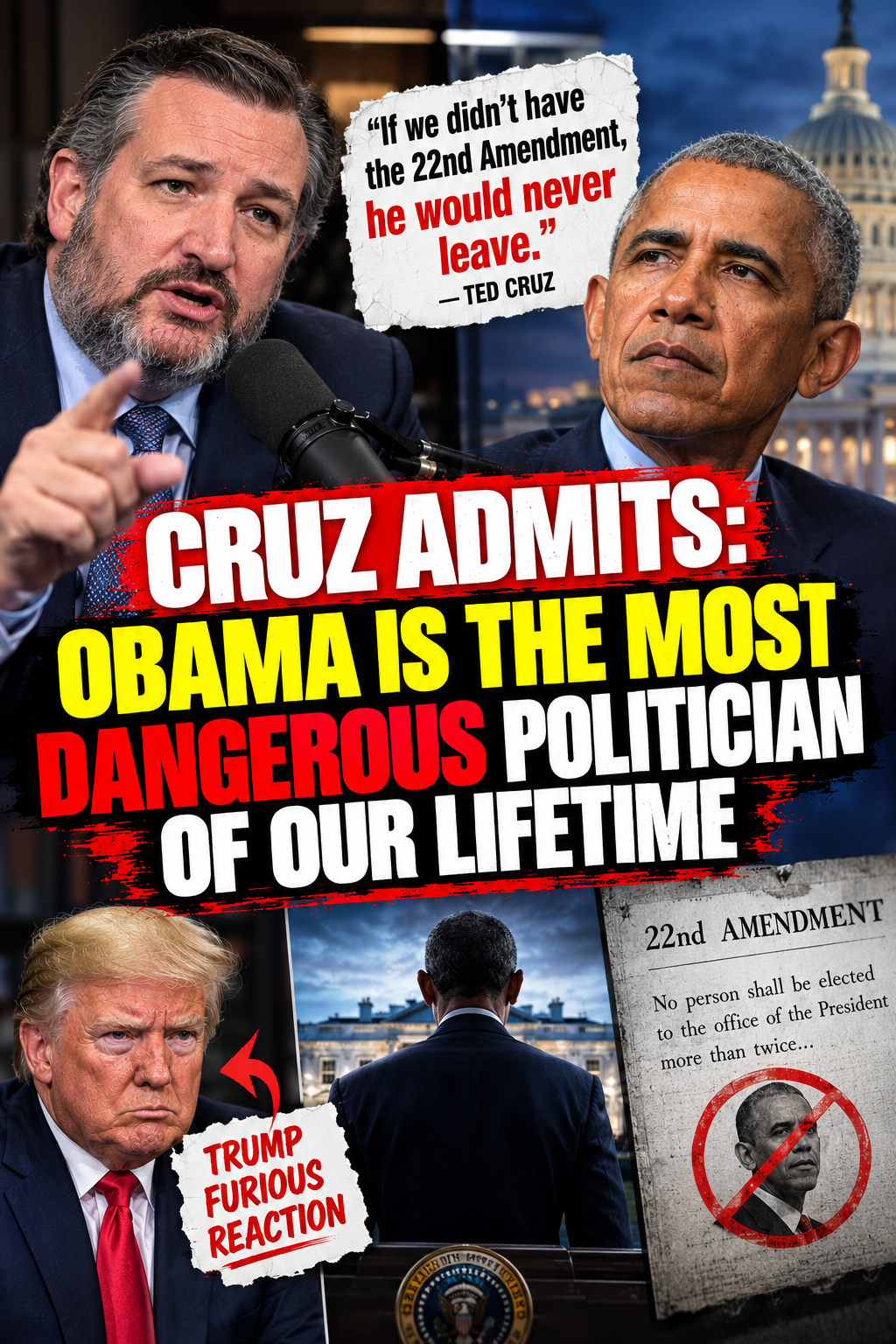
October 30, 2026 — In a striking assessment from one of Barack Obama’s longtime Republican critics, Senator Ted Cruz has acknowledged that the former Democratic president may be the most effective Democratic politician of their generation, praising his communication skills while warning Republicans not to underestimate his influence on the campaign trail.
Cruz made the remarks on the October 26 episode of his podcast, Verdict with Ted Cruz, while discussing Obama’s recent campaign appearance in Ohio and the message Democrats may use in the final days before the November 3 midterm elections. Cruz said Obama and former President Bill Clinton stood above other Democratic politicians in their ability to communicate and connect with voters.
The most attention-grabbing line concerned presidential term limits. Cruz said that, without the 22nd Amendment, it would not surprise him if Obama spent the rest of his life in the White House. The comment was a hypothetical assessment of Obama’s political appeal—not a claim that Obama had sought to abolish term limits or remain president unlawfully.

Why Cruz says Obama remains a formidable political force
Cruz’s comments came during a discussion of Obama’s recent criticism of Trump’s White House renovations. Obama had compared the president’s decorative choices to a Cheesecake Factory restaurant renovated by former Iraqi leader Saddam Hussein, a line that became a prominent part of the political conversation.
Asked whether this kind of message could work for Democrats, Cruz offered a mixed assessment. He cautioned against dismissing Obama’s influence, describing him as potentially the most effective Democratic politician of their lifetime and comparing his political abilities with those of Clinton. Cruz also called Obama’s communication skills “really powerful” and “really dangerous.”
The significance of the remarks lies in their source. Cruz has spent much of his political career opposing Democratic priorities and criticizing Obama’s presidency. His assessment therefore stands out as an acknowledgment of an opponent’s political strengths, even though Cruz’s broader purpose was to warn Republicans about the messaging Democrats could use against them.
Cruz was not endorsing Obama’s policies. Instead, he argued that Democrats could use Obama’s ability to frame political issues to build a campaign narrative around corruption, economic concerns and the conduct of the Trump administration. He suggested that Obama’s recent remarks could preview the themes Democrats pursue in 2027 and the 2028 presidential campaign.

What the 22nd Amendment actually says
The reference to the 22nd Amendment is important because it establishes a constitutional limit on presidential elections. Ratified in 1951 following Franklin D. Roosevelt’s four elected terms, the amendment provides that no person may be elected president more than twice. It also addresses the circumstances of a vice president or other successor who serves part of another president’s term.
Obama served two elected presidential terms, from 2009 to 2017. Under the amendment’s ordinary application, he cannot be elected president again. Cruz’s comment imagined a United States without that constitutional restriction; it did not describe a realistic legal route for Obama to return to the presidency for a third elected term.
Changing the amendment would require a constitutional amendment under Article V, involving supermajority approval in Congress or a convention process initiated by the states, followed by ratification by three-fourths of the states. It is not something a president can accomplish simply by signing an executive order.
The constitutional point also places the quote in perspective. Cruz was making a statement about Obama’s hypothetical electoral appeal, not presenting evidence that Obama had plans to remain in office indefinitely.

The political warning behind the compliment
Cruz’s principal concern was not the possibility of Obama personally returning to office. It was the influence the former president could exert on Democratic messaging and congressional politics.
In the podcast, Cruz argued that Obama’s recent campaign appearances offered an early look at how Democrats might frame the 2028 election. He predicted that corruption could become a central theme, particularly if Democrats gained control of one or both chambers of Congress in the midterms. In that scenario, Cruz said, Republicans could face repeated congressional hearings focused on allegations of misconduct and government ethics.
Those remarks are best understood as Cruz’s political analysis, not confirmation that Democrats have adopted a finalized 2028 strategy. Campaign messages can change, and the issues that dominate a future election will depend on events, candidates, economic conditions and voters’ priorities.
Still, Cruz’s warning reflects a familiar feature of American politics: former presidents can retain considerable influence after leaving office. They may campaign for candidates, raise money, shape party messaging and draw attention to issues that their party wants voters to consider.
Obama remains a prominent Democratic figure, but his influence should not be confused with formal control over the party or its future candidates. Democratic campaigns will also depend on governors, senators, House candidates, local organizers and voters whose priorities may differ from those of the former president.
How this fits into the fight over the 2026 midterms

The timing gives Cruz’s comments additional significance. With Election Day on November 3 approaching, both parties are trying to define the issues that will determine how voters assess the current administration and Congress.
For Republicans, Cruz’s message was a warning not to underestimate Obama’s ability to deliver a concise, memorable criticism of the president. For Democrats, Obama’s campaign appearances offer an opportunity to use a nationally recognized former president to support candidates and draw attention to their arguments about the economy, ethics and government priorities.
The wider contest is not simply about whether Obama remains popular or whether Cruz respects his communication skills. It is about which party can persuade voters that its account of the country’s problems is credible—and that its candidates have a practical response.
Cruz’s remarks also illustrate a distinction between political effectiveness and agreement on policy. A politician can acknowledge an opponent’s skill at communicating without accepting that opponent’s positions. In this case, Cruz’s praise was paired with a warning to Republicans about the potential electoral consequences of underestimating Obama’s influence.
Did Trump react angrily to Cruz’s comments?
The image supplied with the story includes the phrase “Trump Furious Reaction,” but the sources reviewed for this article do not establish that Trump issued a specific angry response to Cruz’s remarks. Without a verifiable statement, recording or reliable report documenting such a reaction, it would be premature to describe the president as furious.
Likewise, the headline’s characterization of Obama as “the most dangerous politician of our lifetime” is not an exact quotation established by the podcast transcript. Cruz called Obama’s communication skills “really dangerous” and said Obama may be the most effective Democratic politician of their lifetime. Those are related but distinct statements, and they should not be merged into a fabricated direct quote.
The verified story is still notable without those embellishments: a Republican senator who has repeatedly opposed Obama’s political agenda publicly acknowledged his exceptional communication skills and warned his party that the former president could help shape Democratic messaging well beyond the current election cycle.
A revealing moment, but not an admission of a secret plan
Cruz’s comments are a reminder that political opponents sometimes offer unusually direct assessments of each other’s strengths. His description of Obama as one of the most effective Democratic politicians of the era recognizes the former president’s ability to influence public debate, while the discussion of term limits emphasizes the constitutional boundary that prevents him from being elected to a third presidential term.
The remarks do not demonstrate that Obama intends to circumvent the Constitution, that Cruz has abandoned his opposition to Obama’s policies, or that Trump reacted angrily behind the scenes. Those claims would require evidence beyond the quote itself.
What the podcast does show is that Cruz believes Obama’s communication skills remain a force Republicans must take seriously. As the midterms approach and both parties begin looking toward 2028, that assessment offers a window into how at least one prominent Republican is thinking about the next phase of the political contest.
Comments (0)
Loading comments...
May You Like

WWE BRONSON REED—INSPIRED—SUDDEN COLLAPSE, MYSTERIOUS STIMULANTS, DEAD AT 38!

DAVENPORT AIRBNB HORROR — “SHOTS AT THE DOOR” GAME, 1 DEAD, 6 INJURED!

STAR DIED AT 38, $10M LIFE INSURANCE INCREASED JUST 30 DAYS BEFORE WWE BRONSON REED'S DEATH!











Popular Posts

