
“Obama Reignited Racism”: Inside Rick Santorum’s Explosive Claim—and the Long War Over the 44th President’s Legacy
“Obama Reignited Racism”: Inside Rick Santorum’s Explosive Claim—and the Long War Over the 44th President’s Legacy
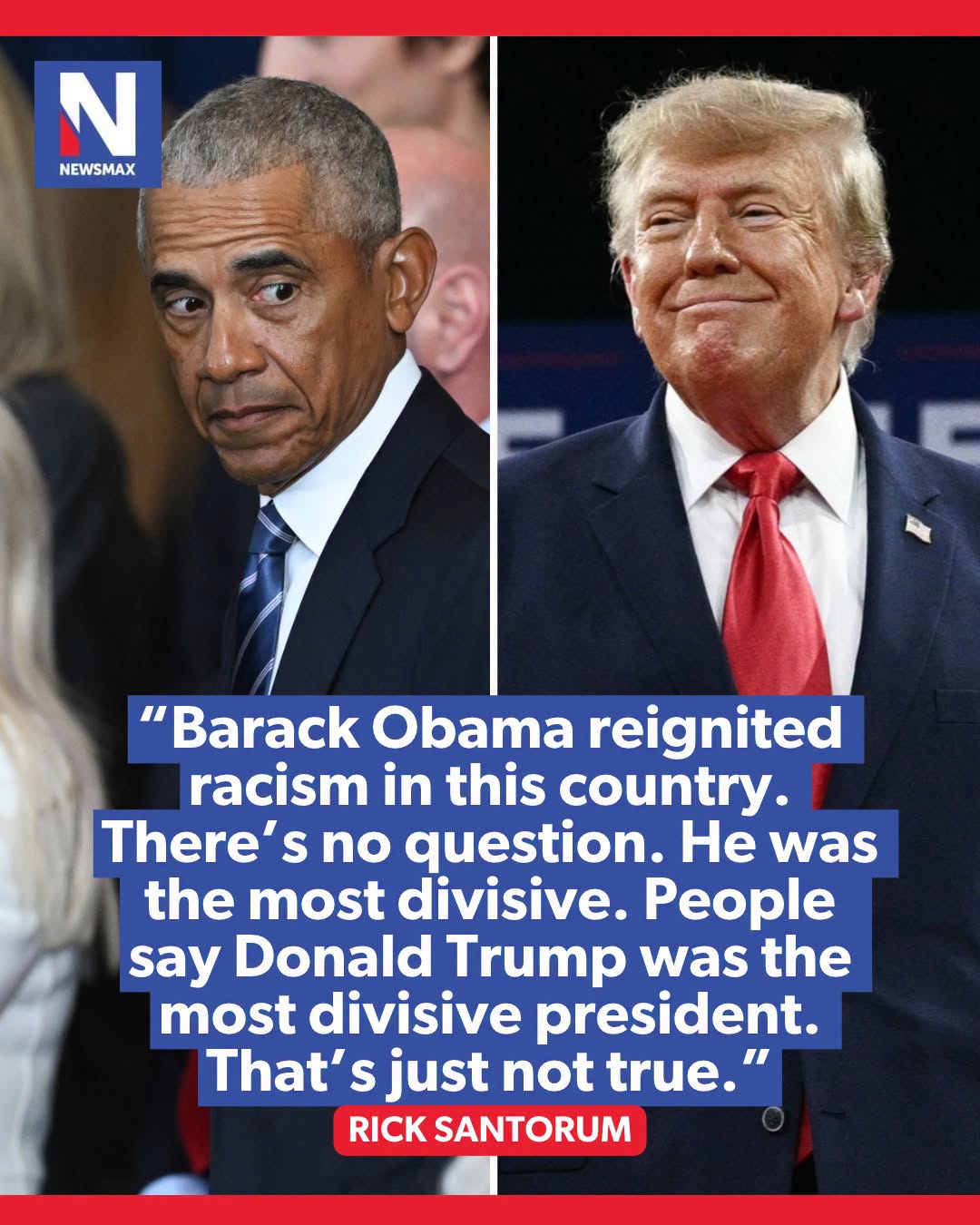
The image is a stark, two-panel provocation. On the left, Barack Obama stares with a tight, weary expression. On the right, Donald Trump grins. Between them, a blue banner carries a quote attributed to former Senator Rick Santorum: “Barack Obama reignited racism in this country. There’s no question. He was the most divisive. People say Donald Trump was the most divisive president. That’s just not true.”
The post, circulated widely on Newsmax and across social media, is designed to land like a counter-punch. For years, the dominant narrative—particularly among Democrats and many in the media—has been that Donald Trump’s political rise was fueled by the racism that Obama’s election exposed. Santorum’s quote flips that script entirely. It argues that Obama was not the victim of racial backlash, but its primary instigator.
This is the story behind the quote, the long history of Santorum’s criticism of Obama, and the fierce, unresolved debate over which president truly bears the responsibility for America’s racial fractures.
The Verdict: A Real Quote, But a Contested History
Unlike many viral political headlines, this one is grounded in a pattern of public statements that Santorum has made over more than a decade. He did, in fact, say that Obama “exacerbated racism” and that he was “the most divisive” president. He has repeated versions of this argument on CNN, on Newsmax, and in conservative media for years.
What makes the claim so explosive is not its novelty, but its persistence. Santorum has been making this case since at least 2018, and he has never wavered from it. The viral graphic simply distills a long-running argument into its most provocative form.
The Origin: The 2018 CNN Confrontation
The core of Santorum’s argument was laid out most clearly during a 2018 appearance on CNN’s State of the Union. The panel was discussing the transition from the Obama presidency to the Trump presidency, and the rise of racial tensions in the intervening years.
Karine Jean-Pierre, a former Obama aide and later White House press secretary, argued that Trump had “tapped into” racism that had been “stewing for the past decade.” She noted that Trump began his political career by promoting the racist “birther” conspiracy theory, and that Obama’s election had provoked an “uproar” among many Americans.
Santorum rejected that framing entirely. “What is being ignored here is the way that Barack Obama played into all this,” he said. “We just can’t go from, oh we elected our first black president, all the sudden we get Donald Trump. There was something in between those two things”.
When Jean-Pierre pressed him, Santorum elaborated: “The thing it tapped into was that many, many, many people saw Barack Obama being just that. Doing more to exacerbate racism in this country”.
Asked exactly how Obama had done this, Santorum pointed to the former president’s responses to police shootings involving Black Americans. “Every time there was a controversy where someone of color was involved, he took the side, many times against the police,” Santorum said. “He did it over and over and over again”.
The Argument: A President Who Chose Sides
Santorum’s critique rests on a specific, if controversial, theory of presidential leadership. In his view, Obama had an extraordinary opportunity to bring the country together after his historic election. Instead, Santorum argues, Obama repeatedly aligned himself with activists and against law enforcement, deepening the perception among many white Americans that the president was not their president.
“President Obama was, to many people out there, someone who could have come together and brought this country together,” Santorum said. The implication is that Obama squandered that opportunity, and that the racial polarization that followed was the direct consequence of his choices.
It is a narrative that resonates deeply with a segment of the conservative base, which has long viewed Obama’s comments on race—from his 2008 speech on race to his remarks after the Trayvon Martin shooting—as divisive and inflammatory. Santorum has been a consistent voice for that sentiment, repeatedly returning to the theme in subsequent appearances. On Newsmax, he has argued that Obama “added to the racial division in the country” and that Democrats’ focus on race is a deliberate strategy to “divide”.
The Counterargument: The Birther Precedent and the Backlash
The problem with Santorum’s argument, critics argue, is that it ignores the historical record of what actually happened after Obama’s election.
The “birther” conspiracy theory—the false claim that Obama was not born in the United States—was not a fringe phenomenon. It was promoted by Trump himself, who spent years demanding that Obama produce his birth certificate. It was a deliberate, sustained effort to delegitimize the first Black president, and it was embraced by a significant portion of the Republican base.
Jean-Pierre’s response to Santorum on CNN was pointed: “Let’s not forget he started his political career talking about birtherism, being the spokesperson of birtherism”. The implication was clear: the racism that Trump “tapped into” was not created by Obama. It was a pre-existing force that Obama’s election brought to the surface, and that Trump exploited for political gain.
Critics also point to the structural factors that shaped Obama’s presidency. He governed during a period of intense partisan polarization, with a Republican Party that, from the very night of his inauguration, pledged to obstruct his agenda. Blaming Obama for the racism he faced, they argue, is a form of victim-blaming that ignores the agency of those who perpetuated it.
The Data: A Polarizing President, But Why?
There is a kernel of truth in Santorum’s claim that Obama was a “divisive” president—at least in terms of public opinion. Gallup polling data consistently showed Obama with one of the largest partisan gaps in approval ratings in modern American history. By 2014, his polarization rating—the gap between Democratic and Republican approval—had been in the top 10 for five consecutive years. In 2012, the partisan gap in his approval rating was a historic 76 points.
But the data does not tell us why Obama was polarizing. Was it because of his policies, his rhetoric, or his race? The answer is almost certainly a combination of all three, and the debate over which factor was dominant is precisely the debate that Santorum and his critics are having. Santorum attributes the polarization to Obama’s choices. His critics attribute it to the reaction to his race and his agenda.
The Political Strategy: A Convenient Narrative
It is impossible to separate Santorum’s critique from its political context. Santorum is a former Republican senator and a longtime conservative commentator. His argument serves a clear political purpose: it absolves the Republican Party—and Donald Trump—of responsibility for the racial tensions that have defined the past decade. If Obama is the root cause, then Trump is merely a symptom, and the Republican Party is not complicit in the racism that many critics see at the heart of Trump’s political movement.
This is not to say that Santorum’s argument is entirely without substance. His point about Obama’s rhetorical choices—particularly his comments on police shootings—is one that some political analysts, including some sympathetic to Obama, have made. But the framing of the viral graphic, with its stark contrast between a scowling Obama and a grinning Trump, strips away all nuance. It reduces a complex historical debate to a simple binary: Obama was the divider, and Trump is the uniter.
The Bottom Line
The viral graphic is right about one thing: Rick Santorum did say that Barack Obama “reignited racism” and was “the most divisive” president. He has been making that argument for years, and he will likely continue to make it.
But the story is not as simple as a single quote. It is a story about a former senator who has spent a decade building a case against Obama’s racial legacy, a former president whose election exposed the deep fractures in American society, and a political movement that has found it useful to blame the first Black president for the racism he endured.
Whether Santorum’s claim is true depends on a question that historians will debate for generations: Was Obama the cause of America’s racial reckoning, or was he its most prominent casualty? The answer, perhaps, is that he was both—and that the debate itself is a reflection of how far the country has yet to go.
📸 Suggested Images
-
The Viral Graphic: The original image featuring Obama and Trump with Santorum’s quote.
The CNN Panel: A screenshot of the 2018 State of the Union panel with Santorum and Karine Jean-Pierre, illustrating the confrontation that crystallized his argument.
The Birther Moment: A photo of Trump at a press conference promoting the birther conspiracy, with a caption noting the historical context that Santorum’s critics argue he ignores.
The Data: A chart showing Gallup’s partisan approval gap for Obama, illustrating the polarization that Santorum describes.
The Counterpoint: A photo of Obama speaking at a prayer service for the victims of the Charleston church shooting, singing “Amazing Grace,” illustrating the moments of racial healing that complicate Santorum’s narrative.
Comments (0)
Loading comments...
May You Like

KUWAIT DRONE ATTACK SPARKS TENSION BETWEEN ISRAEL, THE U.S AND IRAN


IOWA CRISIS — 150+ WITH LEAD AND MERCURY POISONING, 69 CRITICAL!

Latest Posts








Popular Posts




