
Obama Renews Criticism of Trump’s White House Makeover as Renovation Dispute Turns Into a Midterm Campaign Issue
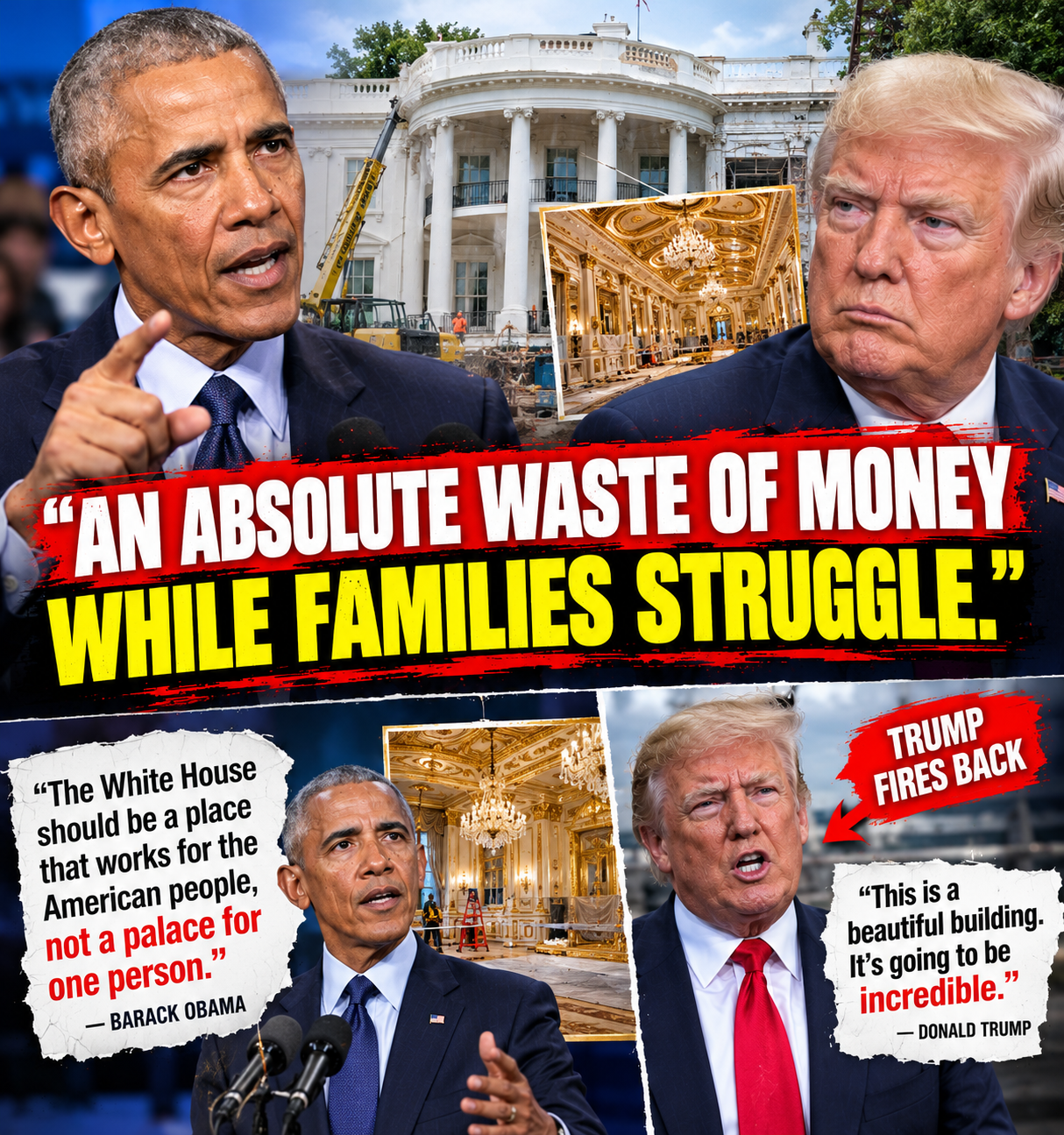
Adispute over the appearance and renovation of the White House has become an unexpected feature of the final days of the 2026 U.S. midterm campaign. Former President Barack Obama has used rallies in Ohio, Michigan and Georgia to criticize President Donald Trump’s attention to redecorating and construction projects, arguing that the administration should be more focused on the cost of living and the economic pressures facing ordinary Americans.
Trump has responded publicly, defending the work as necessary maintenance and improvements to an important national building. What began as a sharp joke about gold decorations has developed into a broader political argument about presidential priorities, public resources and the use of the White House as a symbol of national leadership.
The viral graphic captures the dispute’s central theme, but its headline needs a factual qualification: the phrase “an absolute waste of money while families struggle” should not be presented as a verified direct quotation from Obama. His documented remarks focused on Trump’s renovation projects and the administration’s response to his joke, which he contrasted with its handling of inflation.
Obama’s “Cheesecake Factory” remark ignites the dispute
The controversy began with Obama’s remarks at a Democratic campaign rally in Cleveland, Ohio, on October 24. Supporting Democratic candidates Amy Acton and Sherrod Brown, Obama criticized Trump’s focus on White House renovations, pointing to the planned ballroom, changes to the Rose Garden, a new South Lawn helipad and the extensive use of gold-colored decoration.
Obama joked that Trump appeared more interested in home renovations than the concerns facing Americans, suggesting that the president should be on the television network HGTV. He then delivered the line that became the center of the political argument: Trump had made the White House look “like Saddam Hussein opened a Cheesecake Factory.” The audience responded with laughter and applause.
The comment was more than a criticism of interior design. Obama connected the renovation work to the economic concerns he was emphasizing on the campaign trail, arguing that Trump was not sufficiently focused on lowering prices for American households. His remarks were political criticism, rather than an independent assessment of the administration’s economic performance.
Trump fires back and defends the renovations
Trump responded on October 26, first attacking Obama’s presidency and then defending the work being carried out at the White House. Speaking to reporters, he said the building had been in poor condition when he returned to office and argued that repairs to its exterior, columns and decorative features were necessary.
At a campaign rally in Mississippi, Trump returned to the issue, saying the White House had to be kept “clean, pristine, beautiful.” He described the renovation spending as “peanuts” and argued that Obama did not understand the importance of maintaining the presidential residence.
Trump also suggested that the former president’s criticism reflected a lack of appreciation for the building’s condition. His defense focused on maintenance, restoration and the symbolic importance of the White House. Obama’s criticism, by contrast, focused on the scale and priorities of the projects, particularly at a time when voters are concerned about prices and household expenses.
The exchange quickly became a campaign talking point, with supporters of both men using the remarks to reinforce their existing views.
Obama takes the argument to Georgia
The dispute did not end with Trump’s response. On October 28, Obama addressed the issue again at a campaign rally in Morrow, Georgia, supporting Democratic Senator Jon Ossoff and gubernatorial candidate Keisha Lance Bottoms.
This time, Obama focused less on the decorations themselves and more on how the administration had responded to his criticism. He told the crowd that officials had mounted a “whole-of-government response” to his joke, rather than concentrating that attention on inflation. He also joked about his own familiarity with the Cheesecake Factory, saying that as the father of two daughters he had spent plenty of time there during their childhood.
Obama then returned to the economic argument. He said rising restaurant prices meant many Americans could barely afford to eat out, and argued that the administration should be paying more attention to those pressures than to a campaign-trail joke about the president’s decorating choices.
The Georgia remarks gave the dispute a second phase: what had initially been a clash over taste and renovations became an argument over which issues the administration chooses to prioritize.
What is being changed at the White House?
The renovation controversy involves several visible projects. Trump has pursued construction of a large ballroom, changes to the Rose Garden, a South Lawn helipad and extensive decorative updates to the Oval Office and other areas. The East Wing has been demolished to make way for the ballroom project, making the construction especially prominent in public debate.
The projects have prompted questions about cost, oversight, historical preservation and the role of private contributions in financing White House improvements. These are separate questions from whether the president likes gold decoration or whether a ballroom is aesthetically appropriate.
It is also important not to assume that every dollar associated with a renovation is taxpayer money. The financing arrangements can differ between projects, and the public should distinguish privately funded construction from government-funded maintenance, staffing and other expenses. A full assessment requires project-specific funding disclosures and cost information.
The White House is both a working government residence and a historic building. Presidents have made changes to it over many administrations, but the scale, funding and preservation implications of particular projects can reasonably attract public scrutiny.
The political significance ahead of Election Day
The timing has helped turn the renovation dispute into a campaign issue. With the November 3 midterm elections approaching, Obama and Trump are both appearing at political events, and each has used the controversy to reinforce a broader message about the other’s priorities.
A Washington Post–ABC News–Ipsos poll cited by The Washington Post found that 59% of respondents believed Trump was spending too much time on White House renovation projects, while 27% said he was spending the right amount and 11% said he was not spending enough time on them. The figures reflect respondents’ views about the president’s time and attention—not a direct measurement of their opinions about the projects’ cost or funding.
For Democrats, the controversy provides an opportunity to connect an easily understood visual issue—the gold decorations and ballroom—to broader concerns about affordability and government priorities. Republicans, meanwhile, can argue that maintaining and improving the White House is a legitimate presidential responsibility and that criticism of its appearance is being used as a political distraction.
Neither argument settles the underlying questions about project costs, financing or oversight. Those require transparent documentation rather than campaign rhetoric.
What the exchange reveals—and what it does not
The documented sequence is clear: Obama mocked Trump’s White House renovation projects at a Cleveland rally on October 24; Trump publicly defended the work and criticized Obama on October 26; and Obama returned to the issue in Georgia on October 28, arguing that the administration had focused more attention on his joke than on inflation.
But the viral graphic simplifies the exchange. Obama’s phrase “an absolute waste of money while families struggle” is not established as a direct quotation in the reporting reviewed here. Nor does the available evidence establish the exact amount of taxpayer money spent on every project or prove that the renovation work has directly caused higher household costs.
The deeper political question is about priorities: how much attention and money should a president devote to renovating a historic national building while voters are concerned about the cost of living? Trump and Obama have offered sharply different answers, and their public exchange has made that disagreement part of the final stretch of the midterm campaign.
Comments (0)
Loading comments...
May You Like

IRAN DEFIES WASHINGTON — SUPREME LEADER CLAIMS U.S. MILITARY ATTACKS FAILED!


BANGCHAK REFINERY DISASTER IN THAILAND—120,000 BARRELS A DAY SHUT DOWN, U.S. OIL PRICES SURGE 10%!












