
Obama Reopens the Iran Nuclear Debate as Trump Faces New Questions Over the War
Obama Reopens the Iran Nuclear Debate as Trump Faces New Questions Over the War
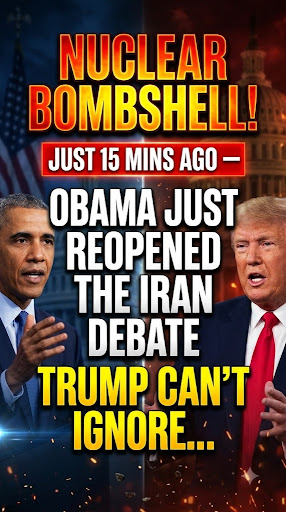
The image points to a real political dispute, but it does not show a new face-to-face confrontation between Barack Obama and Donald Trump. The underlying story is Obama’s criticism of Trump’s Iran policy during campaign appearances in October 2026, where the former president argued that the 2015 nuclear agreement had constrained Iran’s nuclear program through diplomacy. His remarks have taken on renewed significance as the Iran conflict and the future of negotiations remain major issues for the Trump administration.
Obama’s October Remarks Return to the Spotlight as Iran War Enters a New Political Phase
WASHINGTON — November 5, 2026
The political argument over how to stop Iran from developing nuclear weapons has returned to the center of U.S. debate. Former President Barack Obama has criticized the decision to abandon the 2015 nuclear agreement, arguing that diplomacy had restricted Iran’s nuclear activities without requiring American military strikes. President Trump, meanwhile, has repeatedly defended his withdrawal from that agreement and the subsequent military campaign.
The dispute has become more consequential following the November 3 midterm elections. Reuters reported on November 4 that Democratic gains in Congress have weakened Trump politically and sharpened the administration’s choice between negotiating an end to the conflict and escalating military action.
1. What Obama Actually Said About Iran
Obama’s remarks that prompted renewed attention came during an October 24 campaign rally in Cleveland, Ohio, where he appeared in support of Democratic candidates. Discussing the war with Iran, he challenged the rationale behind the military campaign and pointed to the nuclear agreement negotiated during his presidency.
Obama argued that Iran had been subject to restrictions on its nuclear program under the 2015 agreement and that diplomacy had offered an alternative to military action.
He said the original rationale for the current conflict was to force Iran to give up its nuclear program, then argued that the agreement his administration negotiated had already constrained Iran’s ability to develop nuclear weapons.
His central criticism was that the United States had abandoned a diplomatic arrangement that, in his view, had been working before Trump's 2018 withdrawal.
2. The 2015 Iran Nuclear Deal at the Center of the Dispute
The agreement Obama referenced is formally known as the Joint Comprehensive Plan of Action, or JCPOA. It was negotiated by Iran and six world powers: the United States, the United Kingdom, France, Germany, Russia and China.
Under the agreement, Iran accepted limits on uranium enrichment, its stockpile of enriched uranium and the number of centrifuges it could operate. The deal also established international monitoring and inspection requirements.
In return, sanctions were eased. The agreement was designed to make it more difficult for Iran to produce enough weapons-grade nuclear material while giving international inspectors greater access to verify its activities.
The agreement did not permanently eliminate every concern about Iran’s nuclear ambitions. Critics argued that some restrictions would expire over time and that the deal did not adequately address Iran’s ballistic missile program or regional activities.
3. Why Trump Withdrew From the Agreement
Trump announced the U.S. withdrawal from the JCPOA on May 8, 2018, during his first presidential term. He described the agreement as deeply flawed, arguing that it did not adequately prevent Iran from eventually obtaining a nuclear weapon.
His administration also objected to the deal’s time-limited restrictions and its failure to address Iran’s missile development and support for armed groups in the region.
The withdrawal was followed by the reimposition of U.S. sanctions. Iran subsequently began exceeding several of the nuclear limits established under the agreement.
The consequences remain a subject of political disagreement. Trump has argued that leaving the deal was necessary to prevent Iran from obtaining a nuclear weapon. Obama and other supporters of the agreement have argued that abandoning its restrictions weakened the diplomatic framework that had constrained Iran’s nuclear activities.
4. What the Evidence Says About Iran’s Nuclear Progress
The debate is not simply a disagreement between two former and current presidents. It also involves a substantive question: did withdrawing from the JCPOA make Iran’s nuclear program easier or harder to contain?
A March 2026 review by FactCheck.org examined Trump's claims that Iran would have obtained a nuclear weapon years earlier if the agreement had remained in place. The publication consulted nuclear-policy experts who said Iran's nuclear program advanced after the U.S. withdrawal.
Experts cited in the report said the JCPOA had imposed restrictions on uranium enrichment, stockpiles and centrifuges, alongside international monitoring. They also said Iran expanded its nuclear capabilities after the United States left the agreement.
However, the report noted that it is impossible to know with certainty what Iran would have done if the agreement had remained in force. It also distinguished between producing weapons-grade uranium and actually manufacturing a nuclear weapon—two different stages.
5. Obama Has Continued Criticizing Trump’s Iran Strategy
The October 24 rally was part of a broader series of campaign appearances in which Obama criticized the administration’s handling of the Iran conflict.
In speeches in Ohio and Michigan, he argued that the war had created serious economic and security consequences. He also questioned whether military action had produced a more stable outcome than diplomacy could have achieved.
Obama’s criticism extended beyond the nuclear agreement. He argued that Iran’s ability to threaten shipping through the Strait of Hormuz had created a source of leverage over global energy markets.
His comments were part of a wider effort to make foreign policy an issue in the midterm campaign, linking the conflict to fuel prices, national security and the consequences of presidential decision-making.
6. Trump’s Position: The Nuclear Threat Must Be Eliminated
Trump has consistently defended his decision to abandon the Obama-era agreement. In official remarks, he has argued that the JCPOA allowed Iran to preserve a pathway toward nuclear weapons and failed to address the threat posed by its missile program.
The administration has presented military action as necessary to weaken Iran’s ability to threaten the United States, Israel and other countries in the region.
But the president's own recent comments indicate that the administration is also considering diplomacy. In a November 2 interview with Reuters, Trump said he was not necessarily seeking to resume military strikes and suggested that a deal with Tehran could still be possible.
That creates a difficult question for the White House: whether negotiations can produce restrictions that Trump considers stronger than the agreement he abandoned in 2018.
7. The Midterm Elections Have Changed the Political Environment
The November 3 elections have added another layer to the debate. Reuters reported the following day that Democratic gains in Congress had weakened Trump's political position and increased pressure on the administration to decide how to proceed with the conflict.
The election result does not automatically determine U.S. military policy. The president retains significant authority over military operations, while Congress has important powers involving funding, oversight and the broader legal framework for U.S. action.
Nevertheless, a Congress more willing to scrutinize the administration could make it politically harder to continue an open-ended conflict without explaining its objectives, costs and expected outcome.
8. What Happens Next in the U.S.–Iran Conflict?
The immediate focus is on whether Washington and Tehran can reach an agreement through indirect negotiations. Reuters reported on November 3 that the two sides remained far apart on major conditions, including sanctions relief, the U.S. naval blockade and Iran’s nuclear program.
The United States has continued to consider military options while diplomatic efforts involving regional mediators have remained active. Trump has said he is prepared to resume military operations if negotiations fail, but has also indicated that he is not in a hurry to make that decision.
The central unresolved issues include Iran’s enriched uranium stockpile, restrictions on future enrichment, sanctions, maritime security and the long-term role of international inspectors.
9. Why the Obama–Trump Nuclear Debate Matters Now
Obama’s comments have revived an argument that has shaped American policy toward Iran for years: whether the country’s nuclear ambitions are better addressed through negotiated restrictions and inspections or through economic pressure and military force.
The two approaches have different risks. Diplomacy can impose verifiable limits, but critics argue that agreements may contain loopholes or temporary restrictions. Military action can damage nuclear and military infrastructure, but it does not automatically produce a lasting agreement or eliminate the underlying political dispute.
The current conflict has made those questions more urgent. With the midterm elections behind him, Trump faces pressure to demonstrate that the military campaign can produce a durable result. Obama’s criticism, meanwhile, has put the abandoned 2015 agreement back into the national conversation.
The viral image suggests that Obama has just delivered a new nuclear announcement that Trump cannot ignore. The documented story is more specific: Obama’s October criticism has renewed scrutiny of the 2015 agreement at a moment when the Trump administration is weighing negotiations against further military action.
Comments (0)
Loading comments...
May You Like

THANKSGIVING NIGHTMARE: OVER 1M BLACKOUTS, NEARLY 2M WATER ALERTS!

BANGCHAK REFINERY IN THAILAND SHUT DOWN, U.S. OIL PRICES JUMP 10%!

TOLEDO I-75 TRUCK CRASH — POTENTIAL BRIDGE COLLAPSE AND MILLIONS IN DAMAGE!

Latest Posts









Popular Posts




