
Obama Returns to the Midterm Campaign Trail as Democrats Fight for Control of Congress in 2026
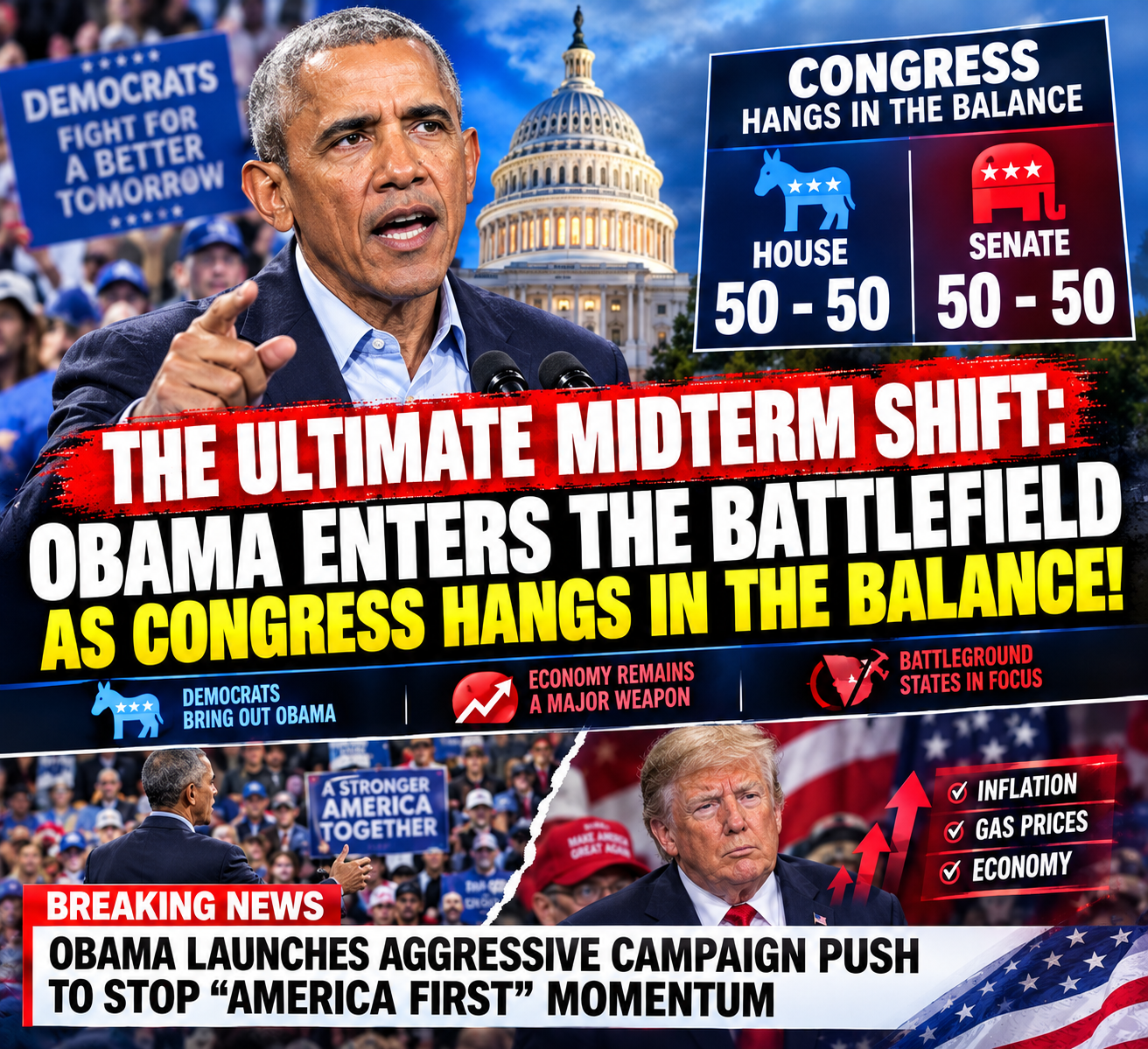
Former President Barack Obama is returning to the national political spotlight as the United States approaches its November 3 midterm elections, adding his voice to a campaign season shaped by economic anxiety, President Donald Trump's agenda and an intense struggle over control of Congress.
For Democrats, Obama's involvement offers an opportunity to draw attention to the stakes of the election, reinforce the party's message on affordability and democratic institutions, and encourage participation among voters who may be less engaged in elections that do not feature a presidential contest.
For Republicans, the midterms represent an opportunity to defend their congressional position and maintain support for the administration's legislative priorities. Trump and his allies have emphasized immigration enforcement, tax policy, national security and their broader economic agenda, while challenging Democratic candidates over spending and government regulation.
The competing messages are unfolding against a complicated political and economic backdrop. Concerns about prices, household budgets and energy costs have become prominent campaign issues, alongside immigration, healthcare and the direction of American foreign policy.
But the viral graphic accompanying this story contains a major factual problem: its suggestion that both the House and Senate are literally divided 50–50 should not be mistaken for an official congressional tally. The House has 435 voting seats when fully occupied, while the Senate has 100. A 50–50 figure may be intended as a metaphor for political competitiveness, but it does not establish either chamber's actual partisan composition or the likelihood of a particular election result.
The more important story is how Obama, Trump and their respective parties are approaching the final days of a midterm campaign that will determine the legislative environment for the remainder of Trump's second presidential term.
The clearest evidence of Obama's expanded involvement is his confirmed October 24 campaign schedule. The former president is appearing in two states with important Senate contests, beginning in Cleveland, Ohio, before traveling to Detroit, Michigan. These appearances are public campaign events, not undisclosed stops or evidence of a secret electoral strategy.
In Cleveland, Obama is joining former Democratic Senator Sherrod Brown, who is challenging Republican Senator Jon Husted, and gubernatorial candidate Amy Acton, who faces Republican Vivek Ramaswamy. Brown is attempting a political comeback in a state that has shifted toward Republicans over the past decade. Obama won Ohio in both 2008 and 2012, making his return symbolically important for Democrats seeking to reconnect with voters in the state.


Obama has already recorded an endorsement for Brown, highlighting the former senator's work on employment, corporate accountability and economic opportunity. The message connects Brown's campaign to themes that have featured prominently in Obama's political career: the economic prospects of working families, the role of major corporations and the importance of public policy in supporting middle-class communities.
In the endorsement, Obama described the Ohio Senate contest as potentially consequential for control of the chamber and emphasized the importance of participation in November.
Republicans have responded by investing their own political resources in Ohio. Trump and Vice President JD Vance have visited the state to support Husted and Ramaswamy, reflecting the significance both parties attach to the contest. The competing appearances also underscore the different political coalitions each party is seeking to mobilize.
Later on October 24, Obama is scheduled to appear in Detroit alongside Democratic Senate nominee Abdul El-Sayed and gubernatorial candidate Jocelyn Benson. The rally is planned for 5 p.m. local time, coinciding with the start of Michigan's statewide early in-person voting period.


Michigan presents a different political challenge. El-Sayed, a former public health official, is running against Republican Mike Rogers for the Senate seat being vacated by retiring Democratic Senator Gary Peters. Benson, Michigan's secretary of state, is competing against Republican Representative John James for governor.
El-Sayed's campaign also reflects divisions within the Democratic coalition. He has previously criticized aspects of Obama's presidency while acknowledging the former president's historical significance and political influence. Their joint appearance demonstrates a willingness to campaign together despite those differences.
Detroit is particularly important to Democratic turnout efforts because of its substantial Black population and its central role in statewide elections. Obama's presence provides a high-profile platform for the candidates, although whether it changes participation or voting preferences can only be assessed with subsequent evidence.
The former president's involvement is not limited to campaign rallies. Earlier this month, he headlined a fundraiser for the Democratic Senatorial Campaign Committee in Virginia and discussed the competitive Senate map with donors.
According to ABC News, Obama has helped raise more than $13 million for Democrats during the 2026 election cycle. He has also recorded campaign advertisements and endorsements while expanding his appearances in closely contested states.
At the Virginia event, Obama cautioned against assuming that favorable polling or an expanded electoral map guaranteed success. He warned that races separated by only a few percentage points could move in either direction.
That caution is important because the graphic's depiction of Congress as a simple 50–50 contest obscures the differences between the House and Senate elections. Control of the House depends on hundreds of individual district contests, while Senate control depends on a smaller set of statewide races and the seats held by each party before Election Day.
Recent public opinion research illustrates the distinction.
What Americans expected before the election
Source: Pew Research Center, published October 15, 2026
Pew Research Center found that 55% of surveyed adults expected Democrats to gain control of the House, compared with 40% who expected Republicans to retain it. Expectations for the Senate were much more evenly divided: 48% anticipated continued Republican control, while 46% expected Democrats to gain the majority. The findings measured public expectations rather than actual election results.
The polling also reveals how strongly partisan identification shapes perceptions of the race. Democratic respondents overwhelmingly expected their party to succeed, while Republican respondents largely anticipated continued Republican control. That divide helps explain why competing political narratives can portray the same election environment in dramatically different ways.
For Democrats, economic dissatisfaction offers a central line of criticism against the administration. They have focused on household expenses, healthcare and the impact of federal policies on working families. Republicans have defended their economic record while emphasizing tax policy, border enforcement and their arguments about Democratic spending priorities.
Those competing claims require attention to specific economic data and policy effects. Rising prices in a particular category do not, by themselves, establish that one candidate or administration caused the increase. Likewise, a campaign promise to lower costs does not demonstrate that a proposed policy will achieve that result.
Obama's next major scheduled appearance will take place in Georgia, where he plans to campaign with Democratic Senator Jon Ossoff and gubernatorial candidate Keisha Lance Bottoms. The Georgia event will extend his involvement into another state with consequential statewide contests. Trump is also scheduled to campaign in Georgia, reinforcing the prominence of both former and current presidents in the midterm campaign.


The contrast between Obama and Trump is politically significant, but their appearances do not constitute a direct electoral contest between the two men. Neither is on the ballot in November. Instead, each is supporting candidates whose victories or defeats will shape the next Congress and the balance of political power in Washington.
The final campaign period will also test the limits of celebrity and presidential endorsements. A well-attended rally can generate media coverage, raise campaign funds and energize volunteers. But those effects do not automatically translate into votes, and the size of a crowd is not a reliable measure of statewide electoral support.
For Obama, the immediate task is to support Democratic candidates in states where Senate and gubernatorial contests have attracted national attention. For Trump, the objective is to reinforce support for Republican candidates and defend his administration's agenda.
The stakes extend beyond party competition. Congressional control will affect legislative negotiations, federal spending, oversight hearings, judicial and executive nominations in the Senate, and the administration's ability to advance its priorities during the final two years of Trump's current term.
With Election Day approaching, Obama's appearances in Ohio and Michigan mark a substantial and verifiable expansion of his campaign activity. His fundraising and endorsements demonstrate that he is investing political capital in the 2026 midterms. What remains uncertain is the electoral effect of those efforts.
The decisive evidence will come from the votes cast on November 3—not from viral graphics, rally crowds or claims that either party has already secured victory.
Comments (0)
Loading comments...
May You Like

DAVENPORT AIRBNB HORROR — “SHOTS AT THE DOOR” GAME, 1 DEAD, 6 INJURED!

WWE BRONSON REED DEAD AT 38, STIMULANTS DETECTED, $10M INSURANCE PAYOUT FROZEN!

WWE BRONSON REED—STAR COLLAPSES AT COMPANY EVENT, FATAL DRUG REACTION SUSPECTEDs!!










Popular Posts



