
Obama Says Trump’s Iran War Was “Unnecessary” — Did It Leave the U.S. Weaker and Iran Stronger?
Obama Says Trump’s Iran War Was “Unnecessary” — Did It Leave the U.S. Weaker and Iran Stronger?
Politics · U.S. Foreign Policy · Fact Check · October 2026
Former President Barack Obama has sharply criticized President Donald Trump’s war with Iran, arguing that the conflict has cost American lives, driven up energy prices and weakened the United States’ strategic position. Speaking at Democratic campaign rallies in Ohio and Michigan on October 24, Obama called the conflict an “unnecessary war that nobody asked for,” turning the Iran conflict into a major issue ahead of the November 3 midterm elections.
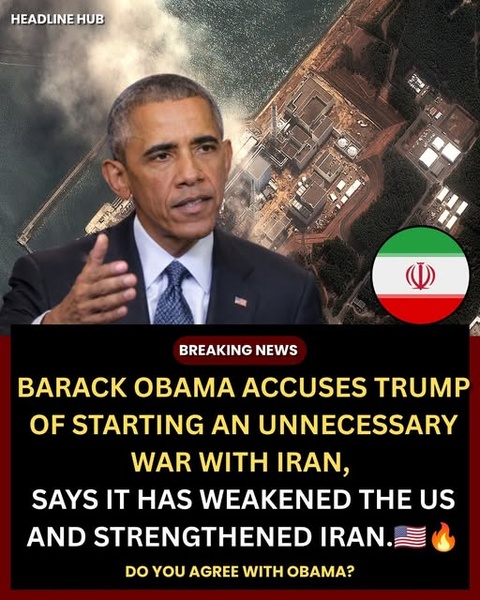
The viral image captures the central thrust of Obama’s criticism, but its claim that the war has strengthened Iran should be understood as Obama’s assessment—not an uncontested conclusion shared by all analysts.
The dispute also reaches back to a major decision from Obama’s own presidency: the 2015 Iran nuclear agreement, which Trump withdrew the United States from in 2018.
What Obama said about the Iran war
At the Cleveland rally, Obama argued that Trump had abandoned a diplomatic approach that was designed to prevent Iran from developing nuclear weapons, only to launch a military conflict that has brought new risks and costs.
“The current president chose to make a series of bad decisions,” Obama said, before describing the war as unnecessary. His argument was that diplomacy had offered a way to constrain Iran’s nuclear program without exposing American forces and regional allies to a wider conflict.
Obama highlighted several consequences:
-
American casualties: He said U.S. forces had suffered deaths and hundreds of wounded personnel.
Pressure on military resources: He argued that the war had depleted missile stockpiles and strained the U.S. military.
Higher energy costs: He linked the disruption of shipping through the Strait of Hormuz to rising oil and diesel prices.
Greater leverage for Tehran: He said Iran had gained the ability to threaten a crucial route for global energy shipments.
These comments were part of a wider political argument. Obama was campaigning for Democrats ahead of the November 3 midterms, urging voters to use the election to restrain the Trump administration.
Why Obama brought up the 2015 Iran nuclear deal
The central historical dispute is the Joint Comprehensive Plan of Action, commonly known as the Iran nuclear deal.
Negotiated during Obama’s presidency and implemented in 2016, the agreement involved Iran, the United States and other world powers. Iran accepted restrictions on its nuclear program and international monitoring in exchange for sanctions relief.
The International Atomic Energy Agency reported that Iran was complying with the agreement during its initial period, apart from limited issues that were addressed. In May 2018, Trump withdrew the United States from the deal and restored sanctions. Iran subsequently reduced its compliance with several nuclear restrictions.
Obama’s argument is that the agreement had constrained Iran’s nuclear activities without a war—and that abandoning it helped create the conditions for the later confrontation.
That is a consequential argument, but it does not settle every question about the agreement. Critics of the deal argued that some restrictions were time-limited and that it did not adequately address Iran’s ballistic missiles or regional activities. The key disagreement is whether the agreement provided a better foundation for containing those risks than the policies that followed.
Has the war made Iran stronger and America weaker?
This is the most important claim behind the viral graphic—and the one that requires the most careful qualification.
The case for Obama’s argument
The conflict has imposed costs on the United States, including military spending, casualties and pressure on weapons supplies. Disruptions around the Strait of Hormuz have also given Iran a means of influencing global energy markets.
The strait is a major chokepoint for international oil and gas shipments. If shipping is threatened or interrupted, the economic consequences can extend far beyond the Middle East, affecting fuel prices, transportation costs and household budgets.
Obama’s claim is that Iran can use this leverage even if it has suffered military damage. In other words, a country does not have to win a conventional military confrontation to gain strategic leverage from the disruption it can cause.
Why the conclusion remains disputed
A stronger position in one area does not necessarily mean Iran is stronger overall. Assessing the balance requires considering military losses, nuclear capabilities, economic damage, the condition of Iran’s leadership and its ability to influence neighboring countries.
The Washington Examiner, in an October 26 analysis, challenged Obama’s assertion that Iran was strategically stronger, while agreeing that the war had weakened the U.S. position in important respects. That disagreement illustrates why the graphic’s sweeping conclusion should not be treated as a universally accepted finding.
The most defensible conclusion is narrower: the war has imposed significant costs on the United States and given Iran opportunities to exert pressure through energy shipping and regional instability. Whether Iran is stronger overall depends on which strategic measures are considered.
The economic consequences are becoming a political problem
The conflict has also become a major issue in domestic U.S. politics.
Obama blamed the war for higher oil and diesel prices and argued that American families were paying for the administration’s decisions. Rising fuel costs can affect more than what drivers pay at the pump: they can also increase the cost of transporting food, moving goods and operating businesses.
Trump, meanwhile, has defended his approach and said the United States is engaged in discussions with Iran. Reuters reported on October 8 that Trump said Washington would not attack Iran before the November 3 midterms, citing what he described as productive discussions. The two countries nevertheless remained divided over issues including uranium enrichment, sanctions and the Strait of Hormuz.
Obama’s intervention therefore comes at a politically sensitive moment. The administration must defend the war’s objectives and costs while Republicans face voters concerned about the economy and the direction of U.S. foreign policy.
Why Obama is speaking out now
Obama’s October 24 appearances in Ohio and Michigan were campaign events, not a formal presidential address or an announcement of a new government investigation.
He used the rallies to criticize Trump’s foreign policy alongside other issues, including trade tariffs, immigration enforcement, alleged corruption and the administration’s priorities. He described the midterm election as a way for voters to limit what he sees as damaging decisions by the White House
That context matters. Obama is a former president with direct involvement in negotiating the original nuclear deal, but he is also a leading Democrat campaigning against the current administration. His remarks should be evaluated both as foreign-policy criticism and as political advocacy.
What the viral image gets right—and what it leaves out
Supported by reporting
Obama did criticize Trump’s Iran war in October 2026, calling it unnecessary. He argued that the conflict had cost American lives, strained military resources and increased Iran’s leverage over the Strait of Hormuz.
Needs qualification
The claim that Iran is now stronger overall is a contested strategic judgment, not an established fact. The image’s dramatic depiction of Obama against an Iranian facility is illustrative; it is not evidence that the pictured scene occurred as shown.
Important context
Obama spoke while campaigning for Democratic candidates before the midterms. His remarks reflect both his foreign-policy critique and his effort to persuade voters to oppose Trump’s party.
The bigger picture
The dispute between Obama and Trump is about more than whether the current war is succeeding. It reflects two competing approaches to Iran: diplomacy and negotiated nuclear restrictions on one side, and military pressure and coercion on the other.
Obama’s central question is whether the military campaign has delivered enough lasting security to justify its human, economic and strategic costs. His criticism gains force from the disruption to energy shipments and the pressure on U.S. military resources. But the ultimate judgment will depend on the war’s longer-term outcome, including whether Iran’s nuclear activities are constrained and whether a durable settlement emerges.
For now, the viral graphic presents a real political dispute in dramatic terms. It accurately reflects Obama’s criticism, but it turns a contested assessment of the war’s consequences into a seemingly settled verdict.
Comments (0)
Loading comments...
May You Like

STAR DIED AT 38, $10M LIFE INSURANCE INCREASED JUST 30 DAYS BEFORE WWE BRONSON REED'S DEATH!

WWE BRONSON REED—STAR COLLAPSES AT COMPANY EVENT, FATAL DRUG REACTION SUSPECTED!

MINNESOTA NIGHTMARE—UNDERGROUND GAS LEAK, HUNDREDS OF HOMES AT RISK, $300M DAMAGE!










Popular Posts


