Obama Steps Back Into the Political Spotlight as Democrats Target Trump’s
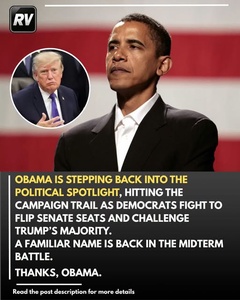
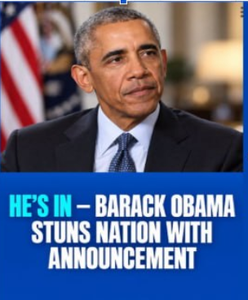
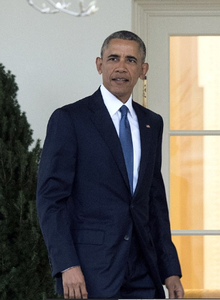
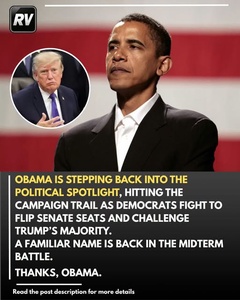
WASHINGTON — Barack Obama is preparing to return to the center of the 2026 midterm campaign, offering Democrats one of their most recognizable political figures as the party tries to break Republican control of the U.S. Senate.
The former president is scheduled to headline a Democratic Senatorial Campaign Committee fundraiser in the Washington, D.C., area on October 7, where he is expected to discuss the importance of winning the Senate and the stakes of the November 3 election. He will appear with Delaware Sen. Lisa Blunt Rochester, a DSCC vice chair.
The timing is significant. Republicans currently hold a 53–47 Senate advantage, meaning Democrats need a net gain of four seats to take control of the chamber.
Obama is not running for office.
But his return to the campaign trail could give Democrats something they badly need in the final weeks of the election: money, enthusiasm and a nationally recognizable messenger.
Obama Is Returning at a Critical Moment
Obama has remained an influential figure within the Democratic Party since leaving the White House, but his involvement in the 2026 midterms has been selective.
That is now changing.
His October appearance will be his first fundraiser for the Democratic Senatorial Campaign Committee during this midterm cycle. The event is designed to help Democrats raise money and make their case for taking back the Senate.
Obama has already supported individual Democratic candidates this year.
In July, he endorsed Iowa Democrat Josh Turek in his campaign to flip the Senate seat being vacated by Republican Sen. Joni Ernst. Obama and Turek promoted the endorsement through a basketball video, an effort aimed at giving the relatively young candidate national attention.
Obama also met with Texas Democratic Senate candidate James Talarico in May, signaling that Democrats were willing to compete in states that have traditionally been difficult territory for the party.
Democrats See a Larger Senate Map
At the beginning of 2026, Republicans appeared to have the advantage.
The GOP entered the cycle with 53 Senate seats and a map that seemed favorable in several Republican-held states.
That calculation has changed.
Recent polling and campaign data indicate that Democrats are increasingly competitive in states that Donald Trump won comfortably in 2024, including Texas, Iowa and Kansas. Reuters reported that Democratic candidates are now competitive in as many as 10 states that Trump carried by double digits.
That does not mean Democrats are guaranteed to win those states.
Many remain Republican-leaning.
But forcing the GOP to spend money defending traditionally safe territory could dramatically change the strategic balance in the final month.
Texas Has Become One of the Biggest Tests
Texas illustrates the changing political environment.
Democrats are challenging Republicans in a state where the GOP has dominated statewide elections for decades.
James Talarico has emerged as the Democratic nominee, while Republicans are preparing for a highly competitive contest involving Trump-backed Ken Paxton. Trump has already made Texas part of his midterm campaign strategy, highlighting how seriously Republicans are taking the state's Senate race.
For Democrats, Texas does not necessarily have to become a Democratic state overnight.
They simply need the race to become competitive enough to force Republicans to spend resources there.
The same strategic logic applies to Iowa, Ohio, Alaska and several other states.
Trump Is Also Back on the Campaign Trail
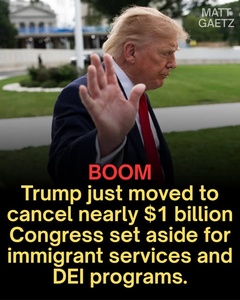
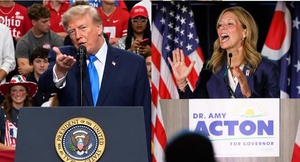
Obama's return comes as Trump is intensifying his own midterm campaign effort.
Trump recently launched a 32-day campaign tour designed to support Republican candidates ahead of the November election. He began in Texas and Oklahoma before planning appearances in additional competitive states.
The contrast is striking.
Trump is campaigning to protect his party's congressional majority.
Obama is campaigning to help Democrats take it away.
The 2026 midterms are therefore becoming increasingly difficult to separate from the two presidents who continue to dominate American politics.
Why Obama's Popularity Matters
Obama remains unusually popular inside the Democratic coalition.
An NBC News poll cited in reports about his upcoming fundraiser found that 77% of Democratic voters said they would be more likely to support a candidate endorsed by Obama. Among registered voters overall, the figure was 43%.
That does not automatically translate into votes.
Candidates still have to win their individual states and districts, and Obama cannot transfer his personal popularity perfectly to every Democrat on the ballot.
But his ability to attract donors, media attention and Democratic voters makes him an important campaign asset.
The Economic Question Could Decide the Election
The Senate battle is taking place against a difficult political backdrop for Trump and Republicans.
Recent polling has shown Trump's approval rating below 40%, while voters have expressed significant concern about prices, fuel costs and the economy. The conflict involving Iran has added another layer of uncertainty, particularly because higher energy prices can quickly become a political liability.
Democrats have increasingly centered their message on the cost of living.
Republicans, meanwhile, are trying to keep the election focused on their economic record, immigration, national security and opposition to Democratic policies.
The final weeks could determine which message reaches undecided voters most effectively.
Taking the Senate Would Change Trump's Second Term
A Democratic Senate majority would have consequences far beyond committee control.
The Senate plays a crucial role in confirming presidential nominees, including federal judges, Cabinet officials and Supreme Court justices.
A Democratic majority could also dramatically increase congressional oversight of Trump's administration.
At the same time, Democrats would still need to contend with the House of Representatives, where control is also highly competitive.
That is why the 2026 election is being viewed as a potential turning point in Trump's second term.
Obama Is Not the Whole Democratic Strategy
There is also a danger in overstating Obama's role.
Democrats cannot simply rely on a former president to recreate the coalition that elected him.
The political environment of 2026 is different from 2008, 2012 or even 2020. Many voters are focused primarily on inflation, wages, housing, health care and the cost of everyday life.
That means Democratic candidates will ultimately have to build their own cases.
Obama can help with fundraising and turnout.
He cannot cast the votes for them.
The Senate Race Is Still Far From Decided
Despite the Democratic momentum, Republicans retain important advantages.
The GOP starts with 53 seats.
Several Democratic incumbents are also defending competitive seats, meaning Democrats must protect their existing territory while simultaneously trying to capture Republican seats.
Current forecasts nevertheless show a genuinely competitive race for control. One recent model gives Democrats a slight edge, projecting roughly 51 Democratic-aligned seats against 49 Republican seats, while emphasizing substantial uncertainty.
That is a forecast—not a prediction of the final result.
The actual outcome will depend on turnout, late-breaking events, candidate performance and the final state-by-state vote.
What Happens Next?
Obama's October 7 fundraiser will mark a more visible return to the 2026 campaign as Democrats enter the final stretch before Election Day.
Trump will continue traveling the country to defend Republican candidates.
Democrats will focus heavily on the economy and affordability, while Republicans will attempt to protect their Senate majority and prevent traditionally red states from becoming unexpected battlegrounds.
The stakes are unusually high.
If Democrats gain four Senate seats, they can reclaim the chamber and place a major institutional check on Trump's presidency.
If Republicans hold their majority, Trump will retain a much clearer path for advancing his agenda and confirming his nominees.
For now, Obama's message is essentially a return to a familiar Democratic strategy: turn out the base, raise money and make the election a referendum on the party in power.
And with less than a month before voters decide, the former president is once again stepping onto a political battlefield where his name still carries considerable weight.
Comments (0)
Loading comments...
May You Like

Russian Drone Strikes Kyiv Bridge as German Chancellor Arrives in Ukraine

Russian Drone Strikes Kyiv Bridge as German Chancellor Arrives in Ukraine