
Obama Targets Trump’s Business Interests as Democrats Turn Ethics and the Economy Into Midterm Campaign Issues
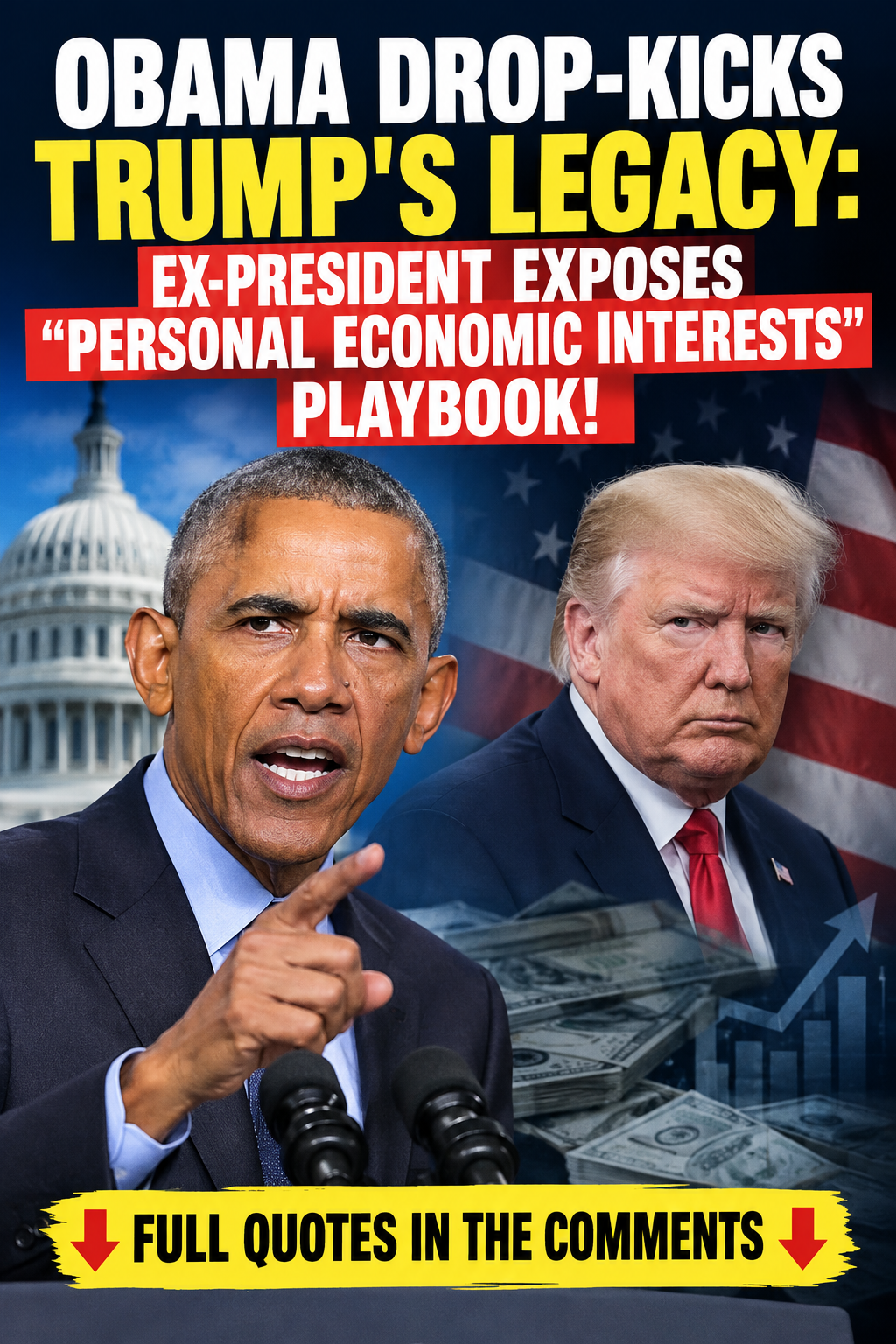
Former President Barack Obama is sharpening his criticism of Donald Trump as Democrats enter the final stretch of the 2026 midterm campaign, bringing renewed attention to the relationship between presidential power, private business interests and the economic policies affecting American households.
The political confrontation comes as Democrats seek to challenge Republican control of Congress in the November 3 elections. Economic concerns, the administration's tariff policies and questions about potential conflicts of interest have become prominent elements of the broader debate over Trump's second term.
But the most provocative claim in a widely circulated political graphic—that Obama has delivered a new speech explicitly accusing Trump of designing tariffs to enrich his personal business empire—requires careful qualification. The graphic provides no date, transcript or recording establishing that Obama made that specific allegation. Nor does it substantiate the claim that the White House issued an immediate response to those exact remarks.
What is documented is that Obama has criticized the relationship between political power and private economic interests, while other Democratic leaders, ethics specialists and journalists have separately raised questions about Trump's business arrangements and the effects of his administration's economic policies.
Those are related issues, but they are not interchangeable. A factual account must distinguish Obama's verified statements from allegations made by political opponents and from conclusions that would require evidence of improper financial benefit.
Obama's current campaign activity provides a clearer picture of the political argument than the graphic's unverified quotation.
On October 24, Obama is scheduled to campaign in Cleveland with former Senator Sherrod Brown and Ohio gubernatorial candidate Amy Acton before traveling to Detroit to support Democratic Senate nominee Abdul El-Sayed and gubernatorial candidate Jocelyn Benson. The appearances are part of a broader effort that includes fundraising, recorded endorsements and digital advertisements.


Obama's economic message has focused heavily on the relationship between working families and powerful corporate interests. In an endorsement released by Brown's campaign, he praised the Ohio Democrat's record of challenging major corporations, Wall Street and pharmaceutical companies.
The message reflects a longstanding theme in Obama's politics: economic opportunity should not depend solely on the interests of the wealthiest individuals and businesses. It also offers Democrats a way to contrast their priorities with Republican tax, trade and regulatory policies without requiring Obama to make the specific personal-enrichment allegation attributed to him in the viral graphic.
At an October 7 Democratic Senatorial Campaign Committee fundraiser in Virginia, Obama also discussed the economic effects of tariffs and the conflict involving Iran. According to ABC News, he praised Iowa Senate candidate Josh Turek for concentrating on farmers affected by those developments.
That is a documented example of Obama criticizing the consequences of administration policy. It is not evidence that he claimed the tariffs were deliberately constructed to increase Trump's personal wealth.
The distinction matters because the allegations concerning Trump's private business interests are substantial enough to warrant examination on their own.
In September, Obama discussed government corruption in an episode of his Audible podcast, A Great Book with Barack Obama, while speaking with historian Jill Lepore about Robert Penn Warren's All the King's Men.
His remarks were more nuanced than the language circulating in some political posts. Obama argued that traditional forms of bribery, patronage and political favors had declined substantially over the course of American history. He also reflected on how reforms that reduced those practices changed the ways politicians assembled governing coalitions.
Axios reported that the discussion came as Democrats were increasingly seeking to make Trump's business dealings and family profits an election issue. But Obama's historical discussion should not be recast as a direct accusation that a particular Trump tariff was designed for personal enrichment.


Questions about the financial relationship between Trump's presidency and his business ventures have nevertheless attracted considerable public attention.
An Associated Press–NORC poll published in October found that approximately 60% of American adults believed Trump was either benefiting illegally from his presidency or acting unethically in ways that benefited him financially. Another 56% believed he had placed substantial emphasis on his personal business interests.
The survey interviewed 2,140 U.S. adults from September 24 through September 28, 2026, with a reported margin of sampling error of 2.9 percentage points. These figures measure public perceptions, not judicial findings or independently established wrongdoing.
The concerns are linked partly to the Trump family's expansion into cryptocurrency and international real estate ventures. Associated Press reporting described financial disclosures showing substantial income from new cryptocurrency businesses, including ventures that had attracted foreign investment.
Such arrangements raise questions about transparency, access to government officials and the possibility that individuals or organizations with business relationships involving the president could also have interests affected by federal decisions.
However, the existence of a business transaction does not automatically establish corruption. Determining whether an improper exchange occurred requires evidence concerning the parties involved, the benefits provided and any connection to official government action.
The White House has rejected accusations that Trump's business activities create improper conflicts of interest, maintaining that the president acts in the national interest. That response is an essential part of the factual record, even as critics continue to question whether existing safeguards adequately address the financial activities of a sitting president.
The tariff debate adds another dimension to the controversy.
Trump has defended tariffs as a way to protect American industries, encourage domestic production, strengthen national security and increase negotiating leverage over trading partners. Critics argue that tariffs can increase costs for American importers, businesses and consumers while provoking retaliation against U.S. exports.
The economic effects are not uniform. Domestic producers competing with imports may benefit from protection, while businesses relying on imported materials can face higher costs. Consumers may encounter price increases depending on how much of the tariff is passed through supply chains.
A Council on Foreign Relations survey conducted with Morning Consult in August 2026 found that affordability remained a widespread concern across partisan lines. Seventy-five percent of respondents were worried about affording groceries and other goods.
The survey also found significant disagreement over who pays tariffs. Among Democratic respondents, 51% said Americans pay them, while 52% of Republican respondents believed foreigners pay them. Economically, tariffs are collected from importers, although the ultimate burden can be distributed among businesses, consumers and foreign suppliers through price adjustments.


Those findings help explain why trade policy has become an important issue in the midterm campaign. For households concerned about prices, the practical effects of tariffs may be more immediate than the broader ideological arguments surrounding them.
But the policy debate must remain distinct from allegations of self-dealing. Evidence that tariffs raise consumer costs does not demonstrate that they were created to benefit the president's private businesses. Conversely, evidence of financial conflicts would require scrutiny even if a particular tariff produced economic benefits for some industries.
Obama's renewed campaign activity comes as both parties compete for control of Congress.
According to Reuters' October 19 election overview, Republicans held narrow majorities in both chambers, with a 218–214 advantage in the House and a 53–47 majority in the Senate. Democrats would need net gains of four seats in each chamber to take control under that reported composition.
The stakes extend beyond legislation. Congressional control will determine which party leads committees, sets oversight priorities and shapes investigations into the executive branch.
A Democratic House majority could intensify scrutiny of administration decisions and potential conflicts of interest. A Republican majority would retain the ability to prioritize the president's legislative agenda and determine how its committees approach oversight.
Obama has cautioned Democrats against treating competitive races as guaranteed victories. At the Virginia fundraiser, he described the election environment as precarious and warned that small polling leads could disappear before Election Day.
His political operation has also become a significant fundraising force. CBS News reported that he had helped raise approximately $13.6 million for Democratic organizations through campaign events and fundraising efforts during the election cycle. The Democratic National Committee has also deployed advertisements featuring Obama encouraging participation and civic engagement.


The advertisements emphasize Obama's continuing role as a prominent Democratic campaign figure, but they do not substantiate every dramatic claim circulating about his speeches.
In one DNC message reported by CBS News, Obama urged Americans to translate political concern into civic participation. He did not name Trump in that particular advertisement, instead focusing on the role of citizens in shaping the country's future.
That approach differs from the confrontational framing of the viral image, which presents Obama as having delivered a sweeping indictment of Trump's personal finances.
The distinction does not diminish the significance of the broader ethics debate. It clarifies where the available evidence ends.
As of October 24, Obama's involvement in the midterms is well documented. His criticism of corporate power, his support for candidates emphasizing working-class economic concerns and his comments about the consequences of tariffs are also supported by published reporting.
Separate investigations, financial disclosures and public opinion surveys have raised questions about Trump's business interests during his presidency. The White House disputes allegations of wrongdoing.
What has not been verified is the specific claim that Obama delivered a new campaign speech explicitly exposing a coordinated tariff strategy designed to enrich Trump's private business empire.
The underlying political debate remains consequential. Voters are being asked to evaluate competing economic proposals, the relationship between private wealth and public office, and the role Congress should play in overseeing presidential decisions.
Those issues will remain relevant after the November 3 elections, regardless of which party controls Congress. For now, the most reliable account is not one of a newly exposed secret financial scheme, but of an intensifying public debate over economic policy, government ethics and presidential accountability.
Comments (0)
Loading comments...
May You Like

EAST COAST STORM CRISIS—5 MILLION AT RISK OF BLACKOUTS, WATER, AND HEATING FAILURES!

1,000+ MILITARY FAMILY RECORDS BREACHED, 200+ MILITARY SITES AT RISK!

FLORIDA AIRBNB NIGHTMARE — 50 TEENS, 7 SHOOTING VICTIMS LINKED TO “SHOTS AT THE DOOR”!








Popular Posts





