
Obama and Vance Clash Over Iran War
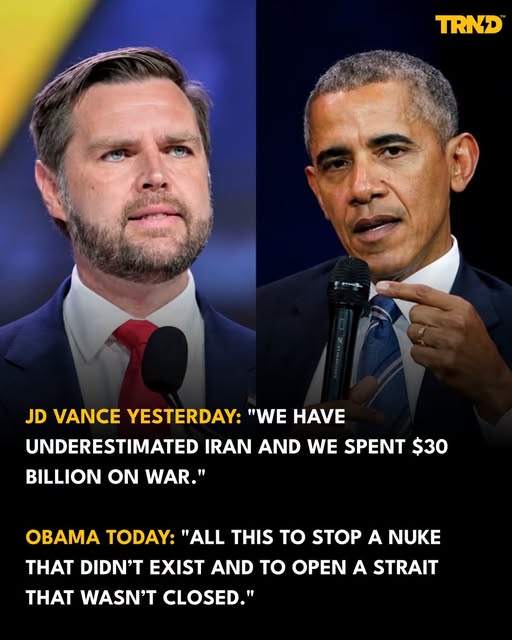
Obama and Vance Clash Over Iran War as Viral Quotes Raise Questions About Military Costs and Nuclear Claims
October 31, 2026 | Washington, D.C. | U.S. Politics & Middle East | Fact Check
A viral political graphic featuring former President Barack Obama and Vice President JD Vance has intensified debate over the Iran conflict, highlighting disputed claims about American military spending, Tehran's nuclear capabilities, and the strategic consequences of war.
The image attributes two striking statements to the political figures, portraying Vance as acknowledging that Washington underestimated Iran while Obama questions the fundamental justification for military intervention.
According to the graphic, Vance admitted that the United States underestimated Iran and spent $30 billion on the war, suggesting that the conflict proved more expensive than anticipated.
Obama is separately portrayed as questioning whether the military campaign was necessary, arguing that it sought to eliminate a nuclear threat while reopening a strategically important maritime passage.
Verification note: The image provides neither original recordings nor links to the alleged statements. Both quotations require independent authentication before they can be presented as confirmed remarks.
Why the Two Statements Matter
The contrasting messages reflect competing interpretations of American policy toward Iran, particularly whether military action has strengthened national security or created additional economic and geopolitical vulnerabilities.
Vance's attributed statement focuses on military expenditure and strategic miscalculation, while Obama's alleged response challenges the assumptions underlying the administration's justification for intervention.
Together, the claims raise three important questions: how much the conflict has cost, what intelligence established about Iran's nuclear program, and whether military operations improved maritime security.
These issues extend beyond partisan disagreements because they concern the effectiveness of American military strategy, the reliability of intelligence assessments, and the consequences for international energy markets.
The Viral Quotations Remain Unverified
A search of publicly accessible reporting found the same wording circulating through social media accounts, including posts dated October 24, but did not establish an original recording for either statement.
The apparent repetition of identical language across different accounts is not independent confirmation. A reliable attribution requires an identifiable speech, interview, official transcript, or authenticated video.
The $30 Billion Figure Needs Context
The graphic presents $30 billion as a definitive measure of American military spending, but it provides no accounting period, government document, or explanation of the expenditure categories.
Military cost estimates can include operational spending, replacement ammunition, equipment losses, personnel deployments, and additional logistical requirements, making comparisons unreliable without a consistent accounting methodology.
Even if an expenditure estimate is accurate, it would not independently establish that Vance admitted the administration had underestimated Iran's military or economic resilience.
Did Iran Have a Nuclear Weapon?
The statement attributed to Obama introduces another important distinction: possessing an operational nuclear weapon is not equivalent to maintaining a uranium enrichment program capable of generating proliferation concerns.
The International Atomic Energy Agency previously documented substantial Iranian uranium enrichment, including material enriched to 60 percent purity, significantly above levels ordinarily required for civilian nuclear power generation.
However, the existence of highly enriched uranium does not automatically demonstrate that Iran possesses a completed nuclear weapon or has successfully developed a deployable nuclear warhead.
The agency has also warned that restrictions on inspections have reduced its ability to verify Iran's nuclear activities, complicating international efforts to assess the program's current status.
Why the Strait of Hormuz Matters
The Strait of Hormuz connects the Persian Gulf with the Gulf of Oman and represents one of the most strategically important maritime passages in international energy transportation.
According to the International Energy Agency, approximately 20 million barrels of crude oil and petroleum products passed through the strait daily during 2025.
That volume represented roughly one-quarter of global seaborne oil trade, making disruptions particularly consequential for energy-importing economies and countries dependent on Persian Gulf exports.
The viral statement attributed to Obama suggests that military intervention created or intensified a shipping problem that Washington subsequently needed to resolve through additional military pressure.
That argument is a strategic interpretation rather than an established historical conclusion, and evaluating it requires examining the timing and causes of specific maritime disruptions.
The Political Disagreement Goes Beyond Two Quotations
Obama's diplomatic legacy remains closely associated with the 2015 Iran nuclear agreement, which sought to restrict Tehran's nuclear activities through negotiated limits and international monitoring.
Trump's approach has emphasized stronger economic and military pressure, reflecting his administration's argument that earlier diplomatic arrangements failed to adequately address long-term security concerns.
Vance's position is especially significant because his public statements carry responsibility for explaining administration policy, military objectives, and the economic consequences of continued American involvement.
The viral comparison therefore captures a genuine foreign-policy debate, even though the specific quotations used to illustrate that disagreement have not been independently authenticated.
What Happens Next?
The central questions remain whether Washington can establish a sustainable security arrangement, prevent further nuclear proliferation, protect international shipping, and demonstrate that military expenditures have produced measurable strategic benefits.
Any credible assessment must distinguish political rhetoric from verified statements, official expenditure figures, intelligence findings, and independently documented developments affecting Iran and the wider region.
For now, the graphic should be understood as a political commentary post containing two unverified quotations, rather than evidence of a confirmed public exchange between Vance and Obama.
Comments (0)
Loading comments...
May You Like

IOWA CRISIS — 150+ WITH LEAD AND MERCURY POISONING, 69 CRITICAL!

AMERICAN FLAG BURNING IN CHICAGO — FREE SPEECH OR DISRESPECT TOWARD AMERICA?

TOLEDO I-75 TRUCK CRASH — POTENTIAL BRIDGE COLLAPSE AND MILLIONS IN DAMAGE!












