Obama–Vance Comparison Sparks Political Firestorm as 2028 Speculation Intensifies
WASHINGTON — A recent comparison between former President Barack Obama and Vice President JD Vance has triggered a sharp political reaction, particularly among Trump-aligned conservatives already debating the Republican Party’s future.
The controversy began after The Wall Street Journal published a commentary by Barton Swaim arguing that Vance and Obama share several similarities in their biographies, careers and political personas.


Swaim’s argument focused partly on the unusual trajectories both politicians followed before reaching national prominence, rather than suggesting that their political ideologies are identical.
Both men experienced difficult childhood circumstances, had largely absent fathers and were raised for significant periods with help from grandparents, according to the comparison.
Their educational paths also became part of the comparison. Obama attended Columbia University before studying at Harvard Law School, while Vance attended Ohio State University and later Yale Law School.
The two politicians subsequently entered different professional worlds before moving into politics, with Obama working as a community organizer and law professor while Vance became an author, investor and politician.


The comparison attracted attention partly because Obama remains one of the Democratic Party’s most recognizable former presidents, while Vance has become an increasingly prominent figure within the Republican administration.
The political significance is therefore less about identical policies and more about whether Vance’s trajectory could eventually resemble Obama’s rapid rise from relatively young senator to national presidential candidate.
Vance entered the U.S. Senate after winning Ohio’s 2022 election and became vice president in 2025, giving him a remarkably rapid ascent through national Republican politics.
Obama similarly attracted national attention after his 2004 Democratic National Convention speech and won election to the presidency only four years later.


The comparison has become particularly relevant because Republicans are already discussing the party’s post-Trump future, even though the 2028 presidential contest remains more than two years away.
Trump has privately encouraged donors to support Vance, according to The Washington Post, although advisers have also emphasized that the president has not publicly settled the 2028 succession question.
At the Republican convention in Dallas earlier this month, Vance delivered a major prime-time speech that received significant attention as Republicans prepare for the 2026 midterm elections.
Coverage of the convention increasingly treated Vance as one of the figures likely to influence the Republican Party’s direction after Trump, alongside Secretary of State Marco Rubio and other potential contenders.


The Obama comparison nevertheless generated resistance from some Trump supporters, who interpreted the Wall Street Journal commentary as an attempt by traditional Republican institutions to shape the party’s future.
Donald Trump Jr. was among those who criticized the comparison, while other prominent conservative commentators also objected to the characterization and questioned the motives behind it.
Some critics portrayed the comparison as another example of tension between Trump’s political movement and traditional conservative institutions that have historically been more skeptical of Trump-style politics.
Axios previously reported that The Wall Street Journal opinion pages had published several critical pieces about Vance, including arguments concerning his foreign policy, political ambitions and relationship with figures such as Tucker Carlson.


The comparison also touches on foreign policy. Earlier this year, commentators noted similarities between Vance’s arguments defending a U.S.-Iran agreement and language Obama used while defending the 2015 Iran nuclear agreement.
Jewish Insider documented similarities in the rhetorical structure, including both politicians asking critics to identify a preferable alternative to diplomatic agreements with Iran.
That does not mean the two administrations pursued identical agreements. The agreements were negotiated under very different circumstances and contained important substantive differences.
Vance has also publicly emphasized that the Trump administration’s approach to Iran differs from Obama’s 2015 nuclear agreement, making the comparison primarily about political rhetoric rather than identical policy.


The broader controversy reflects an unusual political moment in Washington, where discussion about the 2028 Republican field has begun well before voters formally choose presidential nominees.
Vance is already being discussed alongside Rubio and other Republicans, although there is no formal Republican nomination contest underway and no certainty about which candidates will ultimately participate.
The Obama comparison also illustrates how political biographies can become part of arguments about future leadership, particularly when a relatively young politician has already reached the vice presidency.
Obama and Vance remain separated by major ideological and policy differences, despite the biographical similarities highlighted by Swaim and other commentators.


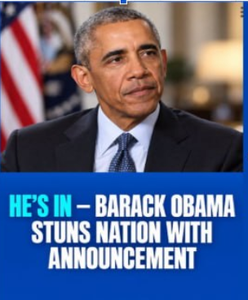
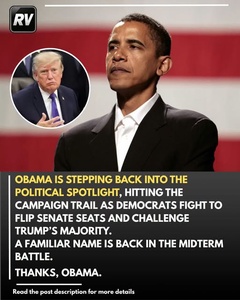
For readers encountering the viral graphic, the phrase “Obama and Vance just set off a new firestorm” should therefore be understood as a description of the reaction to a published comparison, not evidence that the two politicians jointly announced a new political initiative.
Obama himself was not reported as participating in the Wall Street Journal comparison or responding directly to the controversy surrounding it.
The central development is instead the reaction to commentary suggesting that Vance’s biography and political trajectory share notable similarities with Obama’s rise.
The controversy is likely to continue as Republicans debate the party’s future leadership, but the 2028 field remains unsettled and political speculation should not be presented as an established outcome.
Comments (0)
Loading comments...
May You Like
Russian Drone Strikes Kyiv Bridge as German Chancellor Arrives in Ukraine
TRUMP HIT WITH 26 ARTICLES OF IMPEACHMENT
South Korea–Ukraine Rift Deepens Over North Korean POW Transfer as PURL Draws New Scrutiny