
Obama vs. JD Vance “Live on Air”? The Viral Graphic Repackages a Real Political Clash
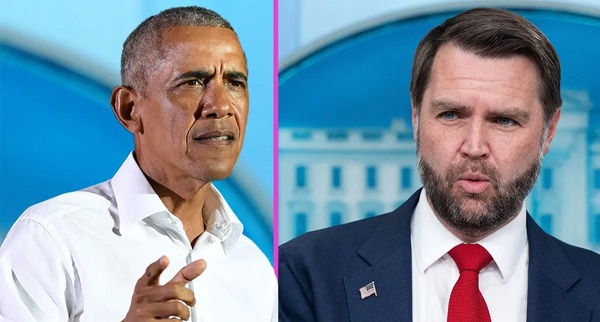
A viral graphic circulating online declares:
“JD Vance and Barack Obama Clash Live on Air — Historic Moment Unfolds.”
The headline makes it sound as though former President Barack Obama and Vice President JD Vance were suddenly placed together in a live television confrontation.
That did not happen.
There was, however, a real and unusually sharp exchange involving the two men in July 2026. Obama publicly criticized Vance's views on American identity and immigration during a conversation with author Malcolm Gladwell. The remarks quickly became political ammunition and were widely framed as a direct attack on the vice president.
But Obama and Vance did not clash face-to-face on live television.
The viral image takes a genuine political dispute and repackages it as a dramatic “live on air” confrontation.
What Actually Happened
The controversy began with comments Obama made during a conversation with Malcolm Gladwell about Reconstruction and the unfinished project of American multiracial democracy.
The discussion was released July 16, 2026.
Obama argued that debates over who belongs in America remain relevant more than 150 years after Reconstruction.
He then turned to Vance.
Obama said that when the current vice president argues that America is defined by a particular people, history and way of life, it resembles what Obama characterized as a “blood-and-soil version” of “We the People.”
Obama also highlighted the fact that Vance's wife, Usha Vance, is the U.S.-born daughter of Indian immigrants.
That led to the most widely circulated portion of the conversation.
Obama Called Vance's Position Hypocritical
Obama's criticism was not simply about immigration policy.
He argued that Vance's rhetoric about American identity was difficult to reconcile with his own family circumstances.
During the discussion, Obama and Gladwell characterized the situation as a form of hypocrisy.
But Obama then made a more complicated argument.
He said “hypocrisy is progress” because hypocrisy can indicate that people recognize there is a moral standard they are failing to meet.
In other words, Obama was not merely arguing that Vance was personally inconsistent.
He was making a broader historical argument about how American attitudes toward race, citizenship and belonging have changed.
Why Did Obama Bring Up Vance?
The immediate backdrop was Vance's evolving argument about what it means to be American.
In a July 2025 speech at the Claremont Institute, Vance argued that America should not be understood solely as a set of abstract political principles.
He described America as “a particular place with a particular people and a particular set of beliefs and way of life.”
Vance also argued that American citizenship should be understood in terms of shared obligations, history and national continuity.
Those comments became central to Obama's criticism a year later.
Obama interpreted Vance's argument as moving away from the idea of America as a civic community based primarily on constitutional principles and toward a more ancestry- and heritage-centered conception of national identity.
That interpretation is strongly disputed by Vance's supporters.
The Birthright Citizenship Fight Added Fuel
The dispute also came amid the Trump administration's battle over birthright citizenship.
Vance has supported efforts to restrict automatic citizenship for certain children born in the United States.
The Supreme Court subsequently blocked the administration's effort to implement Trump's birthright-citizenship order, while Vance criticized the decision as a major mistake.
That policy dispute helps explain why Obama's comments resonated so strongly.
For Obama and his supporters, the debate is about whether American citizenship should remain primarily a civic and constitutional concept.
For Vance and his supporters, the argument is about national identity, immigration, assimilation and the obligations associated with citizenship.
Those are fundamentally different visions of what defines the American nation.
But There Was No “Live Clash”
This is the most important fact-check of the viral image.
Obama's remarks came during a recorded conversation with Malcolm Gladwell.
Vance was not sitting across from Obama.
There was no televised debate between them.
There was no live studio confrontation.
There was no moment when Obama and Vance exchanged insults face-to-face.
The original discussion was about Reconstruction and American democracy, and Vance became one of the contemporary political examples Obama used to illustrate his argument.
So the phrase “clash live on air” is misleading.
The confrontation was political and rhetorical, not a literal live television confrontation.
The “Historic Moment” Was Actually a Viral Political Moment
The exchange nevertheless became significant because Obama rarely comments so directly on an individual member of the Trump administration.
The former president's decision to single out Vance created a predictable partisan reaction.
Supporters of Obama interpreted the remarks as a warning about nationalism and the direction of the Republican Party.
Vance's critics saw the remarks as a continuation of a broader debate over immigration, citizenship and race.
Conservatives, meanwhile, accused Obama of unfairly interpreting Vance's position and of using the loaded phrase “blood and soil” to associate Vance with racial nationalism.
Fox News and other conservative outlets prominently highlighted Obama's comments and the Nazi-era historical associations of the phrase.
What Does “Blood and Soil” Mean?
This part of the controversy deserves care.
“Blood and soil” is a historically loaded expression associated with Nazi ideology and racial nationalism.
Obama used the phrase as a characterization of what he saw in Vance's argument.
Vance did not use the phrase “blood and soil” in the speech Obama was criticizing.
That distinction matters.
Vance's actual argument emphasized American history, national continuity, shared beliefs and the idea that America is more than an abstract political proposition.
Obama interpreted that argument through the lens of a more exclusionary conception of citizenship.
That is an argument about the meaning and implications of Vance's words — not evidence that Vance himself embraced the specific phrase Obama used.
Vance's Position Is More Complicated Than the Meme Suggests
Vance has explicitly acknowledged that immigrants have enriched America.
In his earlier remarks, he pointed to his own marriage to Usha Vance and described her parents as people who had enriched the United States.
His argument was not that immigrants could never become fully American.
Rather, he emphasized assimilation, national continuity and the idea that newcomers enter an existing national community rather than redefining the country from scratch.
Critics argue that this conception of national identity can become exclusionary.
Supporters argue that it is simply a more traditional understanding of nationalism.
That disagreement is the heart of the controversy.
Obama Was Making a Larger Point About Reconstruction
The viral graphic strips away most of the historical discussion.
Obama was talking about Reconstruction after the Civil War and the constitutional struggle over citizenship, voting rights and racial equality.
He argued that the problems Americans debated during Reconstruction have not completely disappeared.
Instead, they have changed form.
That is why he connected Vance's arguments about citizenship to the broader history of the Fourteenth Amendment and the definition of “We the People.”
Obama ultimately took a relatively optimistic view.
Despite his criticism, he said the progress toward a multiracial democracy remains real and argued that Americans should not become cynical simply because the country repeatedly struggles with questions of race and equality.
Vance's Recent Political Profile Has Also Raised the Stakes
The dispute comes as Vance has become one of the most prominent figures in the Republican Party.
In September 2026, he has been increasingly visible on the campaign trail and at Republican events ahead of the midterm elections.
The Washington Post reported that Vance has taken an aggressive role in the Michigan Senate race, including attacking Democratic nominee Abdul El-Sayed.
He also held a White House press briefing on September 3, where he addressed the Iran conflict, gas prices, the midterms, data centers and other issues.
That means the Obama-Vance dispute is not occurring in a political vacuum.
Vance is increasingly being treated as one of the central figures of the Republican Party's future.
Obama, meanwhile, remains one of the Democratic Party's most influential former presidents.
Their ideological clash therefore carries significance beyond a single podcast conversation.
What the Viral Graphic Gets Right
The image is based on a real political confrontation in substance.
Obama really did criticize Vance.
He really did accuse Vance's conception of American identity of resembling a “blood-and-soil” version of “We the People.”
He really did highlight Vance's marriage to Usha Vance, whose parents immigrated to the United States.
And the remarks really did generate a significant political backlash.
So the underlying story is real.
What the Graphic Gets Wrong
The sensational framing is where the problem begins.
Obama and Vance did not clash live on television.
The image also creates the impression that the two men were involved in a direct televised confrontation.
They were not.
The sequence was:
Vance made his argument about American identity in 2025 → Obama discussed that argument with Malcolm Gladwell in July 2026 → Obama's comments went viral → political supporters and opponents amplified the dispute.
That's very different from a live debate.
The Bigger Political Question
The deeper issue is not whether Obama and Vance literally confronted each other on television.
It is what kind of nation the United States should be.
Vance's argument emphasizes:
- national continuity;
- shared history;
- assimilation;
- civic obligations;
- cultural cohesion;
- and skepticism toward defining America solely through abstract political ideals.
Obama's argument emphasizes:
- constitutional principles;
- multiracial democracy;
- equal citizenship;
- Reconstruction's unfinished legacy;
- and the danger of defining belonging through ancestry.
Those competing visions are likely to remain part of American politics for years.
And because Vance is widely viewed as a potential central figure in the Republican Party's post-Trump era, Obama's criticism may ultimately matter less as a personal feud than as a preview of a much larger ideological battle.
The Bottom Line
The viral headline “JD Vance and Barack Obama Clash Live on Air — Historic Moment Unfolds” is misleading.
There was no live television confrontation between Obama and Vance.
But there was a real and unusually direct political clash.
Obama criticized Vance's views on American identity and immigration during a recorded conversation with Malcolm Gladwell, calling Vance's approach a “blood-and-soil” version of “We the People” and describing the contradiction involving Vance's immigrant family connections as “hypocrisy.”
Vance's underlying position, however, was not identical to the language Obama used to characterize it.
The viral graphic turns a recorded political critique into a fake-looking live showdown — but the ideological fight between Obama and Vance is very real.
Comments (0)
Loading comments...
May You Like
Jack Smith Defends His Integrity as Trump Investigations Face Renewed Political Firestorm

Obama Steps Back Into the Political Spotlight as Democrats Target Trump’s

Shocking news from Ohio: an unexpected development ahead of Trump's rally













