
Obama vs. Trump: Viral Speech Comparison Rekindles Debate Over Education, Rhetoric and Political Leadership
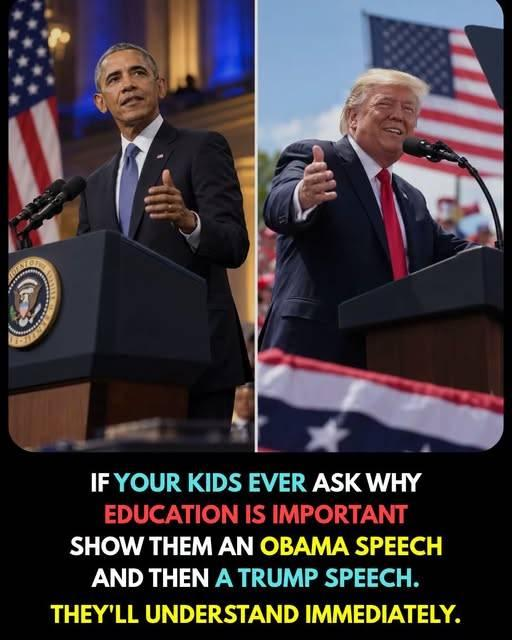
A viral political meme comparing speeches by former President Barack Obama and President Donald Trump has reignited a familiar American debate: what makes a political leader an effective communicator, and how much should speaking style influence the public’s judgment of leadership?
The graphic suggests that playing children one speech from Obama and another from Trump would immediately demonstrate why education matters. It presents the two men as contrasting examples of public speaking, inviting viewers to compare vocabulary, sentence structure, clarity and argumentation. But the image is a political opinion, not a controlled test of intelligence or educational achievement. A fair comparison requires looking at what each speaker says, how each addresses an audience and whether the message is supported by evidence.
The debate has gained fresh attention amid the 2026 midterm campaign. Over the weekend, Obama appeared at Democratic rallies in Ohio and Michigan, delivering sharp criticism of Trump’s administration, while Trump continued to use rallies and public appearances to defend his record and attack political opponents. Their contrasting performances have once again made communication style part of the wider contest over political leadership.
Two different approaches to political communication

Obama’s public speaking has often relied on carefully structured arguments, extended sentences, historical references and rhetorical devices such as repetition and parallelism. In formal speeches, he frequently builds an argument step by step, uses pauses to emphasize key points and returns to a central phrase to help audiences follow the message.
Research on Obama’s rhetoric has examined how he adapts his delivery to different settings and audiences. A study of eight speeches delivered in 2009 found that formality and the presence or absence of a teleprompter affected his language and delivery more noticeably than whether an audience consisted primarily of native or non-native English speakers. The findings suggest that his style was adaptable rather than simply a fixed display of polished language.
That approach can make a speech feel orderly and deliberate. It can also support complex explanations of public policy, particularly when the speaker connects individual proposals to a broader narrative about national identity, history or shared responsibility.
Yet polished delivery is not proof that every argument is correct. A well-organized speech can contain weak evidence, misleading claims or policies that deserve criticism. The quality of a political argument must be judged by its substance as well as its presentation.

Trump’s style is often more conversational, repetitive and improvisational, particularly during rallies and unscripted exchanges with reporters. He frequently uses short phrases, emphatic assertions, vivid comparisons and repeated slogans. Rather than building every point into a formal speech, he may shift between topics, address an audience member or return repeatedly to a phrase designed to be memorable.
An Associated Press analysis of Trump’s speaking style noted the contrast between his spontaneous, free-flowing remarks and more carefully prepared presidential addresses. Linguists have also emphasized that his delivery varies by setting: campaign rallies, interviews and formal speeches can produce substantially different forms of language.
That informality can be a deliberate political asset. Supporters may interpret it as authenticity, accessibility or a rejection of conventional political language. Critics may see the same habits as disorganized or imprecise. Those reactions depend partly on the audience’s expectations and political outlook, not just on the words themselves.
The distinction is important: a formal speaking style and an informal speaking style are different communication choices, not automatic measures of intelligence. A speaker can be eloquent but evasive, or informal while making a clear and persuasive point. The relevant question is whether the audience can understand the argument and whether the argument withstands scrutiny.
What does research actually say about the two styles?

Academic studies have compared Obama’s and Trump’s political communication using transcripts, rhetorical techniques and speech-delivery patterns. Their work offers a more useful framework than the viral meme’s simple contrast between education and supposedly inferior speech.
A 2019 study published through Sapienza University of Rome examined the two presidents’ communication approaches by analyzing speeches from their inaugurations and their first month in office. Another study, published in 2018, examined language in Obama’s and Trump’s election victory speeches, focusing on how word choice, storytelling and visual presentation helped construct their public identities.
A separate study of Trump’s political discourse found that his language varied with the context. Researchers observed simpler sentences and less diverse vocabulary in debates, while some campaign speeches contained richer vocabulary and more carefully edited passages. The study cautions against treating a single speaking sample as a complete representation of a politician’s language.
This is why a rigorous comparison should use speeches of similar length and purpose. Comparing a prepared inaugural address by one president with an impromptu answer from another would be misleading. The subject, audience, occasion and degree of preparation all influence how a person speaks.
A meaningful assessment would examine several features:
-
Vocabulary: Does the speaker use precise language suited to the subject, and explain unfamiliar terms when necessary?
Structure: Are the main claim, supporting reasons and conclusion easy to identify?
Evidence: Are statistics, quotations and historical examples accurate and relevant?
Clarity: Can listeners understand the argument without losing track of the point?
Audience connection: Does the speaker adapt appropriately to the people being addressed?
Accountability: Does the speaker address difficult questions and acknowledge uncertainty when the facts warrant it?
These criteria can be applied to either president—or to any public figure—without assuming the outcome in advance.
Why vocabulary and critical thinking matter

The meme’s underlying point about education raises a legitimate issue, even if its conclusion is overly simplistic. Education is not merely the ability to use sophisticated words or deliver a polished speech. It also involves understanding evidence, distinguishing fact from opinion, recognizing weak arguments and changing one’s mind when reliable information contradicts an earlier belief.
Vocabulary matters because precise words can communicate distinctions that vague language obscures. Structured arguments matter because they help listeners understand how a conclusion follows from the evidence. Critical thinking matters because a confident speaker can still make a claim that is false.
These skills are particularly important in politics, where speeches often combine verifiable statements with emotional appeals, predictions and claims about opponents’ motives. A useful exercise for students is to listen to two speeches on the same issue and ask:
-
What is each speaker’s main claim?
What evidence supports that claim?
Which statements are facts, and which are opinions or predictions?
What important information might be missing?
Does the speaker respond to opposing arguments fairly?
The goal is not to teach students to admire one politician and dismiss another. It is to help them recognize the difference between persuasive delivery and a well-supported argument.
The political context behind the viral comparison

The meme is circulating during an intensely partisan election period. Obama’s October 24 campaign appearances in Ohio and Michigan included criticism of Trump’s economic record, foreign policy and approach to governing. The Associated Press reported that Obama urged voters to reject what he described as cruelty and indecency while campaigning for Democrats ahead of the November 3 midterms.
Against that background, a side-by-side comparison of the presidents’ speaking styles can quickly become a proxy for a larger argument about political identity. People may share the graphic because it reflects their existing views, because they find one style more compelling or because they want to challenge what they perceive as a decline in political discourse.
But a viral meme does not establish how all Americans view the two men, nor does it demonstrate that one style produces better policies or more effective leadership. Those are separate questions requiring different kinds of evidence.
The same caution applies to clips described as the “wildest moments” from each president. Short excerpts can be useful illustrations, but they may omit the context needed to understand the full argument. Comparing complete transcripts or longer recordings is more reliable than judging a speaker through selectively edited moments.
Beyond the meme: Judge the argument, not just the delivery
The comparison between Obama and Trump highlights a real difference in public communication: Obama often uses a carefully organized, formal rhetorical style, while Trump frequently relies on conversational phrasing, repetition and improvisation. Research has examined these patterns, but it also shows why context matters.
The meme goes further by implying that the difference itself proves the importance of education. That is a political interpretation, not a scientific conclusion. Speaking style alone cannot establish a person’s intelligence, education or competence, and polished language does not guarantee accurate reasoning.
For parents and educators, the more valuable lesson is to encourage young people to listen critically. Ask them to identify a speaker’s claim, test the supporting evidence, notice emotional language and consider whether the conclusion follows logically. Those habits are more durable than memorizing which politician sounds more impressive.
Ultimately, the strongest comparison is not simply about who uses longer words or delivers the smoothest speech. It is about whether a speaker communicates clearly, reasons carefully, treats evidence responsibly and helps listeners understand the issues they face. Those standards can—and should—be applied consistently to both Obama and Trump.
Comments (0)
Loading comments...
May You Like

WWE BRONSON REED—STAR COLLAPSES AT COMPANY EVENT, FATAL DRUG REACTION SUSPECTEDs!!

EAST COAST MEGASTORM—2 MILLION HOUSES DAMAGED, 5 MILLION AT RISK OF BLACKOUTS, WATER FAILURES!

WWE BRONSON REED DEAD AT 38, STIMULANTS DETECTED, $10M INSURANCE PAYOUT FROZEN!










Popular Posts



