
Obama Warns of a “Dangerous Moment” for American Democracy as He Challenges Trump Over Presidential Power, Iran and the 2026 Midterms
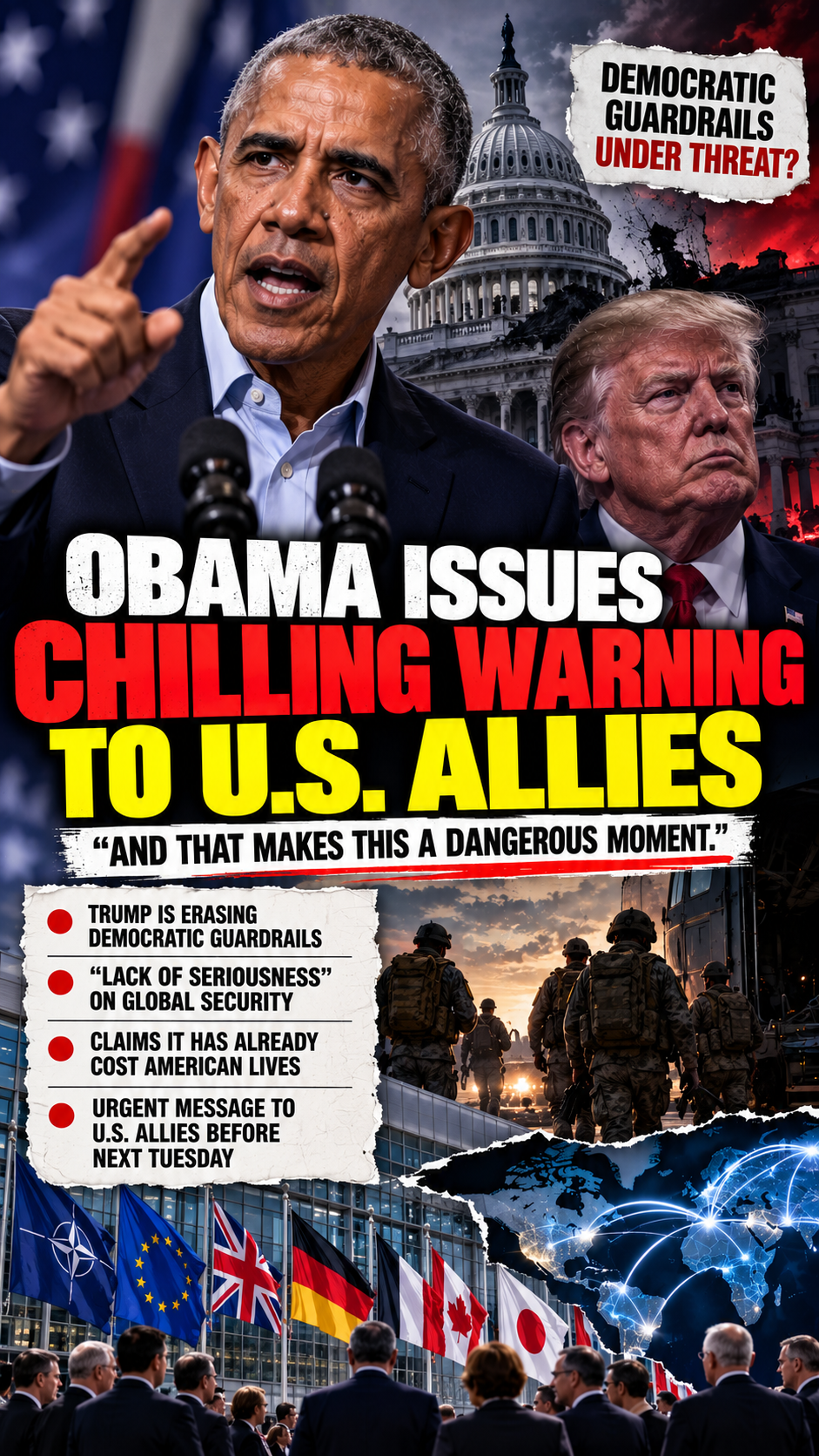
Former President Barack Obama has issued a warning about the erosion of democratic restraints on presidential power, arguing that Donald Trump's second administration is challenging institutional norms that previous presidents regarded as essential to governing the United States.
His comments come as the country approaches the November 3 midterm elections, with control of Congress, the administration's foreign-policy decisions and the future of executive accountability at the center of an increasingly contentious national debate.
In remarks circulated ahead of the election, Obama described a change in how presidential authority is being exercised, questioning whether established expectations about the limits of executive power still carry the influence they once did.
“What you’re seeing, I think, is the sense that through executive power, many of the guardrails and norms that I thought I had to abide by as president of the United States, that George Bush thought he had to abide by as president of the United States, that suddenly those no longer apply,” Obama said.
He concluded: “And that makes this a dangerous moment.”
The warning was part of a broader intervention by the former Democratic president, who returned to the campaign trail on October 24 with appearances in Ohio and Michigan.
At those events, Obama criticized Trump's handling of the economy, the war involving Iran and the administration's approach to political accountability. He also urged voters to consider the role Congress plays in scrutinizing presidential decisions.
His remarks were sharply partisan campaign speeches, not an official assessment issued by the U.S. government or its international allies.
They nevertheless raised questions extending beyond the immediate election: how much authority a president should exercise without congressional approval, what role political conventions play in restraining executive power, and how American domestic decisions affect countries that depend on Washington for security cooperation.
The documented record supports Obama's warning about presidential norms and his criticism of the Iran conflict. It does not establish that he issued a formal emergency message to NATO governments or directly instructed allied leaders to take action before Election Day.
That distinction matters because the viral account accompanying his remarks combines statements about domestic democratic institutions with an international warning that has not been independently authenticated.

Obama's latest intervention brought together two themes that have defined much of his criticism of Trump: the limits of presidential power at home and the consequences of American leadership abroad.
The first concerns what Obama calls democratic guardrails. These include formal legal restrictions, such as constitutional protections and judicial review, as well as unwritten conventions governing how presidents interact with Congress, federal agencies, the courts and political opponents.
The distinction between law and convention is central to the debate.
A president may possess substantial legal authority while still facing longstanding expectations about how that authority should be exercised. Some presidential practices are constrained directly by statutes or court rulings; others depend on political accountability, transparency and institutional restraint.
Obama's argument is that conventions respected by earlier administrations have become less influential under Trump.
That is a political and institutional criticism, rather than a judicial finding that every contested presidential action is unlawful.
Trump and his supporters have advanced a different view, arguing that presidents require strong executive authority to carry out the policies voters elected them to implement. The administration has also defended its efforts to reorganize federal agencies, strengthen immigration enforcement and challenge what it considers entrenched bureaucracy.
The underlying constitutional question is where legitimate executive discretion ends and where congressional authority, judicial review and individual rights impose enforceable limits.
Those boundaries are not determined by political rhetoric alone. They are tested through legislation, litigation, oversight and the decisions of public institutions.
Obama's remarks brought that debate into the final days of an election in which voters will choose the members of Congress responsible for many of those checks.

The former president's criticism became particularly pointed during his October 24 appearance in Cleveland, where he campaigned for Democratic Senate candidate Sherrod Brown and gubernatorial candidate Amy Acton.
Obama described the country as facing serious economic and political challenges, including housing costs, healthcare expenses, technological change and public distrust of government.
He argued that effective government requires more than political messaging and criticized what he characterized as an excessive emphasis on spectacle and personal confrontation.
In a passage documented by RealClearPolitics, Obama said the country's challenges required serious leadership and accused officials in the current administration of failing to meet that standard.
His criticism also extended to both political parties. He acknowledged that Democrats had sometimes allowed bureaucracy and procedural obstacles to slow the delivery of public benefits.
That acknowledgment is significant because it places his argument within a wider debate about government performance rather than treating every problem as the product of one administration.
Obama's broader claim was that institutions lose public confidence when they fail to address everyday concerns and when political leaders appear more focused on conflict than results.
The sharpest foreign-policy criticism concerned the war with Iran.

During his Cleveland speech, Obama accused Trump of initiating a military conflict that had increased economic pressure on American households and disrupted a strategically important shipping route.
The United States and Israel began military strikes against Iran in late February 2026. The conflict subsequently expanded into a prolonged confrontation involving attacks on military installations and restrictions affecting maritime traffic.
The Strait of Hormuz, between Iran and Oman, is a critical passage for international energy shipments. Disruption there can affect global oil supplies, transportation costs and fuel prices far beyond the Middle East.
Obama argued that the administration had underestimated the consequences of military action and had failed to provide a convincing account of how the conflict would achieve its objectives.
He also defended the nuclear agreement negotiated during his presidency, which placed restrictions and monitoring requirements on Iran's nuclear program in exchange for sanctions relief.
Trump withdrew the United States from that agreement in 2018, arguing that it failed to address Iran's broader regional activities and did not provide sufficiently durable safeguards against future nuclear development.
Supporters of the agreement argued that its monitoring and restrictions offered a diplomatic means of limiting Iran's nuclear capabilities.
That longstanding disagreement resurfaced in Obama's October remarks, with the former president presenting the current conflict as evidence of the costs of abandoning diplomacy.
Obama also cited the human consequences of the fighting.
He said American personnel had been killed, hundreds wounded, and allied facilities attacked during the conflict.
Reporting published October 25, citing Pentagon figures, put American military casualties associated with the war at 21 killed and 865 wounded.
Those figures concern the reported consequences of military operations, not a legal determination that any particular policy decision was responsible for each casualty.
Obama attributed those consequences to the administration's strategy. The Trump administration has defended military action as necessary to address Iranian security threats.
The distinction between the documented casualties and the competing explanations for the conflict is essential to understanding the dispute.

The Iran war has also sharpened questions about American alliances.
European governments, Gulf states and other U.S. partners have faced difficult decisions involving military cooperation, energy security and diplomatic engagement.
An attack on an American base abroad can have consequences for the host country. Disruption of a major shipping route can affect economies that are not direct participants in the conflict.
Obama's criticism therefore carries an international dimension even when delivered to domestic campaign audiences.
In an interview reported earlier in 2026, he argued that restoring confidence in the international order could prove more difficult than repairing some domestic political damage.
He also emphasized that American leadership should account for the dignity and interests of people beyond U.S. borders.
Those remarks provide context for his concern about international relationships. They should not, however, be confused with a new October 24 directive to NATO or other allied governments.
The immediate campaign speeches were directed at American voters, not at a formal meeting of allied leaders.
No independently verified text reviewed for this article establishes that Obama issued a specific ultimatum or emergency instruction to Britain, France, Germany, Canada or NATO before November 3.

The distinction between Obama's criticism and official U.S. foreign policy is also important.
As a former president, Obama retains political influence and the ability to comment publicly on international affairs. He does not direct American diplomacy, command the armed forces or negotiate on behalf of the current administration.
Foreign governments may consider his views when assessing American political debate, but they must conduct official relations with the sitting government.
Trump remains responsible for the executive branch's diplomatic and military decisions, subject to the constitutional powers of Congress and the courts.
The administration has argued that its foreign-policy approach is intended to strengthen American security, increase allied contributions to defense and use economic pressure to achieve negotiating objectives.
Critics, including Obama, argue that certain decisions have damaged international confidence and increased security risks.
These are competing assessments of policy choices whose consequences can be examined through military developments, economic data, diplomatic agreements and the positions of allied governments.
Obama's latest speeches also connected international instability with domestic economic pressures.
He argued that rising energy prices, expensive housing and healthcare costs were creating financial strain for households.
Some of those pressures have multiple causes, including global supply conditions, domestic economic policy and long-term structural problems.
The war's effect on oil transportation is a relevant factor, but attributing every increase in household costs to a single administration would oversimplify the economic evidence.
That distinction does not eliminate the political significance of the issue. It clarifies what can be established and what remains a matter of interpretation.

Obama continued his criticism in Detroit, where he appeared alongside Democratic Senate candidate Abdul El-Sayed and gubernatorial candidate Jocelyn Benson.
The Michigan event placed particular emphasis on political conduct, discrimination and the responsibilities of public officials.
Obama defended El-Sayed against attacks involving his Muslim identity and drew a parallel with false allegations about his own birthplace and religion during his political career.
He also praised Benson's response to pressure surrounding the 2020 election.
The former president argued that democratic institutions depend not only on written laws but also on officials willing to follow lawful procedures when confronted by intimidation or partisan demands.
That argument reflects a broader concern about election administration and the peaceful transfer of political power.
Election officials are responsible for applying state and federal law, verifying results and administering voting procedures regardless of the preferences of political candidates.
Disputes over elections may be brought through established legal processes. Unsupported claims of fraud, however, do not by themselves establish that certified results are invalid.
Obama's remarks sought to connect those principles with the conduct of contemporary political campaigns.
Associated Press reporting from the October 24 events also documented Obama's criticism of personal attacks used in the Ohio governor's race, including an advertisement involving the estranged mother of Democratic candidate Amy Acton.
Trump defended the advertisement when questioned by reporters. Ohio Republican Governor Mike DeWine was among those who criticized it.
The exchange illustrated how the two parties are approaching political conduct as an issue in its own right.
Obama has argued that public life requires standards of honesty and restraint. Trump and his allies have frequently defended confrontational campaigning as a response to what they consider unfair treatment by political opponents and the media.
The question for voters is not simply whether a statement is forceful, but whether it is accurate and how it relates to the responsibilities of public office.

Trump responded to Obama's campaign appearances through social media.
He criticized the former president's record, particularly the 2015 Iran nuclear agreement, and challenged Obama's assessment of his administration.
The president also defended Republican policies while campaigning in Georgia, where he presented a more favorable assessment of the economy and his administration's achievements.
The two leaders' positions differ substantially on the Iran conflict, taxation, trade, immigration and the role of federal government.
Those differences are relevant to the midterm campaign because Congress can influence the administration's ability to pursue legislation and provide oversight.
But Obama's criticism does not establish that Trump has unlawfully eliminated every democratic safeguard, just as Trump's defense of his policies does not settle the legal and institutional disputes surrounding executive authority.
Those questions require examination of specific decisions, statutes, court rulings and documented government actions.
The November 3 elections will determine all 435 seats in the House of Representatives and the Senate seats scheduled for this cycle.
The resulting composition of Congress will affect committee leadership, investigations, appropriations and the passage of legislation.
A Congress controlled by the president's party may support much of his legislative agenda, although individual lawmakers can still disagree with the administration.
A Congress controlled by the opposition may increase scrutiny and pursue different legislative priorities, while facing its own constitutional limits.
Neither outcome automatically changes the president's legal powers or eliminates the authority of the courts.
The system depends on the interaction of multiple institutions, including Congress, the judiciary, state governments, the executive branch and the electorate.

Obama's warning is ultimately about that interaction.
He argues that democratic government depends on more than elections alone. It also requires public officials to accept legal constraints, respect institutional responsibilities and recognize that political authority is temporary.
His opponents dispute the implication that the Trump administration has uniquely endangered those principles and maintain that strong executive action can be consistent with democratic accountability.
The resulting debate cannot be resolved through slogans about democracy or executive power.
It requires examining concrete questions: whether agencies are acting within statutory authority, whether courts can enforce their decisions, whether Congress can obtain information necessary for oversight, whether election officials can perform their duties independently and whether citizens retain effective legal protections.
The foreign-policy debate requires similar specificity.
American allies have an interest in predictable security commitments and reliable diplomatic communication. Washington has an interest in addressing threats and negotiating arrangements it considers favorable to national security.
Disagreements between governments do not necessarily mean an alliance has collapsed. Nor does continued cooperation mean that underlying concerns have disappeared.
The consequences depend on actual military decisions, agreements, economic measures and diplomatic relationships.
Obama's October campaign appearances brought these questions into sharper public view, especially through his criticism of the Iran war and the administration's approach to governing.
The verified record establishes that he warned about weakened presidential norms, questioned the administration's judgment on national security and urged greater congressional accountability.
It also establishes that the conflict with Iran has involved American casualties and disruption to an internationally important energy corridor.
What remains unverified is the viral claim that Obama issued a formal, urgent message to U.S. allies instructing them to act before the midterm elections.
The central story is a former president challenging the sitting administration over constitutional restraint, foreign-policy judgment and the responsibilities of Congress—not a confirmed emergency diplomatic directive to America's allies.
As the United States approaches November 3, those disputes remain part of a wider national discussion about how presidential power should be exercised, how government decisions should be scrutinized and how domestic political choices can affect international security.
Comments (0)
Loading comments...
May You Like

WWE BRONSON REED—INSPIRED—SUDDEN COLLAPSE, MYSTERIOUS STIMULANTS, DEAD AT 38!

EAST COAST MEGASTORM—2 MILLION HOUSES DAMAGED, 5 MILLION AT RISK OF BLACKOUTS, WATER FAILURES!











Popular Posts



