
Obama’s “It’s Mine!” Moment Goes Viral Again — The Economic Argument Behind the Dramatic Headline
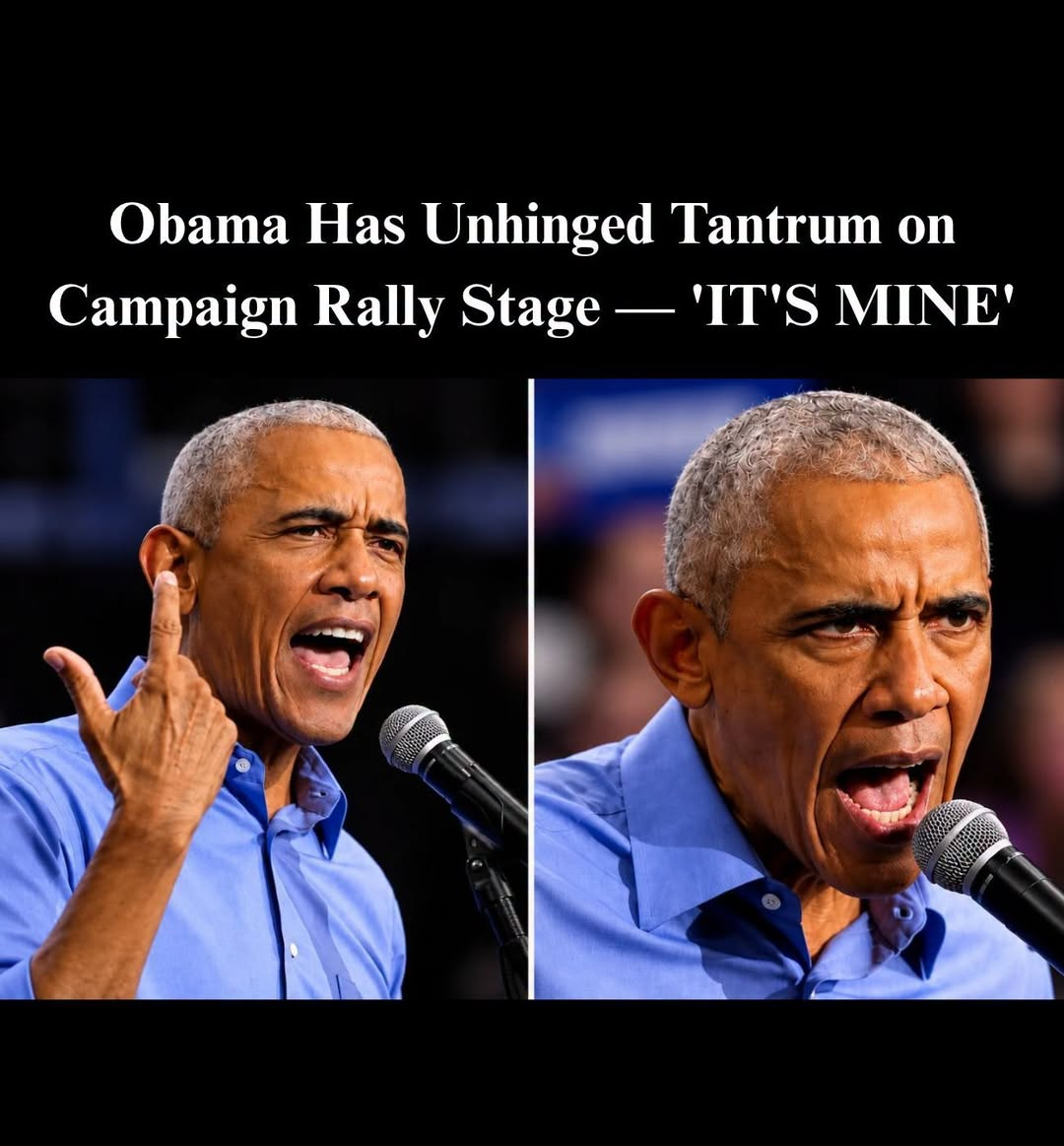
A dramatic image of former President Barack Obama shouting into a microphone is circulating with a provocative claim: that he had a furious onstage outburst over Donald Trump’s lifestyle and later provoked a midnight counterattack from Mar-a-Lago. But the original remarks tell a different story. The key phrase behind the viral headline — “it was my economy” — came from a campaign rally in Pittsburgh on October 10, 2024, when Obama was campaigning for then-Democratic presidential nominee Kamala Harris. It was not a newly documented speech at a 2026 midterm rally.
The distinction matters. Obama was not claiming ownership of a building or arguing that Trump could not have something. He was responding to voters who remembered the economy during the early years of Trump’s first presidency as relatively strong. Obama’s argument was that Trump had initially benefited from economic conditions that had developed during the Obama administration, including an extended period of job growth.
The original speech was pointed and combative, and Obama used emphatic delivery to make his political case. But the available transcript does not support the viral graphic’s implication that the phrase “It’s mine!” was a standalone declaration about Trump’s lavish lifestyle. Nor do the sources reviewed establish the alleged midnight social-media counterattack described in the caption.
What Obama actually said in Pittsburgh
Obama’s remarks came during a rally supporting Harris in the final weeks of the 2024 presidential campaign. He addressed a familiar political question: why some voters remembered the economy at the beginning of Trump’s first term favorably, despite the fact that Trump had inherited an economy that had been expanding for years.
Obama’s response was direct. He said the economy was doing relatively well when Trump entered office because it was, in his view, the economy Obama’s administration had helped build. He pointed to 75 consecutive months of job growth that had occurred before Trump took office and argued that the Republican president had benefited from that momentum.
The full context makes the purpose of the remark clearer. Obama was criticizing Trump’s economic proposals, including plans for further tax cuts and broad tariffs. He argued that voters should consider the likely effects of those policies rather than rely on a general sense of nostalgia for the economy during Trump’s first years in office.
The line was effective as political rhetoric because it compressed a complicated debate about economic inheritance and presidential responsibility into a short, memorable phrase. But the claim that an economy belongs to one president is rhetorical shorthand, not a complete economic analysis.
Presidents influence economic outcomes through taxation, spending, regulation and other policies. They also inherit conditions shaped by previous administrations, the Federal Reserve, private-sector decisions, global markets and unexpected events. A careful assessment therefore requires more than assigning all credit or blame to one president.
Why the image makes the moment look different
The graphic uses two tightly cropped photographs of Obama speaking, combined with a headline that labels his behavior an “unhinged tantrum.” That framing encourages viewers to interpret facial expressions and gestures as evidence of anger or loss of control before they have heard the words themselves.
Yet a still photograph cannot establish the tone of an entire speech, the events leading up to a remark, or the speaker’s state of mind. Obama’s original remarks were emphatic, but the transcript shows him making a political argument about economic performance and responsibility. Describing that moment as a “tantrum” is an editorial judgment, not a neutral account of what happened.
The wording in the graphic also differs from the key sentence in the original speech. Obama said, “Yeah, it was pretty good because it was my economy.” The surrounding remarks concerned job growth and the economic conditions Trump inherited. The phrase “You can’t have it!” in the graphic’s broader framing is not established by the original Pittsburgh transcript as part of that exchange.
This is a familiar pattern in online political communication: a forceful expression, a short quotation and an emotionally charged headline can be combined to create a story that appears more dramatic than the underlying event. The image may accurately show Obama speaking passionately, but that does not validate every claim attached to it.
The economic dispute behind the sound bite
Obama’s argument centered on the transition between administrations. He cited a sustained period of employment growth that began before Trump’s first inauguration and argued that Trump had benefited from those conditions. His remarks also attacked Trump’s tax-cut proposals and warned that broad tariffs could raise costs for American consumers.
Trump and his supporters have offered a different interpretation of his first-term economic record, pointing to tax legislation, business activity and labor-market performance. In a 2024 interview, Trump defended his own economic record when asked about Obama’s claim that he had inherited a strong economy.
Evaluating these competing claims requires examining specific indicators and the time periods involved. Employment growth, wage increases, inflation, gross domestic product, federal deficits and household purchasing power can tell different parts of the story. No single campaign quotation settles how much credit either administration deserves.
The chronology also matters. The COVID-19 pandemic disrupted the U.S. economy during Trump’s first term, making comparisons across the full four-year period more complicated than comparisons limited to the period before the pandemic. Similarly, economic conditions under Obama varied considerably between the aftermath of the 2008 financial crisis and the later years of his presidency.
A serious comparison should account for those differences rather than treating the economy as a simple possession that one president hands to another.
Was there a new Trump response from Mar-a-Lago?
The caption claims that Obama’s remarks triggered a “massive, furious midnight counter-attack” from Mar-a-Lago. However, the sources reviewed for this article do not verify a new, specific response matching that description on October 28, 2026.
There is a documented history of Trump and his allies disputing Obama’s economic claims. Trump defended his first-term record in interviews during the 2024 campaign, while conservative commentators challenged Obama’s characterization of the economic conditions Trump inherited. Those exchanges provide context for the longstanding political dispute, but they should not be presented as proof of a new overnight confrontation.
The distinction is especially important when older footage resurfaces online. A real video can be paired with a current headline and thereby appear to show a new development, even when the underlying event occurred years earlier. In this case, the original rally date is confirmed: October 10, 2024.
Without a verifiable post, statement or recording documenting the alleged new response, the claim of a midnight counterattack remains unsubstantiated.
Why the clip continues to attract attention
The exchange remains politically relevant because it touches on a question that repeatedly shapes American elections: which president deserves credit for a strong economy, and which policies should voters blame when conditions deteriorate?
For Obama and Democrats, the argument is that Trump benefited from an economic expansion already underway and that his policy proposals should be judged against their potential costs. For Trump and Republicans, the counterargument is that their policies helped support growth and that Obama’s account gives insufficient credit to the Republican administration’s decisions.
Both positions are political interpretations that need to be tested against economic data. They should not be confused with the separate claim that Obama lost control of his emotions during the speech.
The viral image also illustrates the importance of distinguishing an original recording from the framing added later. A headline can direct viewers toward a particular conclusion before they have examined the underlying evidence. Reading the full transcript, checking the event date and looking for corroboration of any claimed response are straightforward ways to establish what actually happened.
The bottom line
Obama’s “my economy” remark was a forceful criticism of Trump’s account of the U.S. economy during the early years of his first presidency. It was delivered at a Harris campaign rally in Pittsburgh on October 10, 2024, and was part of a broader argument about job growth, tax cuts and tariffs.
The viral graphic reframes that exchange as an “unhinged tantrum” over Trump’s lifestyle, but the original transcript does not support that interpretation. The accompanying claim of a new, furious midnight response from Mar-a-Lago also remains unverified in the sources reviewed.
The real story is a longstanding political dispute over economic credit and presidential responsibility — one that continues to shape how Americans evaluate the records and promises of their leaders.
Comments (0)
Loading comments...
May You Like

EAST COAST CATASTROPHE — $20 BILLION AT STAKE, 5 MILLION AT RISK OF LOSING POWER, WATER AND HEAT!


BOMBSHELL NEW JERSEY FLOOD — 112 KM/H WINDS, SEAWATER FLOODING INLAND, 120,000 HOMES AT RISK!










Popular Posts



