
Obama’s North Carolina “Ultimatum” Goes Viral as a Real Senate Battle Puts the State in the National Spotlight
North Carolina has emerged as a major battleground in the fight for control of the U.S. Senate, with former Governor Roy Cooper and Republican Michael Whatley competing for an open seat in a race drawing national attention ahead of the November 3 midterm elections.
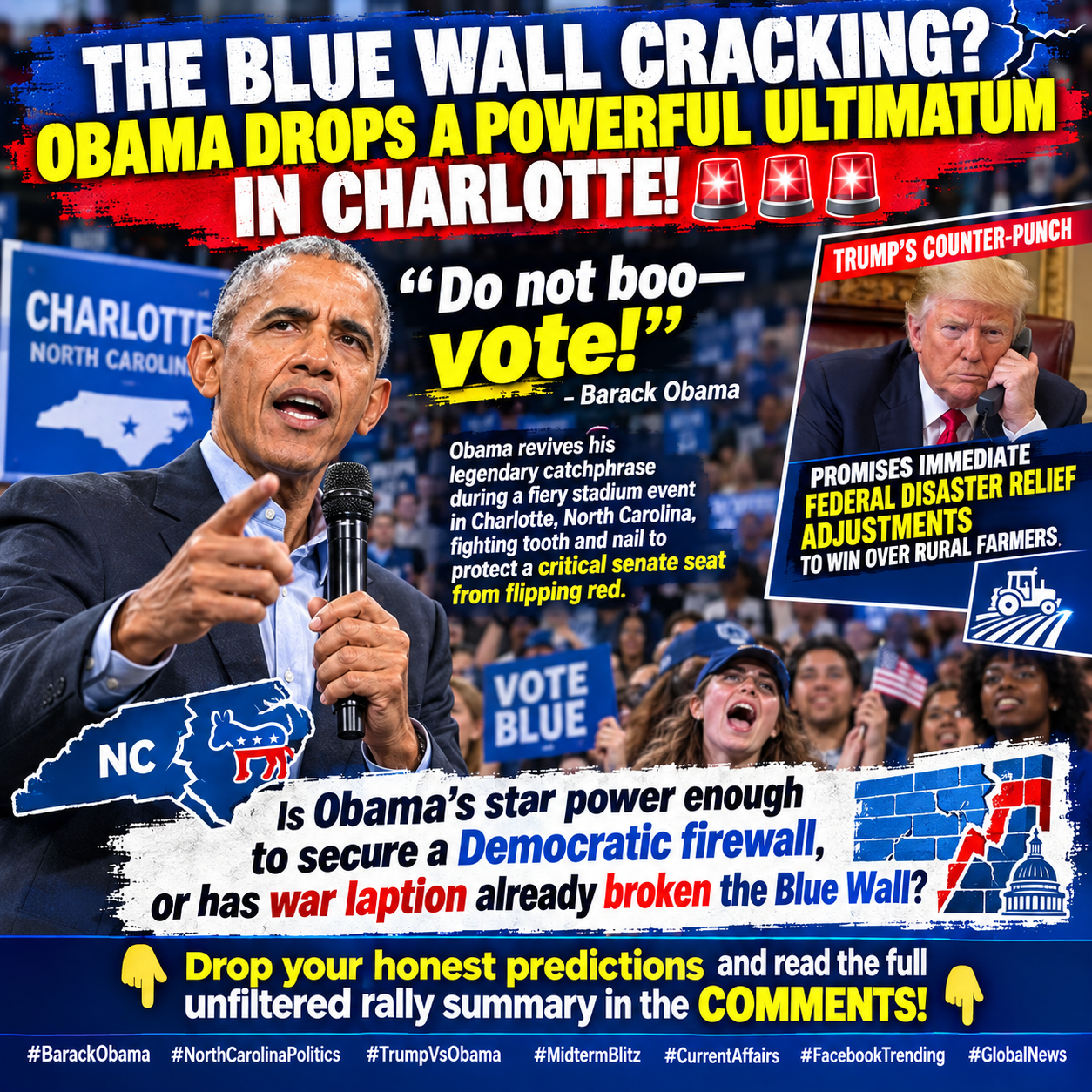
But a dramatic political graphic circulating online has added another element to the contest: a supposed stadium rally in Charlotte featuring former President Barack Obama, who is portrayed as delivering an emotional appeal to voters while President Donald Trump responds with promises of immediate disaster assistance for rural communities.
The image attributes a familiar phrase to Obama: “Do not boo—vote!” It presents the former president as fighting to protect a Democratic Senate seat from turning Republican and describes Trump's response as a new federal disaster relief initiative.
The actual political situation is more complicated.
There is no independently verified October 24 Charlotte stadium appearance by Obama in the reporting reviewed for this article. His documented campaign itinerary instead places him in Cleveland, Ohio, and Detroit, Michigan, where he is supporting Democratic candidates in competitive Senate and gubernatorial races.
The graphic also mischaracterizes North Carolina's Senate contest. The seat is currently held by Republican Senator Thom Tillis, who is retiring. Democrats are attempting to gain the seat, not defend a Democratic incumbent.
And although Trump has announced a significant new federal assistance program for farmers, it is an $8 billion initiative addressing elevated diesel costs—not a newly verified disaster relief adjustment announced from Mar-a-Lago in response to an Obama rally.
These corrections do not diminish the importance of North Carolina's election. They establish the factual foundation for understanding why the state's voters, economic concerns and competing political messages have become central to the national campaign.
North Carolina's Senate race has attracted attention because it involves two prominent candidates with sharply different political backgrounds.
Cooper served two terms as governor, from 2017 to 2025, after previously serving as the state's attorney general. His campaign has emphasized affordability, healthcare access and his experience working with a Republican-controlled legislature.
Whatley, a former chairman of the Republican National Committee, has emphasized his alignment with Trump's agenda, including immigration enforcement, tax policy and economic development.
The election will fill the seat being vacated by Tillis, a Republican who decided not to seek another term. That makes the contest a potential opportunity for Democrats to gain a seat currently held by the opposing party.

Cooper's campaign has placed particular emphasis on healthcare affordability and Medicaid expansion.
During his governorship, North Carolina enacted Medicaid expansion in 2023, extending coverage to hundreds of thousands of additional residents. Cooper has cited the policy as an example of bipartisan cooperation and argued that federal healthcare changes could threaten coverage and increase costs for families.
Whatley and other Republicans have defended the administration's broader tax and spending priorities, arguing that economic growth, reduced regulation and fiscal discipline are important to long-term prosperity.
The debate reflects different approaches to the relationship between government spending, economic opportunity and public services.
Recent polling provides a measurable picture of the contest without establishing its eventual outcome.
North Carolina U.S. Senate — October polling
Elon University survey, September 29–October 8, 2026
A separate East Carolina University survey conducted September 30 through October 3 reported 50% support for Cooper and 43% for Whatley among likely voters.
The ECU survey also found that 55% of likely voters identified the economy and cost of living as their leading issue. Among those respondents, support was measured at 60% for Cooper and 31% for Whatley.
The differences between surveys illustrate the importance of methodology, sampling periods and voter assumptions. Polls provide snapshots of opinion during their fieldwork periods; they do not determine the election result or guarantee that respondents will cast ballots.

The state's political geography also helps explain why the contest is attracting national attention.
Charlotte and the surrounding Mecklenburg County area contain a large and diverse electorate. The state's Research Triangle, including Raleigh and Durham, is another major population center, while smaller cities, rural communities and agricultural regions have different economic and political characteristics.
Approximately 40% of registered North Carolina voters are unaffiliated with either major political party, according to Reuters' October 18 examination of the Senate race. That creates an electorate in which party registration alone cannot explain the outcome.
The graphic's emphasis on working-class voters also points toward a genuine economic issue: the cost of fuel and agricultural production.
On October 19, Trump and Agriculture Secretary Brooke Rollins announced an $8 billion Harvest Fuel Relief program to provide one-time payments to farmers experiencing higher operating costs during the 2026 harvest season.
According to the U.S. Department of Agriculture, payments will be calculated using a uniform formula intended to cover part of modeled losses caused by market disruptions and higher input expenses. The assistance is designed to help producers manage elevated diesel costs.

The program is significant because diesel is used in farm machinery, irrigation equipment, transportation and other agricultural operations. Higher fuel prices can increase production costs even when commodity prices do not rise enough to offset those expenses.
Reuters reported that the administration introduced the initiative amid concerns about energy prices and the financial strain facing farmers. The announcement came during a campaign appearance in Kansas, not during a verified exchange with Obama in Charlotte.
That distinction matters for understanding the policy.
The Harvest Fuel Relief program is agricultural cost assistance. It should not be confused with federal disaster relief programs that respond to hurricanes, floods or other declared emergencies.
North Carolina has experienced serious natural disasters, and federal recovery assistance is an important subject for many communities. But the image provides no documented order, agency announcement or official statement establishing the claimed immediate disaster relief adjustment from Mar-a-Lago.
Without that evidence, the supposed Trump counterannouncement cannot be reported as a confirmed event.
Obama's alleged Charlotte remarks require similar scrutiny.
The phrase “Don't boo—vote” is genuinely associated with the former president. It appeared repeatedly in his 2016 campaign speeches, including a November 6 rally in Orlando, Florida.
At that event, Obama told an audience that political opposition should be expressed through voting rather than simply booing a candidate. The official White House archive preserves the exchange in its transcript.

The authenticity of the historical phrase does not establish that Obama repeated it at a newly claimed Charlotte stadium event.
His documented October 24 itinerary includes appearances in Ohio and Michigan, with another rally planned in Georgia on October 28.
In Ohio, he is supporting Sherrod Brown's Senate campaign and Amy Acton's gubernatorial bid. In Michigan, he is campaigning for Abdul El-Sayed and Jocelyn Benson. Those appearances are part of the Democratic Party's broader effort to compete for congressional and statewide offices.
The absence of a confirmed Charlotte rally also means there is no verified transcript supporting the graphic's description of a new ultimatum, a direct exchange with Trump or a speech focused on protecting a Democratic-held North Carolina Senate seat.
North Carolina's actual campaign developments provide enough material for substantial political reporting without relying on those claims.
Early voting began October 15 and continues through October 31. According to Axios Charlotte, turnout during the first four days was 37% higher than during the comparable opening period of the 2022 midterms.
The report also noted that Democratic voters had cast more than twice as many ballots as Republican voters during that initial period.
Those figures describe early participation, not the final partisan balance of the electorate. They do not account for every subsequent voting day or determine how unaffiliated voters will cast their ballots.

Voters in Mecklenburg County are also deciding contests beyond the U.S. Senate.
The November ballot includes U.S. House races, state legislative contests, judicial elections, local offices and bond measures. Charlotte voters are considering a package of city bonds totaling $425 million, according to Axios Charlotte's October voter guide.
The guide also notes that eligible voters can register and vote on the same day during the early-voting period.
These down-ballot issues illustrate why participation in the midterms has consequences beyond the national confrontation between Trump and Democratic leaders.
At the state level, Republicans hold a supermajority in the North Carolina Senate and are one seat short of a supermajority in the House, according to Axios' September legislative overview.
The composition of those chambers affects negotiations over state budgets, education, healthcare and the governor's veto authority.

Nationally, the election will determine whether Republicans retain control of Congress or whether Democrats gain sufficient seats to change the balance of legislative power.
The Senate contest in North Carolina contributes to that wider competition, but its significance should be understood through the candidates, their policy positions, documented polling and voter participation—not through a purported Obama rally that has not been substantiated.
For Cooper, the campaign centers on his governing record and arguments about healthcare and affordability. For Whatley, it centers on Republican economic priorities and support for the Trump administration's policies.
For rural communities, agricultural costs and federal assistance are genuine concerns. For urban and suburban voters, housing expenses, employment, healthcare and local development may also play important roles.
No single rally, endorsement or campaign slogan can establish how all these groups will vote.
The image's question about whether Obama's influence can protect a Democratic position or whether Republicans will make gains therefore rests partly on an inaccurate premise: North Carolina's open Senate seat is currently Republican-held, and the reported Charlotte Obama appearance remains unverified.
What is clear is that the state is participating in a consequential national election, with measurable differences between the candidates' platforms and substantial public attention to the economy.
As November 3 approaches, the evidence to watch is the candidates' documented statements, the administration's actual policy announcements, updated election data and ultimately the ballots cast by North Carolina voters.
The political contest is real. The supposed Charlotte ultimatum has not been established.
Comments (0)
Loading comments...
May You Like

EAST COAST MEGASTORM—2 MILLION HOUSES DAMAGED, 5 MILLION AT RISK OF BLACKOUTS, WATER FAILURES!

DAVENPORT AIRBNB HORROR — 40 OF 50 TEENS TEST POSITIVE FOR DRUGS SUPPLIED BY THE HOST'S MOM!










Popular Posts




