
Obama’s Pittsburgh “Mega-Rally” and Pennsylvania Voter Data Leak Claims Face Scrutiny as Midterm Campaign Intensifies
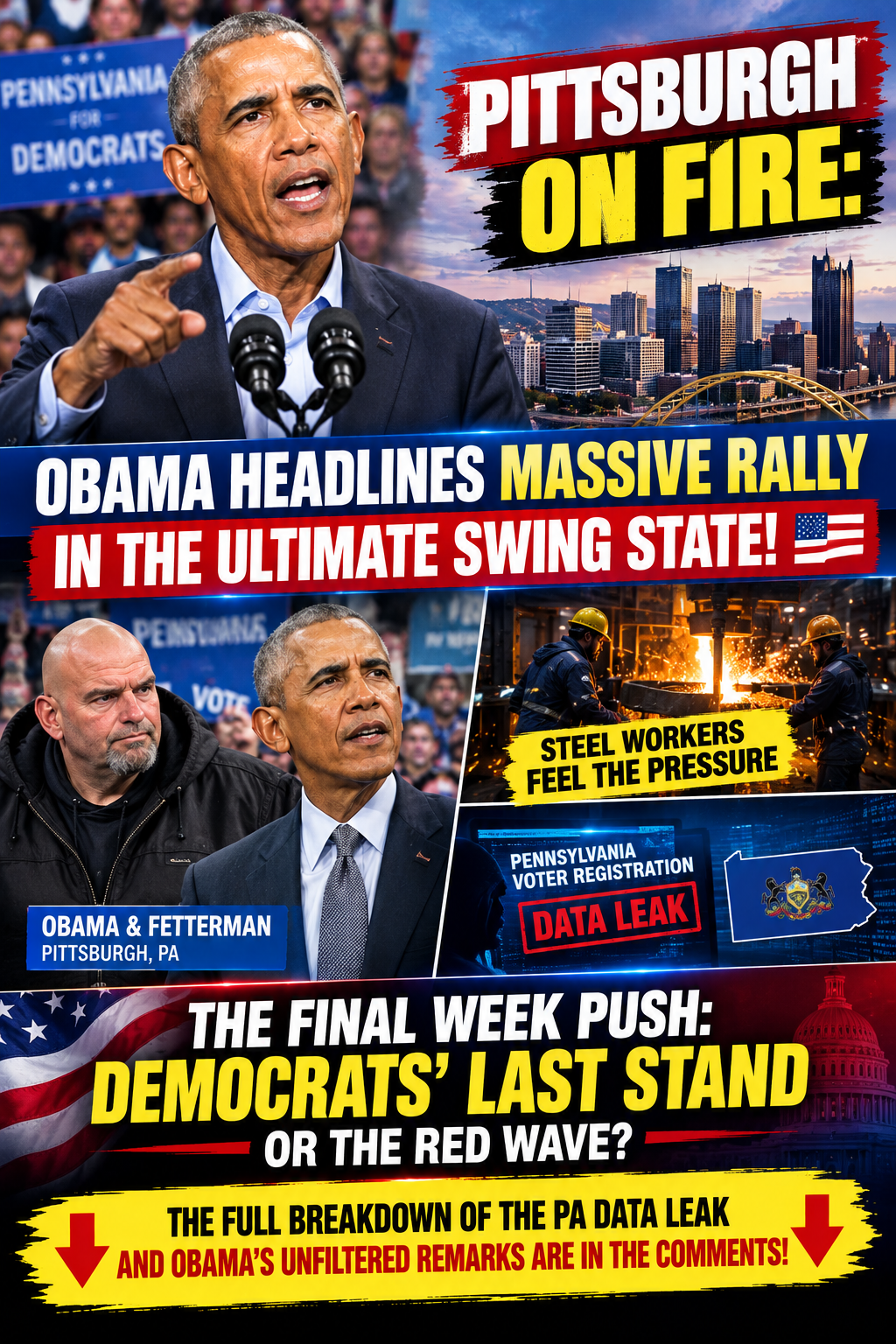
A dramatic political image portraying former President Barack Obama at a massive Pittsburgh rally alongside Senator John Fetterman is circulating as Pennsylvania enters the final stretch of the 2026 midterm elections. The graphic combines familiar campaign themes—industrial jobs, economic pressure and congressional control—with an especially serious allegation: that a major leak of Pennsylvania voter registration data disrupted the campaign shortly before Obama took the stage.
But a review of current campaign schedules, Pennsylvania election records and published reporting reveals a substantially different picture.
Obama is campaigning in Ohio and Michigan on October 24, not at a confirmed Pittsburgh rally with Fetterman. The available reporting also does not establish that a new breach of Pennsylvania's voter registration system occurred minutes before an Obama appearance, or that the former president delivered the speech about Trump's alleged closed-door steel industry deals described in the graphic.
That does not make Pennsylvania irrelevant to the national campaign. The state remains an important political battleground, and its voter registration trends, industrial economy and election administration are subjects of genuine public debate.
The distinction is between those documented developments and an unverified narrative that combines them into a single dramatic event.
With Election Day scheduled for November 3, that distinction matters. False or misleading claims about voter information can spread rapidly during the final days of an election, potentially confusing voters about the security of their personal information and the integrity of the electoral process.
The most immediate verified political event in Pittsburgh on October 24 is a Democratic get-out-the-vote rally featuring Pennsylvania Governor Josh Shapiro and Lieutenant Governor Austin Davis, scheduled for 7 p.m. to 8:45 p.m. Eastern Time. The published event information does not list Obama or Fetterman as participants.

Obama's actual schedule tells a different story. According to the Associated Press, he is due to begin the day in Cleveland, Ohio, campaigning with Democratic Senate candidate Sherrod Brown and gubernatorial candidate Amy Acton. He is then scheduled to travel to Detroit, Michigan, where he will support Senate nominee Abdul El-Sayed and gubernatorial nominee Jocelyn Benson.
The former president is also expected to campaign in Georgia the following week, alongside Senator Jon Ossoff and gubernatorial nominee Keisha Lance Bottoms. These appearances form part of an expanding Democratic campaign effort as the November 3 elections approach.
That schedule does not rule out a future Pennsylvania appearance. It does mean that a claim about a Pittsburgh rally already taking place cannot be reported as fact without additional confirmation.
The graphic's portrayal of Fetterman as Obama's campaign partner is also politically significant because it overlooks tensions between the Pennsylvania senator and other Democrats.
An Associated Press report published in September described Fetterman's growing isolation within his party after disagreements over Israel, progressive candidates and some Trump administration policies. The report also noted his appearance at a Republican political gathering, where he praised fellow Pennsylvania Senator David McCormick and emphasized his commitment to protecting the state's steel industry.
Fetterman remains a Democrat, but his relationship with parts of the party has become strained. The AP reported that some local Democratic leaders did not want him campaigning for their candidates.

That background does not make a joint Obama–Fetterman appearance impossible. It does, however, make verification particularly important before presenting the two as the leaders of a coordinated campaign event.
There is another important distinction in the graphic's account of the Senate battle: Pennsylvania has no U.S. Senate election in 2026.
Fetterman's current term runs until 2029, with his seat next scheduled for election in 2028. McCormick's seat is next scheduled for election in 2030. The state's voters will instead decide contests for governor, all 17 U.S. House seats and positions in the Pennsylvania General Assembly.
Those elections remain consequential. The congressional contests will contribute to the national balance of power, while the gubernatorial and state legislative races will shape Pennsylvania's domestic policy agenda.
Governor Shapiro is seeking reelection against Republican state Treasurer Stacy Garrity. Their contest involves competing positions on state spending, education, taxation, economic development and the direction of Pennsylvania government.
The state legislature is another important battleground. Spotlight PA reported in September that Democrats held a narrow 103–100 majority in the state House, while Republicans controlled the state Senate 27–23.
That balance places considerable importance on individual legislative districts, where relatively small changes in representation could alter committee leadership, the legislative agenda and negotiations with the governor.

The economic backdrop in western Pennsylvania adds substance to the political debate.
Pittsburgh's history as a steelmaking center makes industrial employment, wages, trade policy and manufacturing investment particularly relevant to the region.
But the graphic's allegation that Obama exposed Trump's recent secret deals with steel executives has not been supported by an identifiable speech transcript, recording or independent report.
There are, however, genuine developments in the steel industry that deserve attention.
U.S. Steel and the United Steelworkers have been engaged in contract negotiations during 2026. The company announced in August that the parties had agreed to extend their existing labor agreement beyond its scheduled September 1 expiration while bargaining continued.
On September 30, U.S. Steel outlined a five-year contract proposal that included compounded base wage increases of approximately 19.3%, a $4,000 ratification bonus for eligible employees and provisions concerning healthcare, pensions and job stability.
Those terms represent the company's proposal, not proof that the union accepted them or that a final agreement had been reached.

The negotiations provide a concrete example of the economic issues facing industrial workers. Wages and benefits are important, but so are the long-term competitiveness of domestic manufacturing, energy costs, investment decisions and the effects of trade policy.
U.S. Steel has connected its investment plans to its partnership with Nippon Steel, while labor representatives have continued to negotiate over the terms of employment.
Those discussions are legitimate subjects for political scrutiny. Yet there is no basis in the reviewed material for presenting them as evidence that Obama delivered a new public accusation about a specific closed-door agreement involving Trump.
The more serious allegation in the graphic concerns Pennsylvania's voter registration system.
Its claim that a major data leak occurred shortly before Obama's supposed Pittsburgh appearance is not corroborated by the current reporting or official information reviewed for this article.
Pennsylvania has recently taken steps to increase public access to voter registration statistics, but the release of public aggregate data is not the same thing as a security breach.
On August 24, the Pennsylvania Department of State launched a voter registration dashboard designed to display information that the state had already been publishing for years.
The dashboard includes statewide and local registration totals, party affiliation statistics and changes in registration numbers over time.
Secretary of the Commonwealth Al Schmidt described the project as part of the state's effort to improve transparency around voter registration trends.

A separate development has also generated discussion about voter registration records.
On October 20, the Public Interest Legal Foundation announced that it had filed a complaint alleging more than 1,100 apparently duplicate registrations in Allegheny County, which includes Pittsburgh.
The organization said its findings involved records that appeared to be duplicated or repeated multiple times.
Those are allegations concerning voter-list maintenance, not evidence that Pennsylvania's registration database was hacked or that private information was stolen.
The complaint also does not establish that duplicate records resulted in fraudulent votes. Its findings would need to be assessed through the appropriate election administration and legal processes.
Pennsylvania's Department of State has explained that its 67 county election boards are responsible for maintaining voter registration records through the Statewide Uniform Registry of Electors system.
Counties regularly review changes of address, death records and other reliable information as part of established list-maintenance procedures. The department has emphasized the importance of keeping records accurate while protecting eligible voters against improper removal.
That administrative work should not be confused with a cyberattack.
A genuine data breach would require evidence of unauthorized access, disclosure or compromise. No such evidence has been identified in connection with the supposed last-minute incident described in the graphic.
There is, however, a broader national dispute about access to voter information.
The Brennan Center for Justice reported in an October 16 update that the Trump administration had sought extensive election records from states, including voter registration lists containing sensitive information.
The organization raised concerns about privacy and security, while federal officials have argued that access to election records is important for enforcing election laws.
That dispute concerns government requests for data and the legal limits on disclosure. It is separate from the allegation of a sudden Pennsylvania voter registration leak.
The distinction is particularly important during an election campaign because confusion about registration records can affect public confidence.
Voters may encounter claims about database vulnerabilities, duplicate registrations, changes in party affiliation or unexpected registration totals. Each requires different evidence and a different explanation.
A discrepancy in a public statistical report does not automatically indicate hacking. An allegation of duplicate registrations does not establish that anyone cast multiple ballots. A request for voter information does not prove that the requested records were improperly disclosed.

Pennsylvania's latest voter registration figures also provide a more meaningful picture of the state's political environment than the viral image's unsupported description of campaign chaos.
According to an Axios report published October 19, Democrats had increased their net registration advantage during 2026. State data through October 12 showed approximately 3.87 million registered Democrats and 3.63 million registered Republicans.
Democratic registration had increased by roughly 55,400 on a net basis since the beginning of the year, while independent registration had also risen substantially.
These figures reflect registration totals and net changes, including adjustments for people moving, dying or updating their records. They are not a forecast of the election result, and they do not establish how many registered voters will actually participate.
The numbers nevertheless illustrate why Pennsylvania continues to attract political attention.
The state's electorate contains substantial Democratic and Republican constituencies, with differing political patterns across Pittsburgh, Philadelphia, their surrounding suburbs and more rural counties.
Economic conditions, candidate records, party organization and turnout will all influence the November contests.
The final campaign period is also unfolding amid disputes over the federal government's approach to election administration.
Reuters reported in September that errors in state motor-voter registration systems had resulted in the mistaken registration of some noncitizens over a period of years. Its investigation found administrative problems in states governed by both parties, while emphasizing that the cases represented a small fraction of the national electorate and did not demonstrate a coordinated scheme of widespread noncitizen voting.
That reporting underscores why election administration claims should be evaluated through documented records rather than dramatic imagery or unsupported accusations.
For Pennsylvania voters, the immediate political decisions concern the governor's office, the state's congressional delegation and the General Assembly.
For workers in Pittsburgh and the surrounding industrial region, questions about wages, manufacturing investment, energy prices and long-term employment remain substantial.
For election officials, the challenge is to administer the November vote accurately while addressing legitimate questions about registration procedures and protecting voters' information.
The viral image combines all three subjects into an attention-grabbing story about Obama, Fetterman and an alleged emergency. Yet its most dramatic assertions are not supported by the available evidence.
Obama is campaigning in Cleveland and Detroit on October 24. Pittsburgh is hosting a separate Democratic rally with Shapiro and Davis. U.S. Steel is engaged in real labor negotiations, and Pennsylvania is publishing updated registration statistics while facing disputes over voter-list maintenance.
Those are documented developments. A surprise Obama–Fetterman mega-rally, a last-minute voter database breach and a newly delivered Obama speech exposing secret steel agreements remain unverified.
As Election Day approaches, the central story in Pennsylvania is not a confirmed campaign emergency but an ongoing contest over economic policy, political representation and confidence in election administration.
The state's voters will ultimately determine the results through the November 3 election.
Comments (0)
Loading comments...
May You Like

EAST COAST CATASTROPHE — $20 BILLION AT STAKE, 5 MILLION AT RISK OF LOSING POWER, WATER AND HEAT!

COASTAL DISASTER — 112 KM/H WINDS, SEAWATER FLOODING, 79,000 NEW JERSEY HOMES AT RISK!

STAR DIED AT 38, $10M LIFE INSURANCE INCREASED JUST 30 DAYS BEFORE WWE BRONSON REED'S DEATH!








Popular Posts




