
Obama’s “Power of the Citizen” Message Takes Center Stage as Trump Defends His Economic Record Ahead of Midterms
Former President Barack Obama is returning to Detroit for a high-profile Democratic campaign rally as President Donald Trump intensifies his defense of his administration's economic and foreign-policy record, setting up a sharp political contrast less than two weeks before the November 3 midterm elections.
Obama's appearance comes at a consequential moment for Michigan, where an open U.S. Senate seat, a competitive gubernatorial contest and the beginning of statewide early in-person voting have placed the state at the center of the national campaign.
The former president is scheduled to appear alongside Democratic Senate nominee Abdul El-Sayed and gubernatorial nominee Jocelyn Benson, bringing his national profile to a party seeking to consolidate support after a divisive primary season.
Trump, meanwhile, used a lengthy rally in Fort Myers, Florida, on October 23 to defend his economic agenda, attack Democratic policies and argue that Republicans should retain control of Congress.
The competing appearances reflect different political messages. Obama is emphasizing Democratic candidates, civic participation and economic opportunity. Trump is defending his administration's record on taxes, trade, immigration and national security while acknowledging the economic disruption associated with the conflict involving Iran.
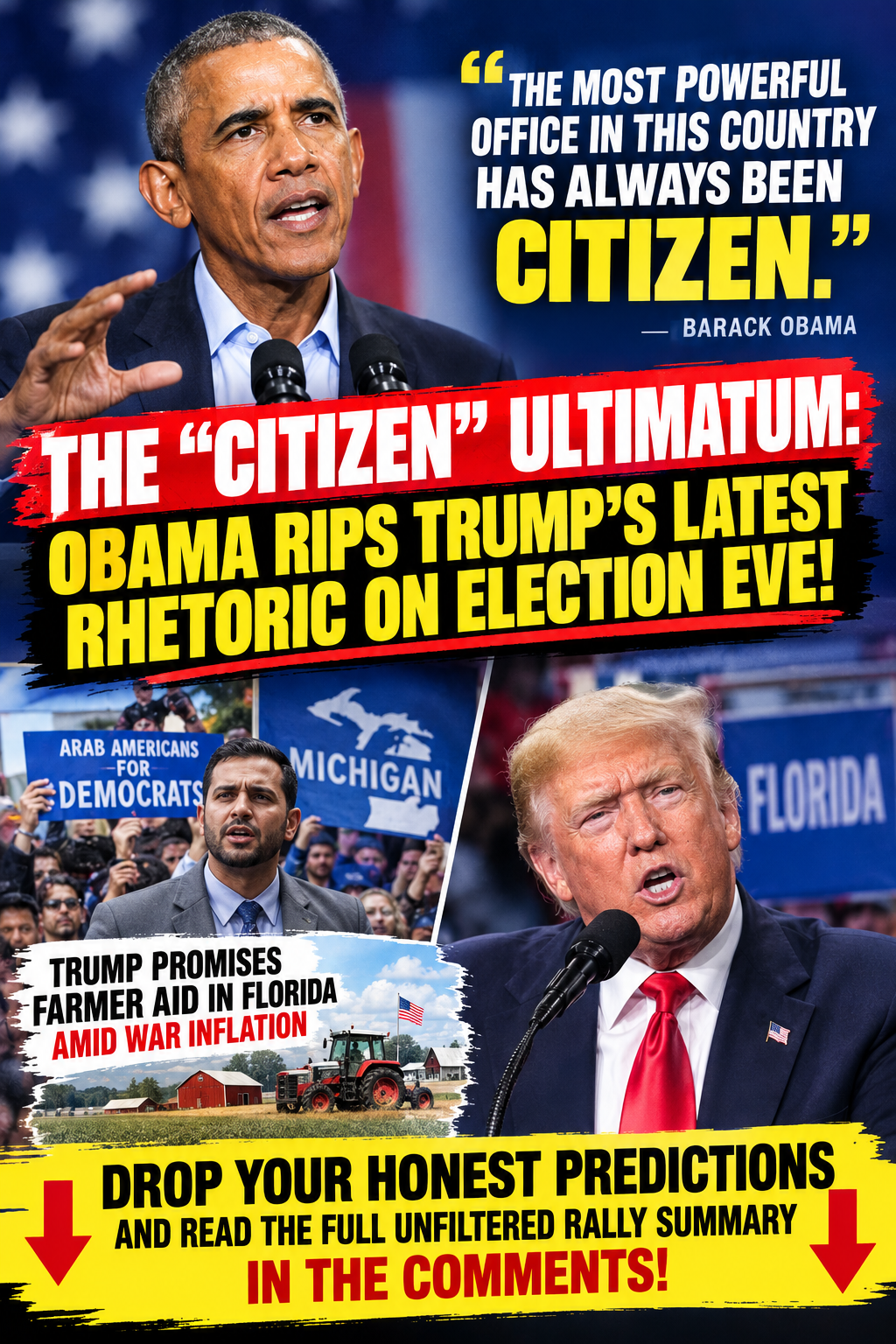
A dramatic graphic circulating online presents the confrontation as a direct exchange over Trump's rhetoric toward Arab-American political figures in Michigan. That specific allegation, however, requires qualification. Although attacks involving religion and identity have become part of the broader political discussion surrounding Michigan's Senate race, the available reporting does not establish that Obama delivered a newly verified speech explicitly condemning the particular Trump remarks described in the graphic.
The image also attributes a quotation about citizens holding the country's most powerful office to Obama. Its exact wording and connection to the October 24 Detroit rally have not been independently established. The sentiment is consistent with Obama's longstanding emphasis on civic participation, but it should not be presented as a verified quotation from a speech that has not yet been documented.
Obama's Detroit appearance is especially significant because of the candidate standing beside him. El-Sayed, a physician and former public health official, is competing against Republican Mike Rogers for the Senate seat being vacated by Democratic Senator Gary Peters.
El-Sayed narrowly defeated Representative Haley Stevens in the Democratic primary, a contest that exposed disagreements between the party's progressive and more moderate factions. His campaign has emphasized healthcare, lower household costs and reducing the influence of corporate money in politics.

Obama's participation represents a public effort to support the party's nominee despite those earlier divisions. El-Sayed has criticized aspects of Obama's presidential record, but he has also acknowledged the former president's importance to American politics.
The two are appearing together at a time when Michigan Democrats are trying to unite different groups of voters, including progressives, moderates, organized labor, Black communities and Arab-American residents.
That coalition is particularly relevant to El-Sayed, who is the son of Egyptian immigrants and could become the first Muslim elected to the U.S. Senate. His background has attracted national attention, but his campaign also faces questions about foreign policy and ideological differences within the electorate.
Republicans have criticized his positions and raised allegations concerning his associations, which his campaign disputes. Such claims should be evaluated individually rather than treated as established evidence of wrongdoing.
The political environment has also been affected by criticism of Muslim political figures, including Democratic Representative Ilhan Omar. In his October 23 Fort Myers speech, Trump attacked Omar in personal terms and questioned her legitimacy as a member of Congress.
The published transcript confirms those remarks, but it does not establish that Trump directed the same statements at El-Sayed during that event. That distinction is particularly important when assessing the viral graphic's assertion that Obama was responding to a specific attack on Michigan's Arab-American candidates.

Obama has already recorded an advertisement supporting El-Sayed. Released earlier in October, the spot presents the Democratic nominee as a physician who has challenged powerful interests while advocating employment opportunities, healthcare and affordability.
The advertisement is part of Obama's wider campaign involvement, which includes recorded endorsements and appearances in multiple states. His October 24 Detroit event is scheduled to begin at 5 p.m. Eastern Time, coinciding with the beginning of Michigan's required early in-person voting period.
The significance of the timing is practical as well as political. Candidates can use high-profile events to draw attention to voting procedures and campaign priorities, although attendance and enthusiasm at a rally do not reliably measure how the wider electorate will vote.
Obama is also scheduled to campaign in Ohio on October 24, supporting Democratic Senate candidate Sherrod Brown and gubernatorial nominee Amy Acton. His expanded campaign schedule demonstrates the importance Democrats attach to competitive Senate races as they seek to change the balance of power in Congress.
Trump's campaign activity offers a contrasting picture of the same election environment.
During his October 23 Florida rally, Trump defended the administration's economic record, argued that Republican policies had strengthened employment and investment, and accused Democrats of threatening the country's prosperity.
He also acknowledged that the military conflict involving Iran had contributed to rising energy prices, while arguing that the costs would eventually decline. His remarks reflected the administration's position that its national security objectives justified short-term economic disruption.

Independent economic reporting provides a more complicated picture.
An Associated Press examination published ahead of the election found that annual inflation had reached 3.7%, compared with 3% when Trump returned to office in January 2025. Unemployment remained relatively low at 4.2%, but job creation had slowed, and higher borrowing costs were affecting households and businesses.
The AP identified several factors contributing to price pressures, including tariffs and the Iran conflict. Those findings complicate claims that the economy is uniformly improving or deteriorating.
The consequences are especially visible in agriculture.
On October 19, Trump announced an $8 billion Harvest Fuel Relief program intended to assist farmers facing high diesel costs during the harvest season. The U.S. Department of Agriculture said the program would provide one-time payments calculated according to modeled fuel expenses and losses.
The announcement was made at a Kansas rally, not first unveiled at the October 23 Florida event, as some online descriptions might suggest.

Reuters reported on October 23 that the assistance would not be distributed before the November 3 election. USDA official Richard Fordyce said payments were expected afterward, potentially toward the end of 2026.
The distinction between announcing assistance and delivering funds is consequential for farmers confronting immediate expenses.
USDA estimates cited by Reuters indicated that farmers could spend nearly $5 billion more on fuel than in the previous year. The planned assistance would be financed through the Commodity Credit Corporation, a federal mechanism also used for earlier agricultural support.
The program illustrates a broader economic dilemma facing the administration. Higher energy prices can increase the costs of harvesting, transportation and food production, while government assistance may offset some losses without directly reversing the underlying increase in fuel prices.
For farmers, the relevant questions include eligibility, payment size, timing and whether assistance adequately reflects their actual expenses.
For voters, the debate extends to the wider cost of living. A Washington Post report published October 24 described how elevated consumer prices, energy costs and trade policies were contributing to dissatisfaction, while warning that a change in congressional control would not necessarily produce immediate price reductions.
This is where the political arguments advanced by Obama and Trump intersect.
Obama's campaign activity emphasizes participation, economic opportunity and Democratic candidates who argue that government should do more to address household costs.
Trump's message emphasizes the administration's tax policies, economic claims, border enforcement and national security decisions. He argues that continued Republican control would allow his administration to pursue those priorities.
Both sides are making arguments about the future of the economy, but the effects of particular policies must be judged against measurable outcomes rather than campaign rhetoric alone.
The election also carries substantial consequences for congressional oversight and legislation. The House determines committee leadership and much of the legislative agenda, while the Senate plays a central role in confirming presidential nominees.
Neither Obama nor Trump is a candidate for Congress in the November election. Their appearances are efforts to support other candidates and shape the public debate.

The viral image's emphasis on the power of ordinary citizens is therefore connected to a genuine feature of the election: congressional control ultimately depends on votes cast in individual districts and states, not on the prominence of national political figures.
But that civic theme should not be confused with a verified quotation from Obama's forthcoming Detroit remarks. Until an authentic recording or transcript is available, the image's wording remains an attribution that has not been independently confirmed.
Similarly, claims that Obama's appearance has already changed the Senate race or that Trump's economic policies have predetermined the election go beyond the evidence.
What can be established is that Michigan's Senate contest has become a major focus of national attention, Obama is campaigning for El-Sayed, Trump is defending his record at Republican events, and rising costs remain a central concern for voters.
As the November 3 election approaches, the two presidents are presenting different accounts of America's political and economic direction.
The results will be determined by the electorate, while the policy disputes over healthcare, energy, trade, immigration and government accountability will continue beyond Election Day.
Comments (0)
Loading comments...
May You Like

MINNESOTA NIGHTMARE—UNDERGROUND GAS LEAK, HUNDREDS OF HOMES AT RISK, $300M DAMAGE!

EAST COAST CATASTROPHE — $20 BILLION AT STAKE, 5 MILLION AT RISK OF LOSING POWER, WATER AND HEAT!

FLORIDA AIRBNB NIGHTMARE — 50 TEENS, 7 SHOOTING VICTIMS LINKED TO “SHOTS AT THE DOOR”!








Popular Posts




