
Obama’s “Untrustworthy” Attack on Trump: A Viral 2026 Political Graphic Raises More Questions Than It Answers
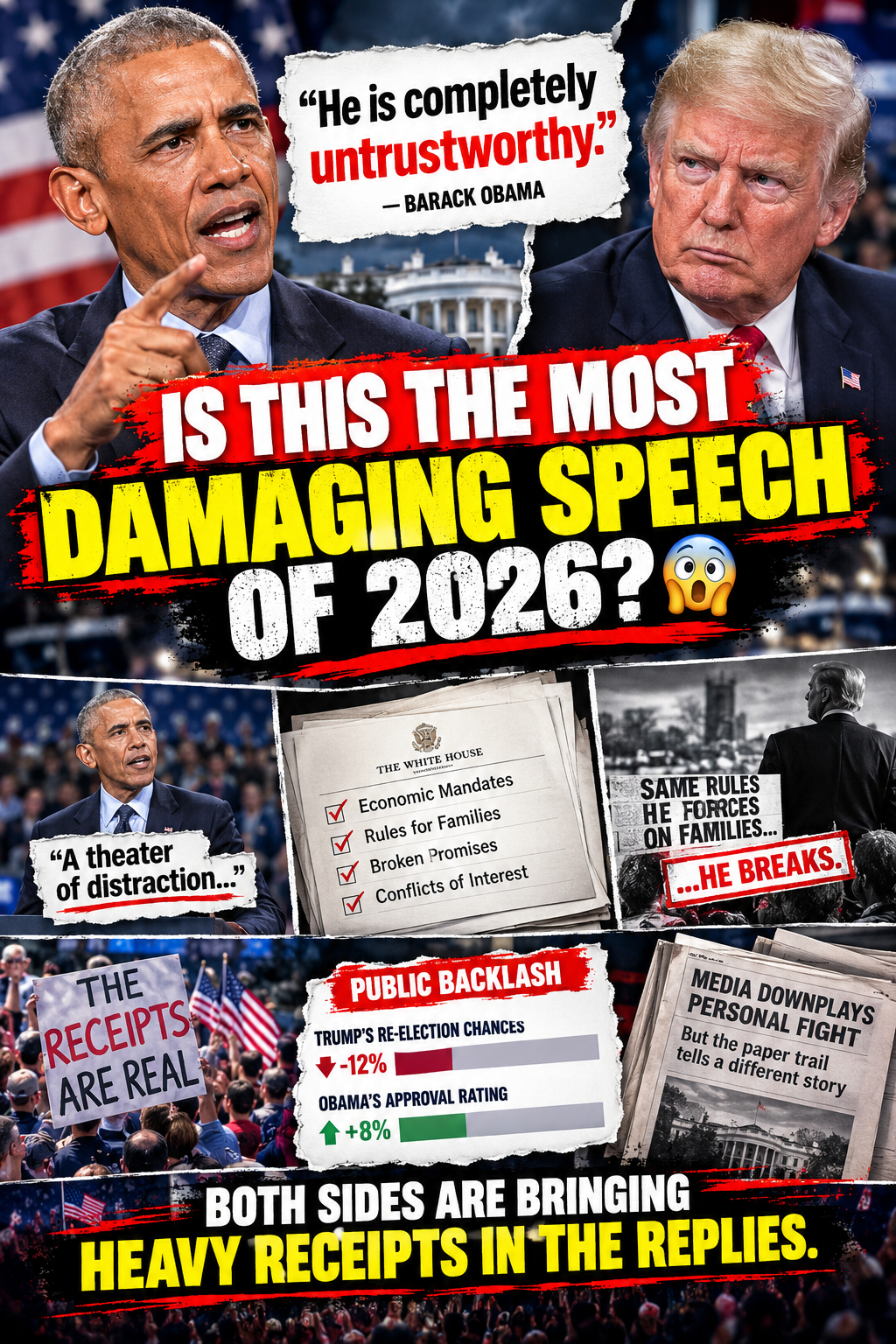
The image presents a dramatic political showdown: Barack Obama allegedly branding Donald Trump “completely untrustworthy,” accusing his administration of hypocrisy, and triggering a backlash supposedly reflected in polling figures. But the graphic combines several distinct claims—and its headline, quotations and statistics should not be treated as verified evidence without reliable sourcing.
The key question is not simply whether Obama has sharply criticized Trump. It is whether he delivered the specific speech described in the caption, whether the quoted language is authentic, and whether the numerical claims about electoral prospects and approval ratings come from credible polling.
What Obama actually said
Obama did return to the campaign trail on October 24, appearing at rallies in Cleveland, Ohio, and Detroit, Michigan, to support Democratic candidates ahead of the November 3 midterm elections. His speeches were sharply critical of Trump, focusing on the economy, the administration’s conduct, the war with Iran, and what he described as the president’s use of public office for personal enrichment.
In Detroit, Obama accused Trump of “straight-up grifting on your dime” and argued that Republicans had become a party of “corrupt government or inept government.” He also called the midterm election a chance to impose accountability on the administration. Those remarks were reported by The Washington Post and Reuters.
However, the graphic’s most prominent quotation—“He is completely untrustworthy”—does not appear in the published accounts of those October 24 speeches. Nor do the reports substantiate the phrase “a theater of distraction” as a direct quotation from Obama in that campaign appearance. The graphic may be combining commentary, paraphrases or material from another context, but without a recording or transcript establishing the wording, those phrases should not be attributed to him as confirmed quotes.
Obama’s verified criticism was nevertheless forceful. In Ohio, he blamed Trump administration decisions, particularly the Iran conflict, for contributing to higher energy and consumer costs. He argued that the president had made choices with consequences for ordinary households, while devoting attention to White House renovations and other highly visible distractions. He also mocked the administration’s gold-heavy renovations, saying the White House looked as though “Saddam Hussein opened a Cheesecake Factory.”
Trump’s response and the escalating political clash
Trump did not remain silent. In a response posted on Truth Social, he attacked Obama’s presidential record, calling him “grossly incompetent” and criticizing his handling of Iran and previous Democratic campaigns. The exchange illustrates how both political figures continue to use their platforms to shape the national debate, even though neither is personally seeking a seat in the November congressional elections.
The political stakes are substantial. All 435 seats in the House of Representatives and 35 Senate seats are being contested. Democrats are seeking to regain congressional control and use their majorities, if they win them, to constrain Trump’s remaining agenda. Republicans, meanwhile, are trying to defend narrow margins and persuade voters that the administration’s policies deserve more time.
The distinction matters: the 2026 election is a midterm election, not a presidential reelection contest. Trump is not on the ballot. A graphic suggesting that his “reelection chances” have fallen by 12 percent therefore needs a clearly identified poll, prediction market or other defined measure before it can be interpreted as meaningful election data.
What the polling actually shows
There is credible evidence of political vulnerability for Trump, but the figures in the viral graphic do not match the polling information identified in the sources reviewed.
The October Marquette Law School Poll found that 37% of registered voters approved of Trump’s job performance, while 61% disapproved. That represented a net approval rating of minus 24 points, with approval at a new low in the poll’s tracking of his first and second terms. The poll surveyed voters from October 14 to 22, 2026.
A Washington Post review of polling published October 29 also found that Trump’s economic approval had deteriorated substantially: from a net positive rating of 12 points early in his second term to below minus 30. The review identified the economy and cost of living as leading voter concerns.
These figures suggest a difficult environment for Republicans, particularly as voters assess prices, economic policy and the administration’s handling of international affairs. But they do not establish that Trump’s reelection prospects have fallen by exactly 12%, nor do they prove that Obama’s speech caused a measurable shift in voter sentiment.
The graphic also claims that Obama’s approval rating rose by 8%. No polling organization, survey dates, sample size or question wording is supplied to support that number. Without those details, the claimed increase cannot be independently assessed. A politician’s popularity among supporters is also not interchangeable with the impact of a campaign speech on undecided voters.
Why the economic argument may matter more than the personal insults
The most consequential part of Obama’s intervention may not be his personal attacks on Trump, but his attempt to connect national policy decisions to the financial pressures facing households. Inflation, fuel prices, tariffs and the cost of living are issues that can influence voters beyond the party’s most loyal supporters.
Reuters reported that Obama linked rising costs to the administration’s decisions, including the Iran war, while also citing earlier Reuters/Ipsos polling in which substantial shares of respondents expressed concern about potential conflicts between Trump’s private business interests and public policy. Those findings are relevant to the broader debate, but they should not be confused with proof of wrongdoing in any particular case.
The administration and its supporters can contest Obama’s interpretation of the economy, the causes of higher prices and the consequences of its foreign policy. Establishing whether a particular policy caused a particular increase requires economic evidence, not simply a campaign speech. Likewise, allegations of corruption or personal enrichment require specific documentation and legal scrutiny rather than being treated as established facts because a political opponent makes them.
A viral headline, a real confrontation—and figures that need receipts
The October 24 rallies confirm that Obama has become an active and prominent voice in the final stretch of the 2026 midterm campaign. His criticism of Trump was direct, his economic message was clear, and Trump responded with attacks of his own. The confrontation is part of a broader struggle over the administration’s record and the future balance of power in Congress.
But the image goes further than the verified record. The “completely untrustworthy” quotation is not confirmed by the published accounts of the rallies; the “theater of distraction” wording is not established as a direct quote; and the claimed 12% decline in Trump’s reelection chances and 8% rise in Obama’s approval rating lack identifiable polling sources. Those figures should not be repeated as facts without the underlying data.
The more defensible conclusion is that Obama has delivered a major political challenge to Trump at a consequential moment for the Republican Party. Whether that message changes votes is a separate question—and one that only reliable polling and, ultimately, the November 3 results can answer.
Comments (0)
Loading comments...
May You Like

U.S. REPORTEDLY STRIKES OIL TANKER NEAR IRAN — COULD GAS PRICES SURGE?

AMERICA'S TRADE DEFICIT SURGES — WHAT DOES IT MEAN FOR AMERICAN FAMILIES?

IRAN DEFIES WASHINGTON — SUPREME LEADER CLAIMS U.S. MILITARY ATTACKS FAILED!












