
Obama’s Viral Economic Attack on Trump Resurfaces
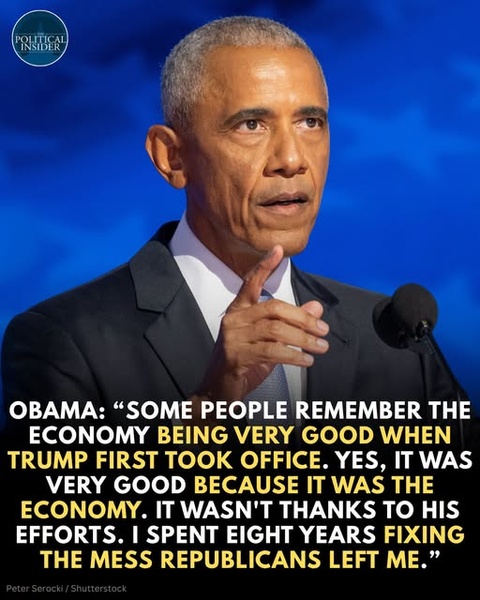
WASHINGTON — A viral image circulating online appears to show former President Barack Obama delivering a blunt verdict on Donald Trump’s economic record: Americans may remember the economy being strong when Trump first entered the White House, Obama says, but that prosperity was largely inherited from the previous administration.
The graphic attributes to Obama the line:
“Some people remember the economy being very good when Trump first took office. Yes, it was very good because it was the economy. It wasn't thanks to his efforts. I spent eight years fixing the mess Republicans left me.”
The quote is real in substance, but the image is misleading in one important respect: it is not a new 2026 statement.
Obama made the remarks during a campaign rally for Kamala Harris in Las Vegas on Oct. 19, 2024, while arguing that voters who remembered the economy favorably during Trump's first presidency were overlooking the economic recovery that had already taken place under Obama.
The resurfacing of the clip comes amid renewed political battles over which party deserves credit for the U.S. economy — and whether voters' memories of Trump's first term accurately reflect the economic conditions he inherited.
Obama’s Original Argument
Speaking in Nevada during the 2024 presidential campaign, Obama directly addressed voters who told him they remembered Trump's first years in office as economically successful.
Obama argued that the strength of the economy Trump inherited was partly the product of the recovery that began during Obama's presidency.
He pointed specifically to the aftermath of the 2008 financial crisis, which had left the U.S. economy in severe condition when Obama took office in January 2009.
“I spent eight years cleaning up that mess that the Republicans had left me,” Obama said at the rally. He then pointed to the 75-month streak of job growth that existed when he handed the presidency to Trump.
The comment was therefore not simply an attack on Trump.
It was an argument about economic inheritance — whether a president should receive credit for conditions that were already improving when he entered office.
The 75-Month Job-Growth Streak Is a Matter of Record
One of Obama's strongest factual points was his reference to the labor market.
According to the Bureau of Labor Statistics and contemporary government records, the U.S. economy experienced 75 consecutive months of job growth through the end of Obama's presidency.
The Obama White House described the streak as the longest period of uninterrupted monthly job growth on record at the time. Average monthly employment gains during the streak were about 199,000.
By December 2016, unemployment had fallen substantially from the levels reached during the financial crisis.
The final employment report before Trump took office showed an unemployment rate of 4.7%, with employers adding 156,000 jobs in December.
That provides important context for Obama's argument.
Trump did not take office during an economic collapse comparable to the crisis Obama inherited.
He entered the White House with an economy that was already expanding and a labor market that had been adding jobs for years.
But Obama Also Inherited an Economy in Crisis
The other half of the story is equally important.
When Obama took office in January 2009, the United States was in the midst of the worst financial crisis in generations.
The unemployment rate was already 7.8% in January 2009 and subsequently climbed to roughly 10% later that year.
The housing market had collapsed, major financial institutions were under enormous pressure and businesses were rapidly cutting jobs.
FactCheck.org noted in January 2017 that Obama inherited an economy that had already lost approximately 4.4 million jobs during the preceding year. By the time Trump took office, the economy had experienced 75 consecutive months of job growth.
That contrast explains Obama's central argument:
Trump inherited an economy recovering from the crisis rather than the crisis itself.
Trump’s First-Term Economy Was Still Strong in Several Respects
That does not mean Trump's first-term economic record can simply be dismissed.
Before the COVID-19 pandemic, unemployment reached historically low levels, economic growth continued and the labor market remained strong.
By January 2018, for example, the unemployment rate had fallen to around 4%, according to BLS data.
Trump also signed the 2017 Tax Cuts and Jobs Act, which significantly reduced corporate and individual tax rates.
Supporters argued that the tax cuts encouraged investment and economic growth.
Critics countered that the benefits disproportionately favored corporations and higher-income Americans while increasing federal deficits.
The economic debate therefore cannot be reduced to one president “creating” a good economy and another “destroying” it.
COVID-19 Changed the Picture
Trump's first term also ended with an extraordinary economic shock.
The COVID-19 pandemic caused massive job losses and an unprecedented disruption to businesses across the United States.
That makes comparisons between the Obama and Trump administrations particularly complicated.
Trump's first three years occurred during a period of continued expansion, while his final year was dominated by the pandemic.
As a result, the headline economic numbers for the entire Trump presidency are heavily affected by the extraordinary events of 2020.
Obama’s Claim About “Fixing the Mess” Is Political Language
Obama's statement that he spent eight years “fixing the mess Republicans left me” is best understood as political characterization rather than an objective economic measurement.
The 2008 financial crisis began before Obama took office and had roots in financial-market and housing problems that developed over years.
Obama inherited the crisis, but the economic recovery that followed was influenced by many factors — including Federal Reserve policy, congressional legislation, private-sector decisions and global economic conditions.
Likewise, Trump's economic performance cannot be attributed exclusively to his own policies.
Presidents inherit economic conditions and influence them through policy, but they do not control the economy by themselves.
Why the Quote Is Going Viral Again
The timing of the renewed attention is significant.
Trump remains a dominant force in Republican politics, while Democrats continue to debate how aggressively to contrast his economic record with those of Democratic administrations.
The viral graphic presents Obama's remarks as though they were a fresh statement about Trump in 2026.
They are not.
The underlying comments come from the 2024 presidential campaign, when Obama was actively campaigning for Harris against Trump.
That distinction matters because presenting an old campaign speech as breaking news can give audiences a false impression that Obama has just issued a new intervention in today's political debate.
What the Numbers Actually Show
The historical record provides support for parts of Obama's argument.
When Trump entered office in January 2017:
- The unemployment rate was about 4.7%.
- The economy had recorded 75 consecutive months of job growth.
- The labor market had recovered substantially from the depths of the 2008-09 financial crisis.
- Job creation was continuing at a steady pace, with 2016 averaging roughly 180,000 jobs per month.
Those figures demonstrate that Trump inherited a relatively strong labor market.
But they do not prove that everything Trump subsequently accomplished was merely the result of Obama's policies.
Economic outcomes are cumulative and influenced by numerous forces.
The Bigger Political Fight
The dispute between Obama and Trump reflects a broader American political tradition.
Presidents often claim credit for strong economic conditions while blaming their predecessors for recessions, inflation, unemployment or fiscal problems.
Republicans have frequently argued that Trump's first-term policies — particularly tax cuts and deregulation — helped sustain the expansion.
Democrats argue that Trump inherited an economy already strengthened by Obama's recovery policies and then benefited from conditions he did not create.
Both arguments contain elements that can be supported by historical data, but neither tells the entire story.
The Viral Image Needs a Correction
The most important fact about the image circulating online is therefore simple:
Obama did say the words represented in the graphic — or very close versions of them — but he did not say them recently.
The remarks came during his October 2024 Las Vegas rally, where he was campaigning against Trump and explicitly discussing voters' memories of Trump's first-term economy.
The underlying economic point is also grounded in real data: Trump inherited an economy with a historically long streak of job growth and a relatively low unemployment rate.
But Obama's claim that the entire economic strength Trump inherited was solely the result of his own eight years in office is a political interpretation, not something economic statistics can establish by themselves.
In other words, the viral quote is genuine — the “breaking news” framing is not.
What the numbers show is a more complicated story: Obama inherited a devastating financial crisis and oversaw a long recovery; Trump inherited that recovery, presided over further economic expansion before the pandemic, and then faced an extraordinary collapse caused by COVID-19. The debate over who deserves credit for each chapter is likely to continue long after the viral graphic disappears
Comments (0)
Loading comments...
May You Like

Russian Drone Strikes Kyiv Bridge as German Chancellor Arrives in Ukraine

Russian Drone Strikes Kyiv Bridge as German Chancellor Arrives in Ukraine













