
Obama’s Youth-Vote Message Meets Trump’s Student Loan Policy as Gen Z Emerges as a Key Midterm Battleground
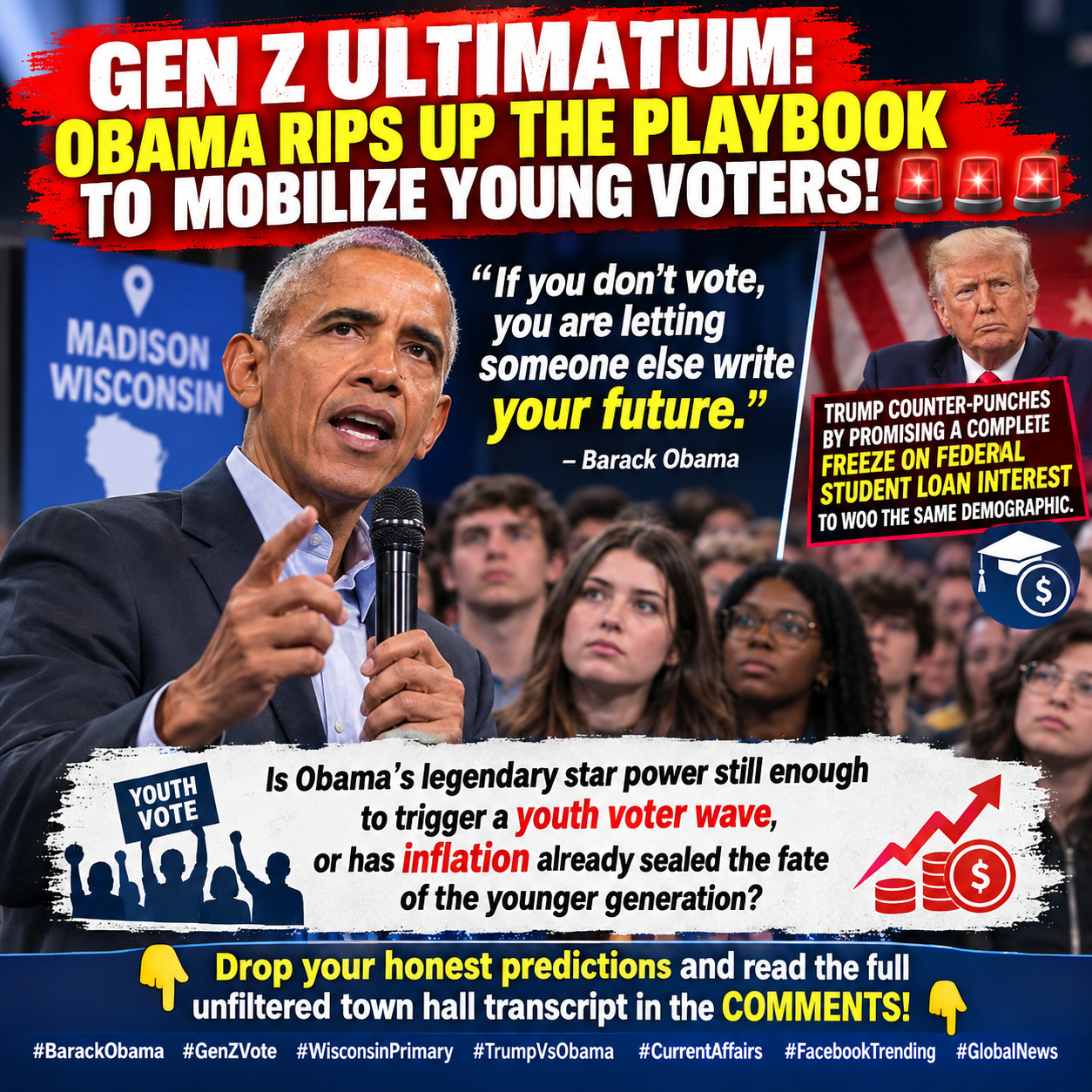
The battle for younger American voters is intensifying ahead of the November 3 midterm elections, as former President Barack Obama expands his campaign appearances and President Donald Trump's administration promotes changes to federal student loan repayment costs.
Across university campuses and communities in politically competitive states, both parties are confronting a generation whose political priorities include housing affordability, student debt, employment opportunities, inflation and uncertainty about the country's economic future.
A widely circulated political graphic presents this competition as a dramatic confrontation in Madison, Wisconsin. It claims Obama delivered an emotional town hall warning that young Americans would surrender control of their future if they failed to vote, while Trump responded by promising to freeze all federal student loan interest.
The underlying issues are real, but two central claims in that account are not supported by the verified information available on October 24.
Obama's confirmed campaign schedule places him in Cleveland, Ohio, and Detroit, Michigan—not at a newly documented Madison town hall. Meanwhile, the Trump administration has announced a temporary student loan interest-rate reduction for qualifying borrowers, not a complete freeze on all federal student loan interest.
The graphic also attributes a specific quotation to Obama: “If you don't vote, you are letting someone else write your future.” Although the sentiment resembles his longstanding emphasis on civic participation, no authenticated transcript or recording has been identified establishing that he delivered those exact words at the claimed Wisconsin event.
Those distinctions are important because the broader story does not depend on an invented confrontation. Young voters are a significant part of the 2026 electorate, and both parties have concrete reasons to compete for their attention.
Wisconsin offers an especially revealing example of how youth political engagement is changing.
A September 30 investigation by PBS Wisconsin examined the competition between Democratic and Republican organizations for Generation Z voters. The report described campus organizing efforts by College Democrats and Turning Point USA, including student-led discussions, candidate forums and attempts to engage people who do not normally participate in political campaigns.
The reporting challenged the assumption that younger Americans form a single, predictable voting bloc.
While young voters have supported Democrats in several recent national elections, Republican organizations have also built networks on college campuses, and Trump improved his standing among younger voters in the 2024 presidential election.

For political organizers, the challenge is not simply whether young Americans recognize a familiar political figure. It is whether they believe candidates understand their experiences and offer credible solutions to their problems.
Students and recent graduates may approach politics through very different circumstances. Some are financing college degrees, while others have entered the workforce without attending university. Some are concerned primarily with rent and wages, while others emphasize reproductive rights, immigration, climate change, healthcare or foreign policy.
That diversity makes broad assumptions about a supposed Generation Z voting wave unreliable.
It also helps explain why student loan policy has become a prominent campaign subject.
On June 18, the U.S. Department of Education announced that eligible federal student loan borrowers enrolled in automatic payments would receive a temporary one-percentage-point interest-rate reduction beginning July 1.
The department subsequently extended the enrollment deadline to December 31, 2026. Qualifying borrowers can receive the reduction through June 30, 2028, provided they continue meeting the program's requirements.
By September 29, the department said nearly two million borrowers had enrolled in automatic payments following the announcement.

The actual policy differs significantly from the complete interest freeze described in the viral graphic.
A full freeze would generally mean that interest stopped accumulating on covered loans during a specified period. The announced policy instead lowers the applicable interest rate for eligible borrowers who use automatic payments.
For example, a qualifying loan with a 6% annual interest rate could receive a reduction to 5%. Interest would continue accumulating, although at a lower rate.
The policy also has eligibility limits. Federal Student Aid states that the additional reduction applies to qualifying Direct Loans disbursed on or after July 1, 2012. Certain older federal loan programs are excluded.
Borrowers who do not enroll in automatic payments or fail to meet the conditions cannot assume they will receive the benefit.
The administration has characterized the measure as an effort to simplify repayment and reduce borrowing costs. Its broader student loan changes include the Repayment Assistance Plan and a tiered standard repayment structure.
Supporters of the approach argue that more predictable repayment arrangements and reduced interest expenses can help borrowers manage debt. Critics of repayment reforms have raised questions about eligibility, protections for financially distressed borrowers and how changes affect people with different loan balances and incomes.
Those are substantive policy questions. They cannot be answered by describing a limited interest-rate discount as universal debt relief.
The financial pressures facing young adults also extend far beyond education loans.
In a September 22 interview published by Tufts University, Leela Strong, director of the Center for Information & Research on Civic Learning and Engagement, described young Americans as confronting difficult employment conditions alongside elevated housing, healthcare and everyday living expenses.
The research found that affordability concerns cut across political identities. Other issues, including abortion, immigration, gun policy and climate change, varied in importance among different groups of young people.

That combination of economic anxiety and political diversity makes the 2026 youth electorate particularly important to understand.
CIRCLE estimates that nearly 50 million Americans ages 18 to 29 are eligible to vote in the midterms, including more than eight million who became newly eligible after the 2024 presidential election.
The organization's research also indicates that youth participation has varied substantially across recent elections.
Estimated U.S. voter turnout among ages 18–29
Source: CIRCLE, Tufts University. Historical national estimates, not a forecast for 2026.
The historical pattern illustrates two important points.
First, young voters have demonstrated substantial political participation, particularly in recent presidential elections. Second, their turnout is not constant. The proportion participating in midterms has generally been lower than in presidential contests.
CIRCLE's analysis found that approximately 23% of eligible young Americans voted in the 2022 midterms, compared with an estimated 47% in the 2024 presidential election.
Those figures do not determine what will happen in November 2026. They provide historical context for understanding why both parties are paying attention to the youngest eligible voters.
Registration data offers another indication of the electorate's changing composition.
An analysis of voter files from 42 states found that the number of registered young voters as of July 1, 2026, was approximately 1% higher than at the comparable point in 2022.
The national increase was modest, but the analysis identified differences among demographic groups. Registration increased among young Asian American and Pacific Islander voters and Latino voters, while the number of registered young Black voters declined in the states covered by the study.
Those findings concern registration, not actual ballots cast, and the geographic coverage does not include every state.

Wisconsin's campus political organizations are responding to these conditions in different ways.
PBS Wisconsin reported that Democratic student organizers have been using campus events and candidate forums to encourage participation, while conservative student groups have emphasized conversations about political values and policy disagreements.
The report included perspectives from young organizers on both sides of the political divide, reflecting an electorate whose views cannot be reduced to a single party identity.
This environment helps explain why a graphic showing Obama addressing a packed university town hall may seem plausible. The former president has a long history of discussing civic participation and appealing to younger audiences.
However, plausibility is not verification.
Obama's confirmed October 24 itinerary begins in Cleveland, where he is campaigning with former Senator Sherrod Brown and Democratic gubernatorial nominee Amy Acton.
He is then scheduled to travel to Detroit to support Senate nominee Abdul El-Sayed and gubernatorial nominee Jocelyn Benson.
The Associated Press reported that Obama also plans to campaign in Georgia the following week.

Those appearances are part of a wider effort to support Democratic candidates in competitive states. The former president's involvement includes public appearances, fundraising and recorded endorsements.
In Cleveland, the campaign event is focused on Ohio's Senate and gubernatorial contests. Brown is challenging Republican Senator Jon Husted, while Acton faces Republican Vivek Ramaswamy.
In Detroit, El-Sayed is running against Republican Mike Rogers for an open Senate seat, while Benson faces Republican John James in the governor's race.
The campaigns have emphasized different policy priorities, but both states are important to the national struggle over congressional representation and state government.
Obama's participation does not establish how young voters will respond to the Democratic candidates. Nor does the Trump administration's student loan policy demonstrate that younger voters will support Republican candidates.
Public reaction to individual proposals can differ from voting behavior, which may reflect many issues simultaneously.
There is also a difference between a young voter supporting a particular policy and supporting the political party responsible for introducing it.
A borrower might welcome an interest-rate reduction while disagreeing with the administration on other issues. Another voter might support the administration's broader economic program while opposing specific aspects of its student loan reforms.
That complexity is a defining feature of electoral politics and one reason why simplistic claims about an inevitable youth surge should be treated cautiously.
The same caution applies to assertions that inflation has already determined the political future of an entire generation.
Higher prices, borrowing costs and housing expenses can influence public attitudes, but they do not establish a uniform political response among younger Americans.
The final weeks of the 2026 midterm campaign will provide more evidence about how parties communicate their economic priorities and how voters evaluate those messages.

For now, the documented developments are clear.
Obama is actively campaigning for Democrats in Ohio and Michigan. Wisconsin's young voters are being engaged by organizations from across the political spectrum. The Trump administration has implemented a temporary interest-rate reduction for qualifying student loan borrowers.
The dramatic Madison town hall, the attributed Obama quotation and the supposed complete federal student loan interest freeze have not been established as described in the graphic.
The central question for the 2026 election is therefore broader than whether one former president can generate enthusiasm or one administration can attract support through a financial policy.
It is how young Americans evaluate competing ideas about the economy, education, employment, government and their future—and how those individual decisions translate into participation on November 3.
Comments (0)
Loading comments...
May You Like

WWE BRONSON REED—STAR COLLAPSES AT COMPANY EVENT, FATAL DRUG REACTION SUSPECTEDs!!

COASTAL DISASTER — 112 KM/H WINDS, SEAWATER FLOODING, 79,000 NEW JERSEY HOMES AT RISK!

EAST COAST STORM CRISIS—5 MILLION AT RISK OF BLACKOUTS, WATER, AND HEATING FAILURES!








Popular Posts




