
A “Creative Solution”? What Could Kushner and Witkoff Put on the Table for October Russia-Ukraine Talks?
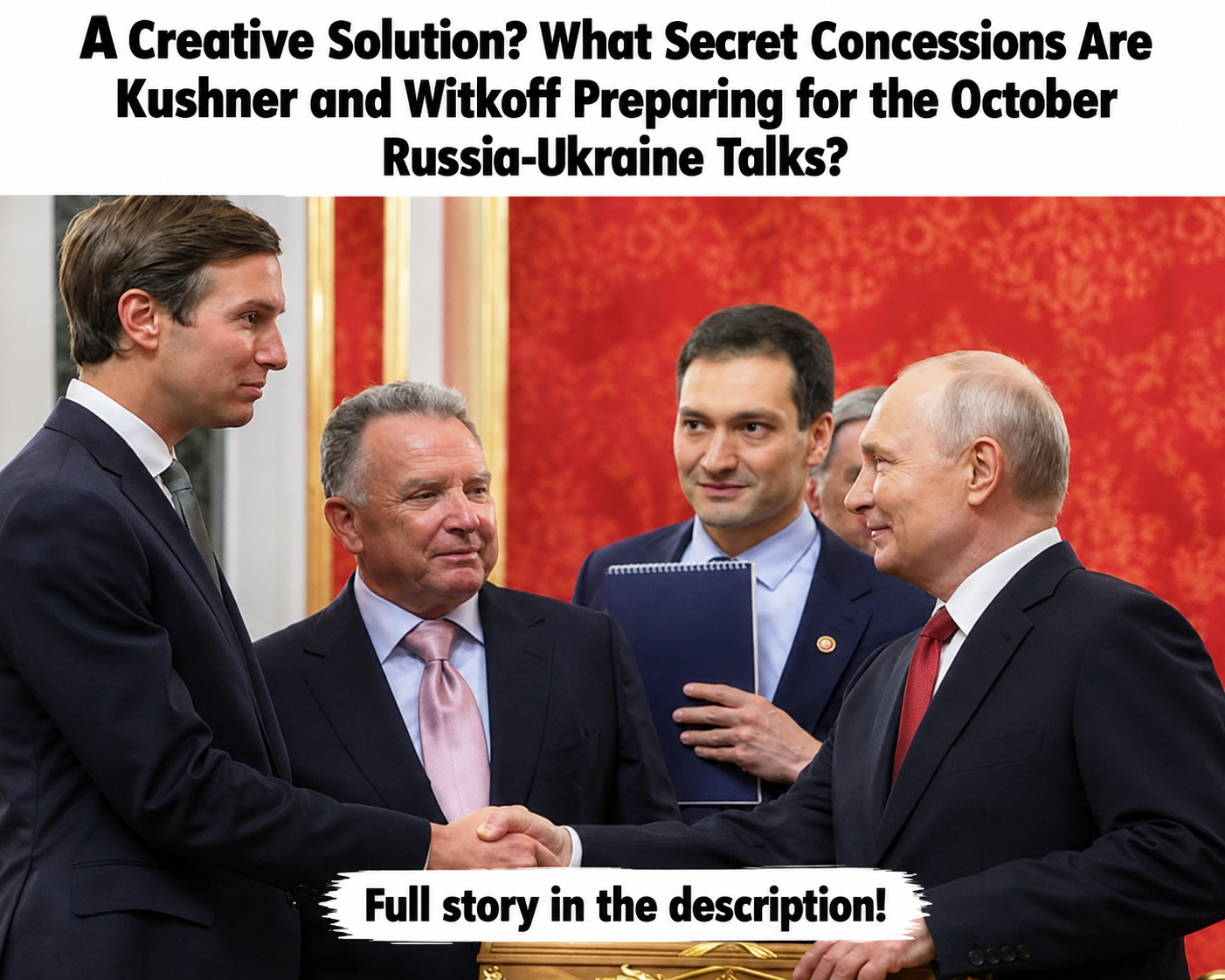
WASHINGTON — Sept. 18, 2026 — A new U.S.-led diplomatic push is putting the Russia-Ukraine war back at the center of Washington’s foreign-policy agenda, with President Donald Trump’s envoys Jared Kushner and Steve Witkoff working to revive three-way negotiations that could resume as early as October.
The image circulating online suggests that the two envoys may be preparing “secret concessions” for the next round of talks. That characterization, however, goes beyond what has been publicly confirmed.
What is known is significant: Kushner and Witkoff met Russian President Vladimir Putin in Moscow on Sept. 5, traveled to Kyiv the following day to meet Ukrainian President Volodymyr Zelenskyy, and said they had discussed ideas intended to narrow the differences between the two sides. Ukraine has since said it is preparing for another trilateral round in October.
The precise contents of Washington’s latest proposals remain undisclosed.


The October Talks Are Real — But the “Secret Concessions” Are Not Confirmed
The most important distinction surrounding the viral headline is between what officials have confirmed and what remains speculation.
Kyrylo Budanov, head of the Ukrainian presidential office, said on Sept. 12 that Kyiv was preparing for the resumption of trilateral talks in October involving Ukraine, Russia and the United States. Reuters reported that Turkey, the United Arab Emirates and Switzerland were among the possible locations mentioned by Zelenskyy, although no final venue had been announced.
The U.K. House of Commons Library likewise reported that another trilateral round was expected in October, but said the date and the level of representation had not yet been finalized.
That means the basic premise of the image — that another round of negotiations could take place in October — has public support.
The claim that Kushner and Witkoff are secretly preparing specific concessions is different.
No publicly released U.S. document confirms a final list of concessions for the October meeting.
What Did Kushner and Witkoff Actually Discuss With Putin?
On Sept. 5, Kushner and Witkoff spent roughly three hours with Putin in Moscow.
The White House described the discussions as involving “substantive plans for next steps” toward ending the war. The official White House record identifies the meeting as part of the administration's effort to continue dialogue aimed at ending the Russia-Ukraine conflict.
The Kremlin also described the discussions as serious and said the American representatives had brought ideas.
The following day, the two U.S. envoys traveled to Kyiv and met Zelenskyy.
Witkoff said the Americans had heard new ideas in Moscow and were trying to communicate the positions of both sides. Reuters reported that the envoys hoped to help narrow the remaining disagreements and revive trilateral negotiations.
But there was no announced peace agreement.
There was also no announcement that Ukraine had accepted Russia's territorial demands.
And there was no public confirmation that Washington had secured Russian agreement to a comprehensive ceasefire.
Zelenskyy Says the U.S. Brought “Decent” Ideas
After the meetings, Zelenskyy offered a cautiously positive description of the American proposals.
He said Kushner and Witkoff had presented several “decent, worthwhile ideas” for ending the war.
But Zelenskyy did not publicly disclose the details.
Reuters reported that he said the Ukrainian side had agreed with the U.S. envoys to continue working on the ideas, while emphasizing that major disagreements remained.
That leaves an important question for October:
What exactly did Washington hear in Moscow, and what did it take from Moscow to Kyiv?
So far, the public record does not provide a complete answer.
The Biggest Obstacle Is Still Territory
Despite renewed diplomacy, the fundamental disagreement between Moscow and Kyiv has not disappeared.
The most difficult issue remains territorial control in eastern Ukraine, particularly the Donbas.
Russia has demanded Ukrainian withdrawal from territory in Donetsk that Moscow claims but does not fully control.
Ukraine has resisted that demand.
Reuters reported that this remains one of the central unresolved questions standing between the two sides.
Kushner himself provided an unusually direct description of the problem during a Sept. 12 appearance at the Yalta European Strategy conference in Kyiv.
He said Putin had laid out what Russia wants and that if Ukraine withdrew to that line, “the rest of the deal” could potentially be put together. Ukraine, he said, does not currently agree to that withdrawal.
That statement does not establish that Washington has accepted Russia's territorial position.
It does, however, show how closely the territorial question remains tied to the broader negotiating framework.


Could Territory Be Part of a “Creative Solution”?
This is where the phrase “creative solution” becomes relevant.
Diplomatic settlements do not necessarily require one side to formally recognize every territorial claim immediately.
Possible negotiating concepts can include:
- Freezing fighting along an existing line of contact
- Temporary territorial arrangements
- Demilitarized zones
- Security guarantees
- Ceasefires linked to specific conditions
- Future negotiations over sovereignty
- International monitoring mechanisms
- Economic arrangements tied to a ceasefire
But none of these should be presented as an agreed October proposal unless negotiators formally disclose them.
The House of Commons Library noted that without movement on the two core issues — territory and future security guarantees — additional official-level negotiations could struggle to produce a breakthrough.
The Ghost of the 2025 28-Point Plan
There is another reason the phrase “concessions” is attracting attention.
Kushner and Witkoff were previously associated with the Trump administration's controversial 28-point Ukraine peace proposal released in late 2025.
A draft obtained and published by Reuters included major provisions concerning territory, NATO membership, military limitations, sanctions and Russia's reintegration into the global economy.
Among the most consequential provisions were proposals that would:
- Permanently bar Ukraine from joining NATO;
- Cap the Ukrainian armed forces at 600,000 personnel;
- Require Ukrainian withdrawal from part of Donetsk;
- Treat Crimea, Luhansk and Donetsk as de facto Russian territory under the proposal;
- Freeze the front line in parts of Kherson and Zaporizhzhia;
- Gradually lift sanctions against Russia;
- Provide a pathway for Russia to return to the G8;
- Establish U.S.-backed security guarantees for Ukraine.
The proposal generated intense controversy and was subsequently revised during negotiations.
Reuters reported at the time that Ukraine and European governments objected to several provisions they viewed as major concessions to Moscow.
But the 2025 draft should not be confused with a confirmed 2026 October agreement.
There is no public evidence showing that the same 28-point framework will simply be presented again.
The Negotiating Landscape Has Changed Since 2025
The strategic environment is also different.
The Trump administration has now spent months attempting to restart negotiations, while Russia and Ukraine continue fighting.
In September, Washington proposed a possible moratorium on attacks against energy infrastructure.
Trump said Russia and Ukraine had agreed to stop such attacks, but neither side initially confirmed a formal agreement. Ukraine said it would support an energy ceasefire if Washington could establish that Russia was genuinely prepared to honor it.
Russia welcomed the idea but added its own demands, including calls for safer commercial shipping and the removal of sanctions on Russian energy.
That illustrates the broader problem facing negotiators:
Even limited ceasefire arrangements quickly become linked to larger political and economic demands.
What Could Ukraine Seek From Washington?
Kyiv has repeatedly emphasized that any settlement must include meaningful security arrangements.
During the Sept. 6 meeting with Kushner and Witkoff, Zelenskyy discussed security and economic guarantees as well as military assistance, particularly air-defense support ahead of winter.
For Ukraine, the issue is not simply stopping the current fighting.
A central question is what prevents another major Russian offensive after a ceasefire.
Possible areas of discussion include:
Security guarantees
Ukraine has sought commitments from Western countries that would provide protection against another Russian attack.
Air defense
Kyiv has requested additional systems, including Patriot batteries, as Russia continues missile and drone attacks.
Economic reconstruction
Washington and European governments could potentially link a settlement to reconstruction financing and investment.
Energy security
Protection of Ukraine's power infrastructure has become particularly important ahead of winter.
Prisoner exchanges
Zelenskyy has also identified prisoner exchanges and humanitarian issues as areas where negotiations could produce concrete results.
What Could Russia Seek?
Russia's publicly stated demands continue to include territorial and security issues.
The Kremlin has also raised sanctions relief and economic normalization.
When discussing Trump's proposed energy truce on Sept. 15, Kremlin spokesman Dmitry Peskov said Russia wanted broader measures, including the removal of sanctions affecting Russian energy supplies.
Russia has also opposed Ukraine's potential NATO membership and has consistently demanded changes to the European security environment.
These positions mean that any comprehensive agreement would probably have to address much more than the battlefield.
A New U.S. Sanctions Law Could Complicate the Diplomacy
The diplomatic effort is taking place at the same time that Washington is moving toward stronger economic pressure on Russia.
The U.S. House has passed a sanctions package targeting Russia's energy and defense sectors and allowing President Trump to impose tariffs of up to 100% on countries purchasing substantial quantities of Russian energy.
The Kremlin has warned that the legislation could make peace negotiations more difficult.
That creates a complicated negotiating environment.
Washington is simultaneously trying to:
increase pressure on Moscow
while also
keep Moscow engaged in negotiations.
How those two approaches interact could become important before the October talks.
Europe Is Watching the Process Closely
European governments have also become increasingly involved.
When Kushner and Witkoff met Zelenskyy in Kyiv, security advisers from Britain, Germany and France participated in discussions, according to reporting on the meeting.
Ukraine has also sought European involvement in future security arrangements.
That matters because a long-term settlement would likely have consequences for European defense, sanctions policy, reconstruction and NATO security.
European governments have generally supported continued assistance to Ukraine while maintaining pressure on Russia, although individual governments differ over how a potential settlement should be structured.
Why October Matters
The proposed October talks would represent the revival of a negotiating format that stalled earlier in 2026.
Previous U.S.-Russia-Ukraine meetings were held in Abu Dhabi and Geneva, but the process later lost momentum as the United States became heavily focused on the war involving Iran.
The House of Commons Library said the next trilateral meeting was expected in October, although the exact date and location remained unsettled.
That means the October meeting, if it occurs, would be less about unveiling a guaranteed final peace treaty and more about determining whether the parties can narrow their positions enough to continue negotiations.
What the Viral Image Gets Right — and What It Leaves Out
The image headline asks:
“What secret concessions are Kushner and Witkoff preparing?”
That wording is designed to create suspense, but the available evidence supports a more measured conclusion.
What is confirmed:
- Kushner and Witkoff met Putin in Moscow on Sept. 5.
- They then traveled to Kyiv and met Zelenskyy.
- They discussed proposals intended to advance negotiations.
- Zelenskyy said some of the ideas were worthwhile.
- Ukraine says it is preparing for another trilateral round in October.
- Russia has not ruled out renewed negotiations.
- Territory remains one of the central disputes.
- Security guarantees remain a major Ukrainian concern.
- Russia continues to seek changes involving territory and sanctions.
What is not confirmed:
- A secret finalized list of concessions.
- A U.S. agreement to transfer Ukrainian territory to Russia.
- Ukrainian acceptance of Russia's territorial demands.
- A finalized October peace treaty.
- A completed ceasefire agreement covering the entire war.
- A deal that would permanently settle Ukraine's territorial status.
The distinction matters because negotiations often involve proposals, trial balloons and conditional ideas that can change substantially before they become agreements.
The Central Question: What Would Each Side Have to Give?
The coming negotiations are likely to revolve around a basic diplomatic equation.
Russia wants territorial and security concessions.
Ukraine wants security guarantees and an end to the fighting without surrendering its negotiating position on sovereignty.
The United States wants the two sides back at the negotiating table and appears to be looking for a framework capable of bridging those positions.
That does not mean a deal is close.
It means the diplomatic process has been reopened.
And reopening negotiations is very different from reaching a settlement.


What Happens Next?
Several developments could determine whether the October process gains momentum.
1. A venue must be finalized
Turkey, the UAE and Switzerland have been mentioned as possible hosts, but no final location has been publicly confirmed.
2. Washington must clarify its framework
The U.S. has indicated that ideas were exchanged but has not publicly released a complete new settlement proposal.
3. Moscow and Kyiv must narrow the territorial dispute
This remains arguably the most difficult issue.
4. Security guarantees must be addressed
Ukraine wants assurances that a ceasefire would not simply create conditions for another war.
5. The parties must determine whether smaller agreements can build toward a larger settlement
Energy infrastructure, prisoner exchanges, shipping and humanitarian arrangements could provide areas for incremental progress.
The Bigger Picture
The image of Kushner, Witkoff and Putin captures a genuine diplomatic development: Washington is again trying to put Russia and Ukraine on a negotiating track.
But the phrase “secret concessions” currently describes an unresolved question rather than an established fact.
The public record shows that U.S. negotiators carried proposals between Moscow and Kyiv in September, that both sides expressed some willingness to continue discussions, and that Ukraine is preparing for possible trilateral negotiations in October.
At the same time, the core disputes remain formidable.
Russia continues to press territorial and security demands. Ukraine continues to seek security guarantees and reject a settlement that would simply accept Moscow's claims. Washington is attempting to bridge those positions while simultaneously increasing economic pressure on Russia.
The next round could therefore reveal whether the ideas exchanged behind closed doors can produce something more concrete.
For now, the most important unanswered question is not whether Kushner and Witkoff have a secret deal. It is whether they have found a formula that Moscow and Kyiv are both willing to discuss.
Comments (0)
Loading comments...
May You Like


Shocking news from Ohio: an unexpected development ahead of Trump's rally
TRUMP HIT WITH 26 ARTICLES OF IMPEACHMENT













