
Oil Surges Past $100 as US-Iran Attacks Escalate — Can Obama Intervene?
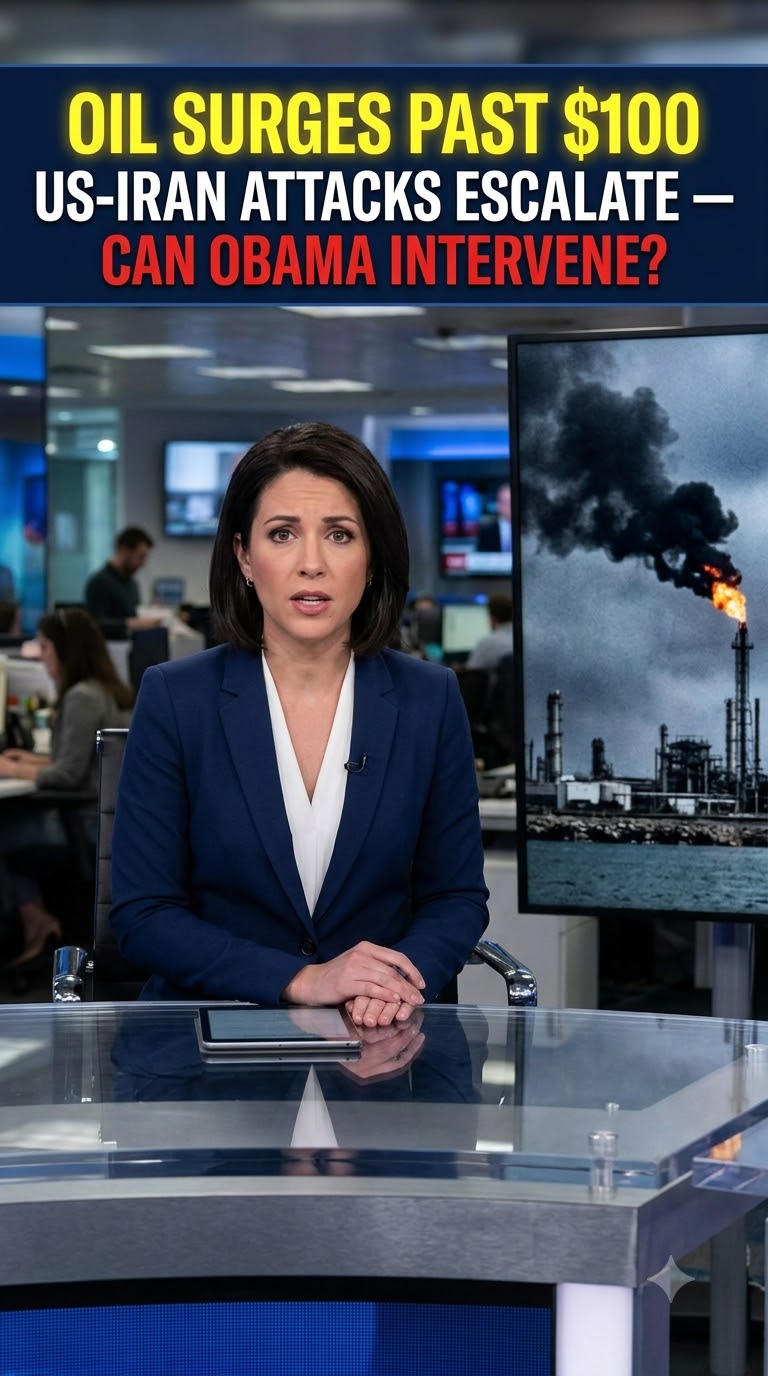
Brent crude shot past $100 a barrel on Wednesday as the United States and Iran exchanged their most intense wave of attacks since the war began six months ago, with the Pentagon destroying five Iranian oil tankers and Tehran striking a U.S. base in Jordan. As gas prices hit a record $4.14 per gallon and diesel soars to $5.85, former President Barack Obama's recent warning that "we can't just bully or bomb our way to solutions" has taken on new urgency — but with no formal role in government, the 44th president's ability to influence events remains limited to the power of his words.
WASHINGTON – Oil prices surged past $100 a barrel for the first time since July as tit-for-tat strikes between U.S. and Iranian forces intensified, threatening to choke off what remains of crude flows through the Strait of Hormuz . The international Brent benchmark climbed to $100.23 a barrel on Wednesday morning, while U.S. West Texas Intermediate hovered around $95 .
The escalation began Tuesday when U.S. Central Command announced it had destroyed five Iranian oil tankers carrying crude, including vessels in the Gulf of Oman and near Kharg Island, Iran's key oil export hub . The strikes were ordered after Iran's Islamic Revolutionary Guard Corps fired ballistic missiles at a U.S. Navy warship twice within two days .
Iran responded swiftly. The IRGC launched ballistic missiles at a U.S. military base near Al Azraq in eastern Jordan, where air defenses intercepted most of them . Tehran also warned tankers near ports in Bahrain and Kuwait to leave their vessels immediately, threatening further retaliation .
The Hormuz Chokepoint: A Market in Crisis
The fighting has effectively shut down the Strait of Hormuz, a waterway that carried roughly one-fifth of the world's oil before the war began on Feb. 28 . According to S&P Global Commodities at Sea, sour crude exports from the Middle East Gulf averaged just 5.88 million barrels per day in the second quarter, down 65% from a year earlier .
"Fifteen ships transited the Strait of Hormuz on Sept. 8, down from a revised 24 ships on Sept. 7," S&P Global reported . Most of the traffic was Iran-linked, with four vessels flagged under the country .
The supply crunch is now being felt at American gas stations. According to AAA, the average price of regular gas reached a record $4.14 per gallon for Labor Day weekend, nearly a dollar higher than last year . Diesel hit an all-time high of $5.85 per gallon, a cost that is being passed directly to consumers through higher prices for groceries and package deliveries .
Obama's Warning: 'We Can't Bully or Bomb Our Way to Solutions'
The price surge has put a spotlight on former President Barack Obama's recent remarks about the conflict. In an exclusive interview with ABC News conducted at the Obama Presidential Center in Chicago, the former president expressed deep skepticism about the Trump administration's handling of Iran .
"It is doubtful that any agreement that arises is going to be significantly different or a significant improvement from the deal that we had in the first place and had worked for, for a long stretch of time before we, the United States, pulled out of it," Obama told ABC's Robin Roberts .
Obama also delivered a broader critique of the administration's approach: "The notion that we can just bully our way or bomb our way to solutions may sometimes seem appealing, but the fact of the matter is that taking the time to explore diplomacy and exhaust the possibilities of coming up with deals that don't solve 100% of the problem but solve 80%, 90% of the problem while avoiding the necessity of going to war" .
"You'd think we would've learned that lesson by now. But it seems like every so often we have to relearn that lesson again," Obama said .
Can Obama Intervene?
The short answer is no. As a former president, Obama holds no formal position in government and has no authority to negotiate with Iran or influence U.S. military operations. His role in the current crisis is limited to that of a statesman and commentator — a voice reminding Americans of the diplomatic path he once pursued.
Still, his words carry weight. In a June interview with NBC's "Today" show, Obama welcomed the ceasefire that briefly halted the fighting, saying he was "very happy" to see a halt in hostilities . But he questioned whether the war ultimately achieved enough to justify its costs.
"We've now fought a war, spent billions and billions of dollars, put enormous strain on our military," Obama told NBC . He added that it appears the United States is now "back where we were before we started the war, except maybe a little bit worse off" .
'We Are Back Where We Started'
The contrast between Obama's diplomatic vision and the current reality is stark. Before the war, Iran's nuclear program had been constrained by the 2015 Joint Comprehensive Plan of Action — the deal Trump withdrew from in 2018 . Now, after six months of conflict and hundreds of billions in military spending, the two nations appear to be negotiating a framework that observers say closely resembles the original JCPOA .
As Washington Post columnist David Ignatius observed this week, the emerging contours of a deal "look very similar to the JCPOA, which Trump scrapped. Some of the provisions may even be somewhat weaker" .
For American consumers, that diplomatic déjà vu offers little comfort at the pump. With gas prices at record highs and winter heating costs looming, the war in Iran is no longer an abstract foreign policy debate — it's a line item on their monthly budgets.
| Key Detail | Information |
|---|---|
| Brent Crude Price | $100+/barrel (highest since July) |
| U.S. Gas Price | $4.14/gallon (record for Labor Day) |
| Diesel Price | $5.85/gallon (all-time high) |
| Hormuz Traffic | 15 ships/day (down from 24) |
| Q2 Middle East Sour Exports | 5.88M b/d, down 65% year-over-year |
| U.S. Action | Destroyed 5 Iranian oil tankers |
| Iran's Response | Missile strikes on U.S. base in Jordan; threats to tankers in Kuwaiti/Bahraini waters |
| Obama's Message | "We can't just bully or bomb our way to solutions" |
| Obama's Role | Former president; no formal authority |
For now, Obama's ability to shape events is limited to the power of his words. But as oil prices continue to climb and American families feel the strain, his critique of a policy built on "bullying and bombing" has found a receptive audience — one that remembers a time when the price of gas was just a little bit lower.
Comments (0)
Loading comments...
May You Like

Obama Steps Back Into the Political Spotlight as Democrats Target Trump’s
Jack Smith Defends His Integrity as Trump Investigations Face Renewed Political Firestorm














