
Orlando Kickboxing Event Erupts in Antisemitic Controversy After Fighter Gives Nazi Salutes
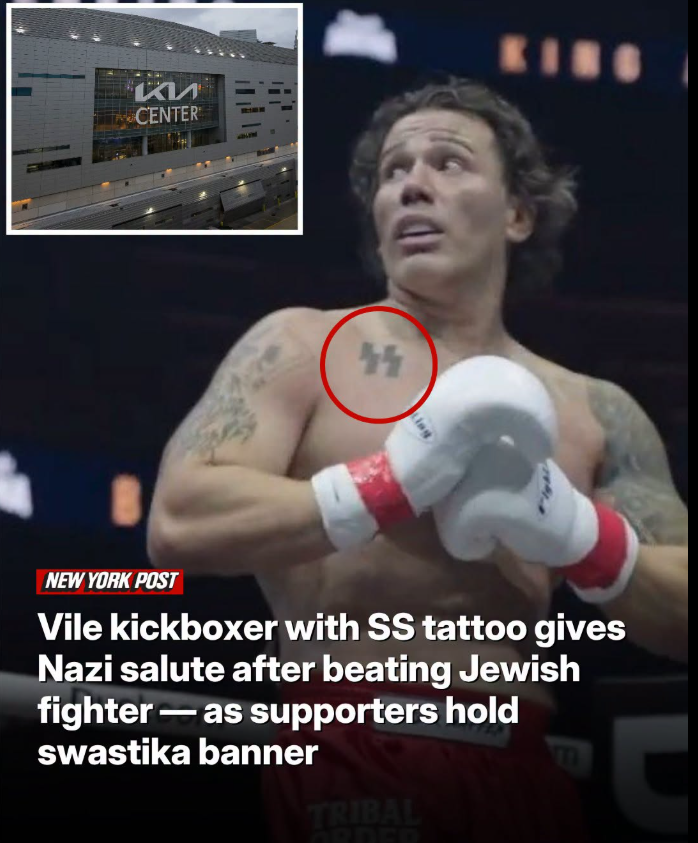
A kickboxing event at Orlando’s Kia Center has drawn widespread condemnation after fighter Paul Miller, known online as “GypsyCrusader,” appeared to give Nazi salutes following his split-decision victory over Jewish fighter Ben “King” Azoulay.
The Aug. 29 event, promoted by Duel Arena, also featured spectators displaying a swastika banner and making Nazi-style salutes. Video of the incident circulated widely online, prompting criticism of the event organizer and the city-owned venue.


Miller Defeated Azoulay by Split Decision
The controversy unfolded during Duel Arena 1, a combat-sports card combining MMA, boxing and kickboxing at the Kia Center.
Miller defeated Azoulay by split decision. Two judges scored the bout 30-27 for Miller, while the third scored it 29-28 for Azoulay. Duel Arena's published results confirm the decision.
The sporting result, however, was quickly overshadowed by what happened after the fight.
According to video reviewed by multiple outlets, Miller appeared to make Nazi salutes from the ring after the bout. Reports also say he used an antisemitic slur while addressing the crowd during his post-fight remarks.
Swastika Flag Appeared in the Crowd
The controversy began even before the fight ended.
Local television station WESH reported that Azoulay entered the arena carrying an Israeli flag. A Nazi flag was subsequently unfurled in the crowd, with some spectators appearing to respond with Nazi salutes. Several altercations reportedly broke out among spectators.
The Washington Post reported that a spectator displayed a large swastika flag and that venue staff eventually removed it. The newspaper also reported that the event's promoter, Duel Arena, did not respond to requests for comment.
The New York Post reported that Miller has an SS lightning-bolt tattoo and that some of his supporters wore other provocative imagery.
Who Is Paul Miller?
Miller, who uses the online name “GypsyCrusader,” has a documented history of extremist rhetoric.
The Anti-Defamation League previously described Miller as a “volatile white supremacist-accelerationist” and said it had shared information about him with law enforcement before his 2021 arrest.
In September 2021, the U.S. Department of Justice said Miller was sentenced to 41 months in federal prison after pleading guilty to firearms offenses, including possessing a firearm and ammunition as a convicted felon and possessing an unregistered short-barreled rifle. He was also ordered to serve three years of supervised release.
Federal prosecutors said Miller had previously been convicted of three felony offenses in New Jersey and had made statements supporting a race-based civil war.
His extremist history is therefore not based solely on the latest footage. It was documented by law enforcement and extremism researchers years before Saturday's event.
Orlando Condemns the Incident
Orlando Venues, which operates the city-owned Kia Center, issued a statement condemning the conduct.
The organization said the city “unequivocally condemn[s]” hate speech, antisemitism, racism and messages encouraging hatred or violence. It emphasized that the views expressed during the event did not represent Orlando or its staff.
The city also cited the First Amendment, saying that as operators of public venues, officials cannot deny access simply because they disagree with a political ideology or viewpoint.
At the same time, Orlando Venues said it was reviewing its event policies following the controversy.
The response has generated a broader debate over whether publicly operated venues should host events involving individuals with well-documented extremist histories.
Why the Venue's First Amendment Defense Is Controversial
The city's statement is important because the issue is more complicated than simply whether officials approve of Miller's views.
The Kia Center is a public venue operated through Orlando Venues. City officials say constitutional restrictions limit their ability to exclude an event based solely on the political ideology or viewpoint of participants.
But the controversy also raises separate questions about venue rules, security and conduct inside the facility. The Washington Post reported that officials had not explained how the swastika banner entered the arena or whether Miller's history had been considered during event planning.
That distinction matters: condemning extremist expression and determining what conduct a venue can legally regulate are not necessarily the same question.
The Bigger Issue: Extremism Meets Influencer Combat Sports
The Orlando incident also illustrates the increasingly blurred boundary between internet personalities, political extremism and combat-sports entertainment.
Duel Arena promoted its inaugural event as a mixture of MMA, boxing and kickboxing, with Miller and Azoulay positioned as one of the night's major attractions.
Miller's history made the matchup unusually controversial before the fighters even entered the ring. His participation brought an established online extremist persona into a mainstream sports arena, where supporters were able to gather physically around the event.
The result was a spectacle that extended well beyond the fight itself.
What the Viral New York Post Graphic Gets Right
The central claims in the graphic are substantially supported by independent reporting:
- Paul Miller fought Ben Azoulay at Orlando's Kia Center on Aug. 29.
- Miller won by split decision.
- Footage appears to show Miller making Nazi salutes after the fight.
- A swastika banner was displayed by someone in the crowd.
- The incident generated multiple confrontations among spectators.
- Miller has a documented history of white-supremacist and antisemitic activity.
The headline's language — particularly “vile kickboxer” — is editorial rather than a neutral factual description. For a standard news report, it is more appropriate to describe Miller's documented extremist background and the conduct captured on video than to reproduce the tabloid's characterization.
Bottom Line
What began as a kickboxing bout at a major Orlando arena has become a national controversy over antisemitism, extremist symbolism and the responsibilities of publicly operated venues.
Miller's Nazi gestures and the appearance of a swastika banner were widely condemned, while Orlando officials said they were legally constrained by the First Amendment and promised to review venue policies. The incident also brought renewed scrutiny to the decision to feature a fighter whose extremist history was already publicly documented.
The controversy is therefore not simply about what happened after one fight. It is also about how online extremism can move from digital platforms into mainstream entertainment spaces — and how venues respond when provocative political expression becomes a physical public spectacle.
Comments (0)
Loading comments...
May You Like

South Korea–Ukraine Rift Deepens Over North Korean POW Transfer as PURL Draws New Scrutiny

Shocking news from Ohio: an unexpected development ahead of Trump's rally

Obama Steps Back Into the Political Spotlight as Democrats Target Trump’s












