
Patty Murray Revives Debate Over Voter Fraud as She Challenges Claims of Widespread Election Abuse
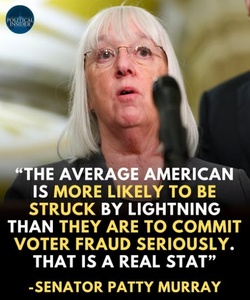
WASHINGTON — Sen. Patty Murray has renewed debate over voter fraud after arguing that such misconduct is extraordinarily rare, as Congress considers sweeping new federal requirements for voter identification and citizenship documentation.
Murray’s Claim
Murray, a Washington Democrat, made the remarks during a March 18, 2026, press conference opposing the Republican-backed SAVE America Act and its proposed election requirements.
During her statement, Murray said Americans were more likely to be struck by lightning than commit voter fraud, describing the comparison as evidence of how uncommon election-related misconduct is.
The quotation featured in the image is therefore based on a genuine statement by Murray, although its broader statistical interpretation requires additional context about different forms of election fraud.
What the Bill Would Change
The SAVE America Act would require people registering to vote in federal elections to provide documentary proof of U.S. citizenship while also establishing federal photo-identification requirements for casting ballots.
The Senate version discussed in March included documents such as passports, birth certificates or naturalization papers as examples of acceptable citizenship evidence.
The legislation also proposed changes affecting mail voting and would require states to provide voter-registration information to federal authorities for additional eligibility checks.
Republicans supporting the measure have argued that stronger verification procedures are necessary to protect election integrity and prevent noncitizens from participating in federal elections.
How Common Is Voter Fraud?
Available research indicates that voter fraud is uncommon, although isolated cases do occur and can lead to criminal investigations or prosecutions.
The Brennan Center has described mail-ballot fraud as extremely rare and noted that election systems contain multiple safeguards designed to detect and prevent ineligible ballots from being counted.
Recent federal investigations provide another perspective. The Associated Press reported that an administration initiative focused on noncitizen voting had produced approximately 1,600 investigations and 160 arrests.
Those figures remain far below earlier claims suggesting that hundreds of thousands of noncitizens were voting illegally, according to the Associated Press report.
The Lightning Comparison
Murray's lightning comparison appears to have been intended as a rhetorical illustration rather than a precise calculation comparing two identical categories of risk.
Research cited by the Brennan Center similarly uses lightning as a comparison when discussing the rarity of mail-ballot fraud, although the organization does not establish Murray's exact wording as a universal statistical measurement.
The distinction matters because “voter fraud” can encompass different offenses, including illegal voting, registration misconduct, ballot-related offenses and other election violations.
Consequently, the available evidence supports the broader conclusion that widespread voter fraud is not common, while individual violations remain possible and are already prohibited by law.
Recent Investigations
The debate has gained new attention as federal officials investigate potential noncitizen registrations and voting, including cases involving administrative mistakes rather than intentional criminal conduct.
Reuters reported that more than 30,000 self-declared noncitizens had been mistakenly added to voter rolls since 2000 across at least twelve states.
The Reuters investigation found that software problems and clerical errors associated with motor-vehicle registration systems contributed to many of those cases.
Those findings illustrate why the number of people appearing incorrectly on voter rolls cannot automatically be treated as evidence that those individuals actually cast illegal ballots.
A Divided Political Debate
Supporters of stronger identification requirements argue that election systems should establish clear safeguards against unlawful voting, particularly when registration databases contain inaccurate or outdated information.
Opponents argue that additional documentation requirements could create obstacles for eligible citizens who lack specific documents or encounter difficulties matching information across government records.
FactCheck.org reported that the SAVE America Act would introduce significant changes to registration and identification procedures, while experts have debated the legislation's potential effects.
The Washington Post similarly reported that the proposed legislation could require some currently registered voters to provide additional documentation under certain circumstances.
The Larger Election Question
The dispute ultimately concerns how governments should balance election-security measures with practical access for eligible voters.
Murray's comments emphasize the rarity of voter fraud, while Republican supporters of the legislation have focused on verification procedures and preventing potentially ineligible voters from participating.
The competing arguments reflect a broader national disagreement over whether existing election safeguards are sufficient or whether federal standards should impose additional requirements on states.
Meanwhile, recent court cases and investigations continue to shape the debate, particularly around federal authority, voter-roll databases and the potential consequences of incorrectly identifying eligible voters.
What Happens Next?
The controversy surrounding voter fraud is likely to remain prominent ahead of the 2026 midterm elections as Congress and state officials debate identification, citizenship verification and voter-registration procedures.
A federal judge ruled this week that the Trump administration could not condition counterterrorism grants on states adopting certain election changes, adding another legal dispute to the broader election-policy debate.
Meanwhile, the Supreme Court has temporarily allowed the administration to use an expanded federal voter-eligibility database while litigation continues over its accuracy, privacy implications and potential effects on eligible voters.
Murray's lightning comparison captures one side of that debate, but the available evidence points to a more nuanced picture: election fraud exists, yet investigations have not demonstrated widespread illegal voting on the scale sometimes alleged.
Comments (0)
Loading comments...
May You Like

Shocking news from Ohio: an unexpected development ahead of Trump's rally

TRUMP’S OHIO WARNING UNDER THE SPOTLIGHT
Jack Smith Defends His Integrity as Trump Investigations Face Renewed Political Firestorm













