Pentagon Removes Decades of Classified Records After Generals Warned Iran War Could Strain U.S. Military
The Pentagon has removed decades of classified documents from an internal military computer system shortly after The Washington Post reported that senior U.S. military commanders had formally warned Defense Secretary Pete Hegseth that prolonging large-scale operations against Iran could seriously strain American forces.
The documents were associated with the Secretary of Defense Orders Book (SDOB) and were removed from an internal portal on SIPRNet, the Defense Department's classified network used by military personnel. Three people familiar with the change told the Post that the records had been pulled. Pentagon spokesman Sean Parnell did not dispute that the removal occurred, although he declined to discuss the details.
The development immediately raised a different question from the original dispute over the Iran war: Why did the Pentagon restrict access to historical operational documents immediately after their contents became the subject of public reporting?
What Was Removed?
The material reportedly consisted of documents associated with the Secretary of Defense Orders Book, a classified system used to route and record important defense decisions.
The SDOB covers matters including:
- deployment orders,
- force allocation,
- military units and resources,
- weapons systems,
- warning and execution orders,
- and other operational decisions.
The Joint Chiefs of Staff describes the SDOB as a briefing used to route draft orders through senior Pentagon officials to the secretary of defense.
According to the Post, the material removed from SIPRNet represented decades of classified documents.
It is not clear from the available reporting whether those documents were destroyed, moved to another classified network, or simply removed from the particular portal where military personnel had previously been able to access them. The Post specifically reported that it was not immediately clear whether the documents remained available elsewhere.
That distinction is critical.
Calling the episode a “purge” can suggest that the records were destroyed. The evidence currently establishes that access to the documents was removed from an internal system, not that the underlying records were necessarily destroyed.
The Timing Is What Makes the Story Explosive
The Pentagon's move came immediately after a major Washington Post investigation into disagreements inside the military over the continuing war with Iran.
The Post reported on August 30 that several senior commanders had warned Hegseth that maintaining large-scale operations against Iran was becoming unsustainable and could weaken America's ability to respond to threats elsewhere.
The concerns were recorded in the August 14 SDOB.
Among the senior commanders reported to have issued formal “non-concurs” were:
- Gen. Alexus Grynkewich, U.S. European Command
- Gen. Francis Donovan, U.S. Southern Command
- Adm. Samuel Paparo, U.S. Pacific Command
- Adm. Daryl Caudle, Chief of Naval Operations
Meanwhile, the Air Force and Army chiefs reportedly agreed to extensions of some deployments but warned that doing so carried significant risks.
What Does “Non-Concur” Mean?
The phrase sounds more dramatic than it actually is.
A non-concur is essentially a formal way for a senior military leader to record disagreement or reservations about an order while still carrying out the civilian leadership's decision.
It provides commanders with a mechanism to explain how an order could affect other missions, resources or readiness.
The Post reported that commanders use the SDOB to identify such risks and that the process itself is not unusual. Pentagon spokesman Sean Parnell emphasized precisely this point after the story appeared, saying that non-concurs are a standard part of military decision-making.
What made this episode unusual was the breadth and seriousness of the reported objections.
Generals Warned That Iran Was Draining Military Resources
The commanders' concerns reportedly went well beyond simply disagreeing with a particular deployment.
The Post reported concerns that continued operations were consuming scarce military resources and reducing America's ability to respond to other threats.
Among the resources under strain were reportedly:
- Patriot missile interceptors
- Tomahawk cruise missiles
- aircraft carriers
- surveillance aircraft
- drones
- naval vessels and other military equipment
Commanders in Europe and Latin America reportedly warned that transferring assets to the Middle East was impairing their ability to fulfill other missions, including responsibilities related to homeland defense.
Adm. Paparo, the Pacific commander, reportedly objected to the continuing requirement to provide forces including an aircraft carrier strike group and destroyers.
That concern is particularly significant because the Pacific Command's primary mission involves preparing for potential threats in the Indo-Pacific, including China.
The Pentagon Says the Reporting Was Inaccurate
The Pentagon has pushed back against the Post's reporting.
Parnell said the department does not publicly discuss internal operational processes, including specific concurrences, non-concurrences or risk assessments.
After the Post published its original investigation, he also characterized portions of the reporting as inaccurate while emphasizing that non-concurs are normal.
The Pentagon has maintained that decisions regarding military deployments are made after considering threats to the United States, the president's strategic priorities and advice from senior military leaders.
But notably, when the Post reported that documents had subsequently been removed from SIPRNet, the Pentagon did not dispute that the access change occurred.
Why Restricting Access Matters
The issue isn't simply whether someone can read an old classified document.
The SDOB can contain information about the location and availability of military forces, ships, weapons and other resources. Military planners use that information to understand what assets are available and where they can be deployed.
One former defense official who routinely reviewed the material told the Post that moving the documents to a more restricted system could dramatically reduce the number of people with direct access.
That could matter during an active conflict.
For example, moving aircraft or weapons from one combatant command to another requires coordination between multiple organizations. If planners have to navigate additional restrictions to obtain the information needed to make those decisions, the process can become slower.
The former official stressed that the change would not make the information impossible to obtain, but would make access more difficult.
Is This Really a “Purge”?
This is where the viral headline goes beyond what has been established.
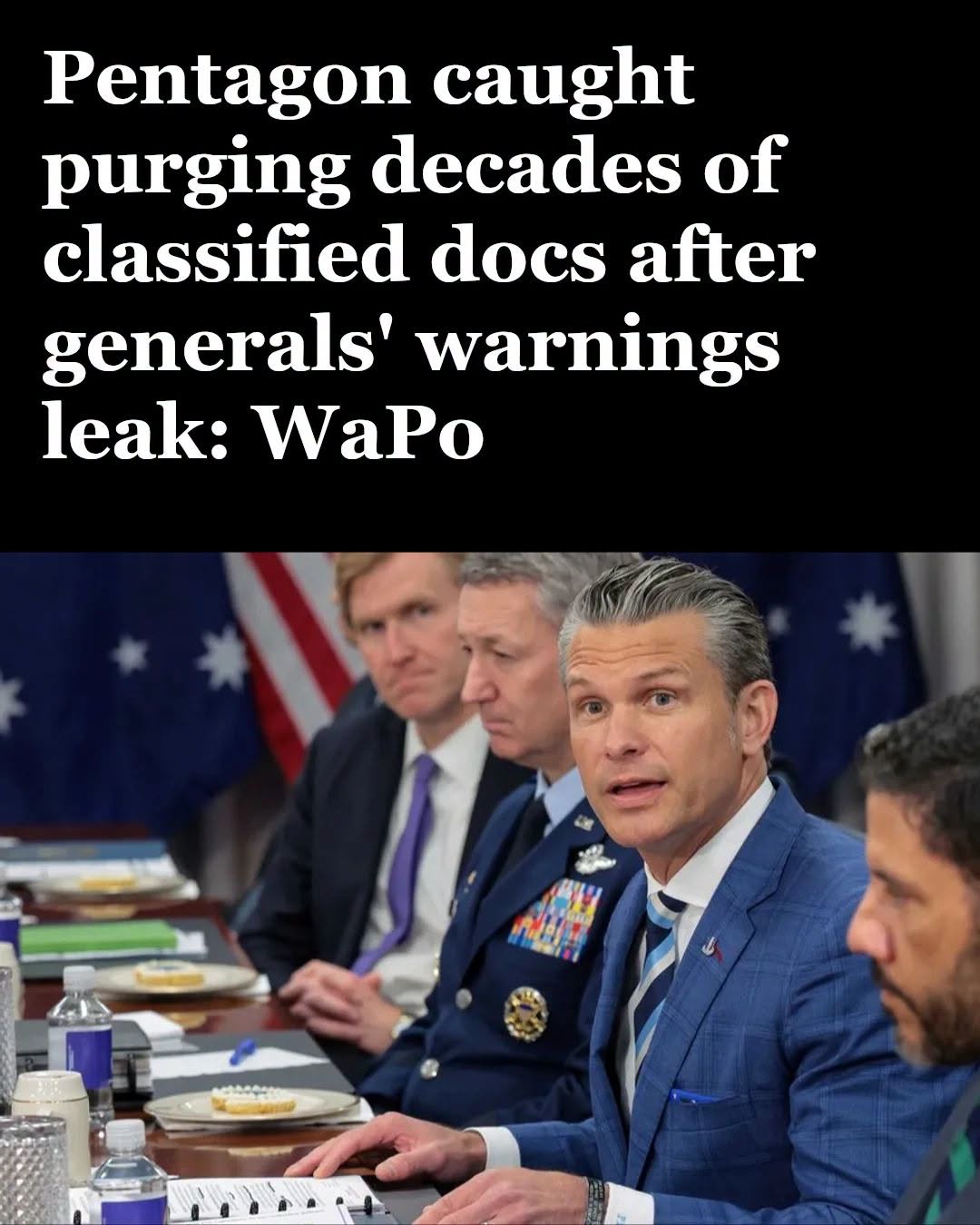
The image says:
“Pentagon caught purging decades of classified docs after generals' warnings leak: WaPo”
The underlying Washington Post report supports the claim that decades of classified documents associated with the SDOB were removed from a Pentagon internal portal after the Post's reporting.
But “purging” is an interpretation.
There is currently no established evidence in the reporting that the Pentagon physically destroyed the documents.
The Post explicitly says it was unclear whether the records remained available elsewhere.
So the more precise description is:
The Pentagon restricted or removed access to decades of SDOB-related classified documents from SIPRNet after the Post reported internal military warnings about the Iran war.
That is already significant without claiming that the records were destroyed.
The Larger Issue: Control of Information Inside the Pentagon
The document controversy comes amid a broader battle over information and leaks inside the Defense Department.
The Trump administration has taken several steps intended to prevent classified information from reaching the media, including increased scrutiny of personnel and legal pressure involving journalists, according to the Post.
The latest episode therefore creates two competing explanations.
The Pentagon's argument
Restricting access to sensitive operational records can be justified on security grounds, particularly while the United States is engaged in an active war.
If classified operational information has been exposed publicly, officials may reasonably want to determine who should retain access and whether existing security procedures are adequate.
The critics' concern
Removing historical records immediately after they become politically embarrassing could make it harder for military personnel to understand past decisions and could reduce transparency within the institution.
That concern becomes especially important when the documents contain the formal reservations of senior commanders.
What the Viral Graphic Gets Right — and What It Leaves Out
✅ Supported by reporting
The Pentagon removed classified SDOB-related documents from SIPRNet.
The documents reportedly span decades.
The move occurred after the Washington Post published its investigation into military concerns about the Iran war.
Senior military leaders had formally expressed reservations about continuing large-scale operations against Iran.
The Pentagon did not dispute that the documents were removed.
⚠️ Needs qualification
“Purging” does not necessarily mean destroying. The available reporting establishes removal from an internal portal, not destruction of the underlying records.
The Pentagon has not acknowledged removing the documents because they contained embarrassing information. That connection is suggested by the timing but has not been established as the official reason.
The military's use of non-concurs is not itself evidence of rebellion or insubordination. It is a formal mechanism for senior commanders to record disagreement while implementing orders.
The Bottom Line
The most consequential part of this story may not be the disappearance of old classified files by itself.
It is the combination of three developments happening almost simultaneously:
- Senior U.S. commanders reportedly warned Pete Hegseth that the prolonged Iran operation was putting increasing pressure on American military resources.
- Their concerns were documented through the Pentagon's formal order process.
- Shortly after those warnings became public through The Washington Post, decades of related SDOB documents were removed from a classified Pentagon portal.
The Pentagon says its operational decisions and security procedures are being managed through appropriate channels.
What remains unclear is why access to the historical documents was changed when it was, where those documents now reside, and whether the restriction will affect the ability of military planners to consult the records during an active conflict.
Those unanswered questions are why this story is likely to remain under scrutiny.
Comments (0)
Loading comments...
May You Like
OBAMA STUNS ON INSTAGRAM: MESSAGE MARKING 34-YEAR MILESTONE SPARKS A BUZZ

TRUMP’S OHIO WARNING UNDER THE SPOTLIGHT

Shocking news from Ohio: an unexpected development ahead of Trump's rally