Premature Babies Caught in the Crossfire as U.S. Measles Outbreak Reaches 35-Year High
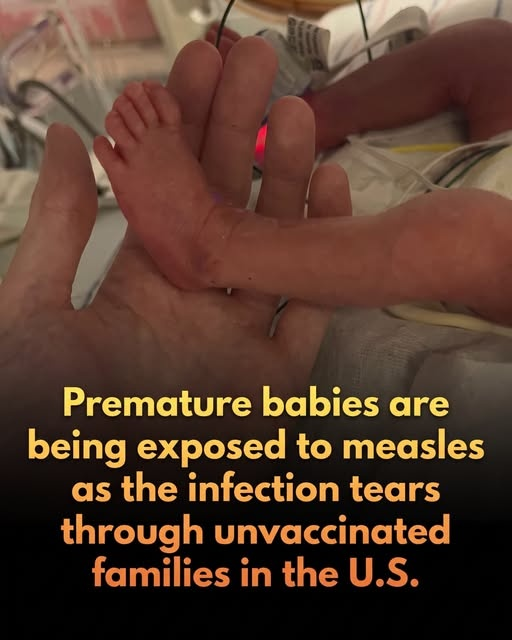
A new measles outbreak story in Pennsylvania is putting a particularly vulnerable group in the spotlight: premature and medically fragile babies who are too young to receive routine measles vaccination.
The graphic says premature babies are being exposed to measles as the virus spreads through unvaccinated communities.
That message is rooted in a real case.
In August, a premature newborn receiving intensive care at Geisinger Medical Center in Danville, Pennsylvania, was exposed to measles after an adult visitor spent several days inside the hospital's neonatal intensive care unit (NICU) and later tested positive. The hospital subsequently tightened access to its NICU.
But the broader graphic needs some important context: not every premature baby is unvaccinated, and many infants are vulnerable precisely because they are too young for the routine MMR schedule. The current measles resurgence is overwhelmingly concentrated in outbreak settings and disproportionately affects people without documented vaccination protection.
And the situation has become substantially more serious since the story first circulated.
As of September 4, 2026, the CDC had recorded 3,134 confirmed measles cases in the United States, the highest annual total in more than 35 years.
A Premature Baby Was Exposed Inside a Pennsylvania NICU
The case that brought national attention to the issue involves Brittany Nicole Sponenberg, whose son had been receiving care in a NICU in Danville.
According to reporting by CNN, the baby had been hospitalized for nearly two months because his lungs and digestive system were still developing after premature birth.
Then his mother received a call from a doctor with alarming news: her baby had been exposed to measles inside the NICU.
The exposure occurred because an adult visitor had been inside the unit between August 14 and August 17.
The visitor subsequently developed a fever and rash and tested positive for measles the following day.
For a healthy vaccinated adult, such an exposure can be concerning.
For a medically fragile newborn, the calculation is very different.
Why a NICU Measles Exposure Is So Serious
A neonatal intensive care unit is designed for babies who are already medically vulnerable.
Premature babies can have:
- immature lungs,
- difficulty maintaining oxygen levels,
- feeding problems,
- immature immune defenses,
- low body weight,
- and other complications associated with being born early.
MedlinePlus notes that premature babies frequently require specialized NICU care because their organs have not had enough time to fully develop.
Adding a highly contagious respiratory virus to that environment creates an entirely different level of concern.
Geisinger explicitly described its NICU patients as among its most vulnerable patients when announcing the new restrictions.
The Baby Was Too Young for Routine MMR Vaccination
This is one of the most important pieces of context missing from the graphic.
Routine measles vaccination does not normally begin at birth.
The standard schedule calls for the first MMR dose at 12–15 months, followed by a second dose at 4–6 years.
That means a newborn cannot simply receive the normal childhood vaccination and immediately eliminate the risk.
During an outbreak or for certain high-risk circumstances, however, the CDC says children 6–11 months old can receive an early MMR dose when health authorities recommend it—for example, during an outbreak or before international travel.
Those children still need the routine two-dose series beginning at 12–15 months.
A very young premature newborn is therefore in a particularly difficult position:
The child needs protection but may be far too young for routine measles vaccination.
Premature Babies Can Also Have Less Maternal Antibody Protection
Prematurity adds another layer.
Babies acquire antibodies from their mothers during pregnancy, particularly during the later stages of pregnancy.
Preterm infants generally acquire less maternal antibody through the placenta than full-term infants, according to the Children's Hospital of Philadelphia's vaccine guidance for premature babies.
Those maternal antibodies also don't necessarily last as long.
That makes vaccination according to the baby's chronological age especially important once the child becomes eligible.
This does not mean premature babies are automatically unprotected or destined to become infected.
It means that protecting them from exposure becomes particularly important before they can receive their own measles vaccination.
What Happened After the Exposure?
According to reporting on the Pennsylvania case, the baby's doctors considered his risk of actually developing measles to be low—but they still took precautions.
The child received preventive medication and was placed under isolation precautions.
The family was told that it could take 28 days before the exposure period could effectively be cleared.
For the family, that meant an already difficult NICU journey became considerably more complicated.
The baby had already been dealing with the consequences of premature birth.
Now the family had to worry about a disease that is extraordinarily contagious and potentially dangerous for infants.
Geisinger Changed Its NICU Rules
The exposure prompted Geisinger to change its visitation policies.
Beginning August 21, the Danville NICU limited visitors to:
- the baby's parents or legal guardians,
- provided they had no measles symptoms.
Parents and guardians were screened for symptoms before entering, and the hospital strongly encouraged surgical-mask use.
Geisinger said it was working directly with families whose babies may have been exposed.
The hospital emphasized that the decision was made specifically because of the vulnerability of NICU patients.
This wasn't simply a general hospital restriction.
It was targeted at a unit containing premature, critically ill and medically fragile newborns.
The Problem Is Bigger Than One Hospital
The Pennsylvania NICU incident occurred against the backdrop of a much larger measles resurgence.
The CDC reported 2,777 confirmed cases as of August 20.
By August 27, the American Academy of Pediatrics' Red Book reported 2,903 cases.
And by September 4, Reuters reported the CDC's total had reached 3,134 confirmed cases.
That means the number increased by more than 350 cases in roughly two weeks between the August 20 CDC snapshot and the September 4 figure.
The outbreak has now produced the highest annual U.S. measles total in more than three decades.
More Than 3,100 Cases in 2026
The scale of the resurgence is striking.
The United States recorded:
2024: 285 confirmed cases
2025: 2,289 confirmed cases
2026: 3,134 confirmed cases as of September 4
The 2026 number has therefore already exceeded the entire 2025 total by approximately 845 cases.
And there are still almost four months remaining in the year.
Most Cases Are Connected to Outbreaks
The CDC reported that 94% of confirmed 2026 cases in its August 20 data were associated with outbreaks.
That is an important clue to understanding what's happening.
Measles does not simply appear randomly throughout the country.
It spreads particularly efficiently when the virus enters communities where enough people lack immunity.
Once transmission begins, the virus can move rapidly from person to person.
The CDC says measles is one of the most contagious diseases in the world and warns that it can be particularly dangerous for babies and young children.
Vaccination Coverage Has Fallen Below the Level Needed for Community Protection
The CDC says communities generally need vaccination coverage above 95% to maintain strong community immunity against measles.
But U.S. kindergarten MMR coverage has fallen.
According to CDC data, coverage declined from 95.2% in the 2019–20 school year to 92.4% in 2025–26.
The CDC estimates that approximately 280,000 kindergartners were at risk during the 2025–26 school year because of this decline.
That may sound like only a few percentage points.
For measles, however, those percentage points can have enormous consequences.
When coverage is high, an infected person is much less likely to encounter another susceptible person.
When coverage falls, chains of transmission become easier to establish.
Why Babies Can Become the Unintended Victims
This is perhaps the most important point in the entire story.
A measles outbreak does not only threaten people who decline vaccination.
It can also threaten people who cannot yet be vaccinated.
That includes some:
- newborns,
- young infants,
- people with certain immune conditions,
- and others who cannot develop adequate protection from vaccination.
This creates what public-health experts sometimes describe as a protection gap.
Imagine a community in which most adults and children are immune.
A newborn doesn't need to be vaccinated immediately to be relatively safe because the virus has difficulty finding enough susceptible people to spread.
But when measles transmission increases, that newborn can suddenly be surrounded by people capable of carrying the virus.
That's why vaccination protects more than the person receiving the shot.
The Image's Claim About "Unvaccinated Families" Needs a Nuance
The graphic says the infection is "tearing through unvaccinated families."
That wording is emotionally powerful, but it is too broad if interpreted literally.
The evidence clearly shows that unvaccinated and people with unknown vaccination status make up the overwhelming majority of U.S. measles cases.
But that does not mean every family affected by an outbreak is unvaccinated.
A premature baby, for example, may be completely unable to receive the routine MMR vaccine simply because of age.
Likewise, vaccinated people can occasionally become infected, although two doses are highly protective.
The CDC estimates that two MMR doses are approximately 97% effective against measles, compared with about 93% after one dose.
So the better description is:
Falling vaccination coverage and outbreaks in under-immunized communities increase exposure risk for everyone—including babies who are too young to be vaccinated.
Measles Is Not Just a Childhood Rash
Another misconception worth addressing is the idea that measles is simply an unpleasant childhood illness.
It can be much more serious.
CDC guidance says measles can cause:
- pneumonia,
- encephalitis, or brain inflammation,
- dehydration,
- hospitalization,
- and death.
In 2025, 12% of reported U.S. measles cases were hospitalized, and three confirmed deaths were recorded.
A CDC educational resource notes that about one in five unvaccinated people in the United States who contract measles may require hospitalization.
Children under five are among the groups at greater risk of severe complications.
That makes an extremely young premature infant particularly concerning.
Pennsylvania Has Become a Major Focus of the Outbreak
Pennsylvania has been one of the states at the center of the 2026 resurgence.
Lancaster County, home to large Amish and Mennonite communities, has experienced a particularly significant outbreak.
CNN reported in late August that Pennsylvania had nearly 400 confirmed cases, with approximately half located in Lancaster County.
The Amish and Mennonite populations should not be described as universally anti-vaccine—vaccination decisions vary among individuals and communities.
But some communities in the region have lower vaccination coverage, allowing measles to spread more readily.
Pennsylvania Also Reported Two Measles-Associated Deaths
The outbreak became even more serious in August when Pennsylvania health officials reported two measles-associated deaths.
The deaths subsequently became the subject of a dispute over how the CDC should classify them.
Reuters reported that Health Secretary Robert F. Kennedy Jr. asked CDC Director Erica Schwartz to remove two Pennsylvania deaths from the federal tally because of questions about whether measles caused or contributed to the deaths.
By September 5, Kennedy acknowledged that one infant death in Lancaster County was caused by measles, based on information from the local coroner, although the CDC had not yet incorporated the death into its official national count.
That distinction is important:
State officials' classification and the CDC's national tally were not, at that point, identical.
So headlines using a precise national death count need to specify which dataset they are referring to.
There Are Other Recent Hospital Exposure Events
The Pennsylvania NICU incident was not an isolated example of measles reaching medical facilities.
On August 20, the Allegheny County Health Department announced that an individual who later tested positive for measles had visited UPMC Children's Hospital of Pittsburgh on August 12 and August 18.
On September 1, Allegheny County authorities announced another potential exposure at UPMC Children's Hospital after two people who visited the hospital on August 27 later tested positive.
Penn State Health also reported a potential exposure at Golisano Children's Hospital after an infected individual was present in the main lobby on August 17.
These incidents illustrate why measles outbreaks can create operational problems for hospitals even when there is no evidence that every exposed patient becomes infected.
Hospitals have to protect people who may be particularly vulnerable.
Why Measles Is Especially Difficult Inside a Hospital
Measles spreads through the air.
According to Penn State Health, the virus can remain in the air for up to two hours after an infected person leaves an area.
That creates an unusual infection-control challenge.
A person doesn't necessarily have to touch an infected patient to be exposed.
Someone can simply enter a space after an infectious person has been there.
That's particularly problematic in:
- emergency departments,
- pediatric clinics,
- waiting rooms,
- children's hospitals,
- and NICUs.
Those facilities contain many people who may be medically vulnerable.
What Happens After Someone Is Exposed?
There is no simple "wait and see" approach when a high-risk infant is exposed.
Health officials may review vaccination and immunity status, monitor for symptoms and consider post-exposure measures.
The timing matters because measles symptoms generally don't appear immediately.
CDC guidance says symptoms typically begin 7–14 days after infection, although the range can be longer.
Early symptoms commonly include:
- fever,
- cough,
- runny nose,
- red or watery eyes.
A rash generally appears later and spreads from the face downward.
Anyone who believes they may have measles exposure should generally call a healthcare provider before physically arriving, so the facility can take precautions to prevent exposing other patients.
That is especially important at children's hospitals and medical facilities treating newborns.
The Vaccine Remains the Most Effective Protection
Despite the political controversy surrounding measles vaccination, the underlying medical evidence remains straightforward.
The CDC recommends two doses of MMR.
Two doses are approximately 97% effective at preventing measles.
And the vaccine isn't merely about protecting vaccinated children.
High vaccination rates help create community immunity, which reduces the probability that the virus will reach people who are too young or medically unable to receive effective vaccination.
That includes the babies at the center of this story.
What the Graphic Gets Right — and What It Leaves Out
✅ What is supported
Premature babies really have been exposed to measles.
A real premature infant in Pennsylvania was exposed in a NICU after an adult visitor later tested positive.
The U.S. is experiencing a major measles resurgence.
The country reached 3,134 confirmed cases by September 4, the highest annual total in more than 35 years.
Unvaccinated and under-immunized communities are driving much of the transmission.
The CDC reported that 94% of cases in its August 20 snapshot were outbreak-associated, while declining vaccination coverage has reduced community protection.
Babies can be particularly vulnerable.
Some are simply too young to receive the routine MMR vaccine.
⚠️ What needs clarification
The image suggests that premature babies generally are being infected by "unvaccinated families."
That is too broad.
The Pennsylvania case involved exposure, not confirmed infection of the baby.
And babies can be vulnerable to measles precisely because they are too young to have received routine vaccination, rather than because their own parents refused vaccination.
The photo itself should also be treated as illustrative unless independently verified as the specific child involved.
The Bigger Lesson
The most troubling part of the current outbreak may not be the number 3,134 by itself.
It is the fact that measles is once again reaching places where vulnerable people cannot simply protect themselves through vaccination.
A healthy adult can check vaccination records.
A school-aged child can receive MMR.
A teenager can catch up on missed doses.
A newborn in a NICU cannot simply make that choice.
That baby depends on the immunity of the people around them—and on infection-control systems working properly.
When community immunity is high, measles has very little room to move.
When immunity falls, the virus finds the gaps.
And sometimes the people who pay the price are not the people who created those gaps.
They are the newborns, premature babies and medically fragile patients who were never in a position to protect themselves in the first place.
Bottom Line
The graphic is based on a real and deeply concerning event: a premature newborn in a Pennsylvania NICU was exposed to measles during the country's largest resurgence of the disease in more than three decades.
But the most accurate way to describe the situation is not that "premature babies are being infected because their families are unvaccinated."
It is this:
A growing measles outbreak in under-immunized communities is increasing the risk of exposure for vulnerable people—including premature and newborn babies who are too young to receive routine MMR vaccination.
And as the U.S. case count passed 3,100 in early September, that risk is no longer theoretical.
Comments (0)
Loading comments...
May You Like
Jack Smith Defends His Integrity as Trump Investigations Face Renewed Political Firestorm

South Korea–Ukraine Rift Deepens Over North Korean POW Transfer as PURL Draws New Scrutiny

gfnhgmnghnmfgnbvvvvvvvvv