
PUTIN UNVEILS SECRET BIOLOGICAL WEAPONS FILE AT APEC—TRUMP ISSUES 24-HOUR ULTIMATUM!
Putin's Nuclear Briefcase Appears at APEC as Trump and Xi Confront Growing Arms Control Questions
SHENZHEN, China — November 19, 2026 — A Russian naval officer carrying what state television identified as President Vladimir Putin's nuclear command briefcase appeared on camera at the Asia-Pacific Economic Cooperation summit in China, drawing attention to nuclear security hours before Putin joined U.S. President Donald Trump and Chinese President Xi Jinping for high-level talks.
The black case appeared in footage broadcast by Russia-1 on November 18, as the leaders gathered in Shenzhen for a summit overshadowed by nuclear weapons, the wars in Ukraine and Iran, and disputes over international security.
Russian television correspondent Yevgeny Popov approached the officer and asked whether he was carrying the nuclear briefcase. The officer answered affirmatively.
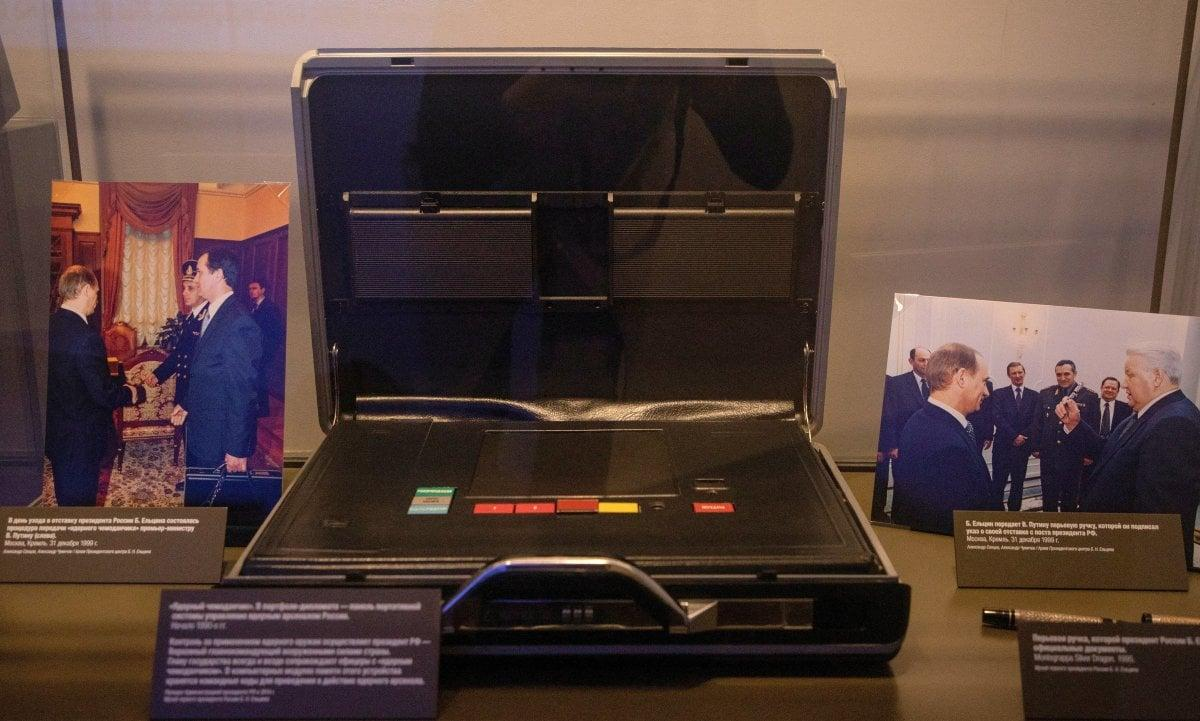
The device was identified as Cheget, a portable communications terminal associated with Russia's nuclear command system.
The footage was reported by Al Jazeera, South China Morning Post and other international news organizations.
The briefcase's appearance immediately raised questions about its purpose and the political message surrounding its unusually public display.
The answer lies in the distinction between nuclear command equipment and the alleged secret biological-weapons file.
The footage supports the former identification. It does not establish that Putin displayed biological-weapons evidence or issued a new threat involving such material.
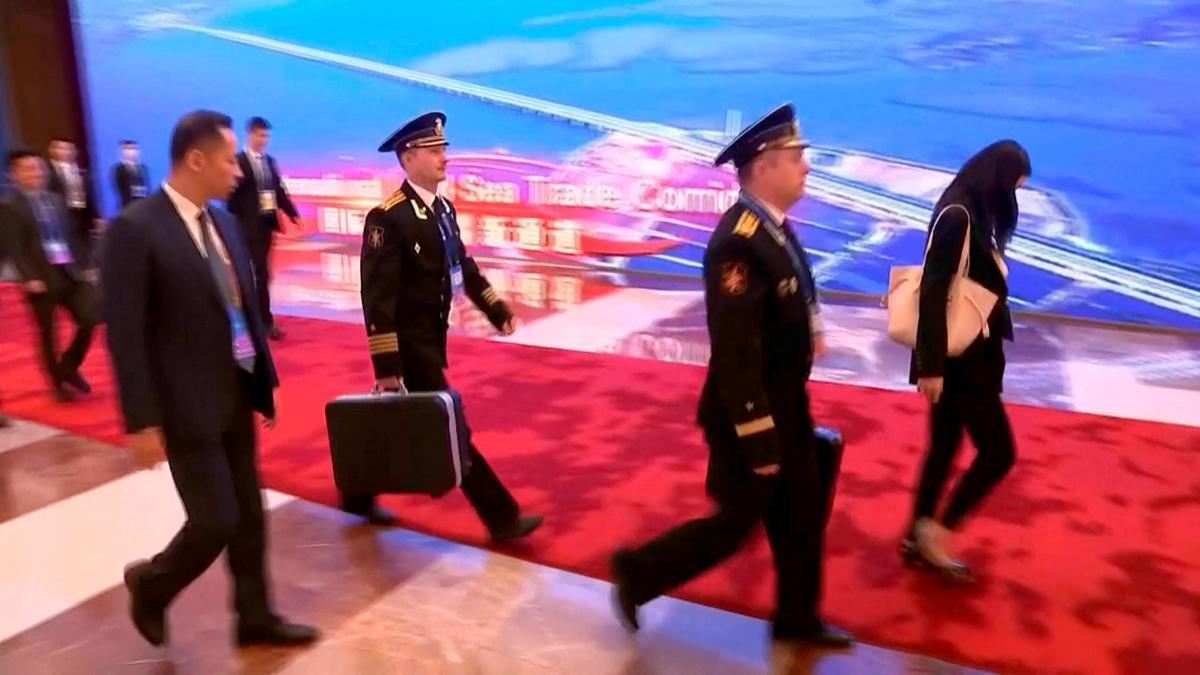
The footage began with Russian television correspondent Popov standing near members of Putin's delegation.
A uniformed naval officer was carrying a black briefcase.
Popov drew attention to the case before approaching the officer.
He asked whether it was the nuclear briefcase associated with the Russian president.
The officer confirmed that identification and repeated his answer when questioned again.
The exchange was brief.
There was no public demonstration of the device's operation.
The case was not opened on camera to reveal its internal components.
Nor did the officer describe classified procedures or display documents.
Nevertheless, the footage attracted international attention because equipment associated with nuclear command is rarely discussed so openly in front of television cameras.
The device identified in the footage is known as Cheget.
It is associated with Russia's system for maintaining communications between the country's political leadership and its strategic nuclear forces.
Cheget is not ordinarily described as a container for intelligence reports or biological-weapons evidence.
Its purpose is connected to command, control and the transmission of highly sensitive military instructions.
Public descriptions indicate that it allows senior Russian officials to communicate through protected channels during a nuclear emergency.
The precise internal configuration is not publicly established.
For security reasons, operational details are closely guarded.
The available footage does not provide an independent examination of the equipment inside the case.
But the identification given by the officer and the established purpose of Cheget point toward nuclear command communications rather than a hidden biological-weapons dossier.
Russia's president is accompanied by personnel responsible for maintaining access to strategic command communications.
That arrangement is intended to preserve continuity of command during travel.
A national leader may be away from the capital when an urgent security decision is required.
Secure communications equipment allows authorized officials to remain connected to military command structures.
The presence of such equipment during an international summit is therefore not inherently unusual.
What made the Shenzhen episode noteworthy was the public exchange between a state television correspondent and the officer carrying the case.
Cheget had appeared in footage during Putin's October 2023 visit to Beijing.
Its appearance in Shenzhen was another rare moment when the system became visible to the wider public.
The officer's answers were central to the story.
Without them, the footage would have shown only a uniformed man carrying a black case.
A briefcase's appearance alone cannot establish its function.
The televised exchange provided an explicit identification from a person presented as part of the Russian presidential entourage.
However, international reporting also noted that the Kremlin had not independently confirmed the identification in a separate public statement.
That distinction does not make the footage meaningless.
It identifies the precise source of the claim: Russian state television and the officer appearing in its recording.
The evidence supports reporting that the case was publicly presented as Cheget.
The footage emerged as Putin, Trump and Xi prepared for a major diplomatic meeting.
The three leaders represent countries possessing substantial nuclear arsenals.
Their discussions were expected to address nuclear arms control and strategic stability.
The timing made the briefcase an especially prominent image.
A device associated with nuclear command appeared in public just as leaders were preparing to discuss how to reduce nuclear risks.
The symbolism was difficult to overlook.
However, symbolism is not proof of a specific political intention.
The footage does not establish that Putin personally ordered the case to be displayed as a warning.
Nor does it establish that Trump responded with an ultimatum.
The documented significance is that the device appeared during a summit where nuclear security was already a central issue.
APEC is an economic forum involving 21 member economies.
Its regular agenda includes trade, investment, technology and regional economic cooperation.
The 2026 gathering in Shenzhen also became a venue for major-power diplomacy.
China's President Xi urged members to preserve open trade and cooperate on technological development.
Meanwhile, the presence of Trump and Putin brought nuclear arms control and international conflicts into focus.
Associated Press reported that the summit was overshadowed by the unprecedented three-way meeting among the leaders.
Their discussions came amid tensions over Ukraine, Iran, advanced technology and the future of international nuclear agreements.
The briefcase footage therefore emerged within a broader diplomatic environment already dominated by security questions.
The three leaders met on November 19 on the sidelines of the APEC summit.
The meeting represented an unusual opportunity for direct discussions among Washington, Moscow and Beijing.
Associated Press reported that the leaders addressed nuclear arms control and efforts to end the wars involving Ukraine and Iran.
Trump presented dialogue with rival powers as a possible way to address international problems.
Putin sought to advance Russia's positions on European security and Ukraine.
Xi emphasized strategic stability and the importance of managing differences among major powers.
Their priorities were not identical.
The meeting brought those competing interests into the same diplomatic setting.
The presence of the Russian nuclear briefcase became a striking image associated with the talks, but it was not itself a negotiated agreement or a new weapons announcement.
The White House had identified nuclear arms reduction as a major objective of the Shenzhen talks.
Before the meeting, spokesperson Olivia Wales said Trump intended to discuss reducing nuclear weapons worldwide.
U.S. officials described nuclear proliferation as a serious concern.
Washington was also interested in bringing China into discussions about future arms-control arrangements.
The United States and Russia possess the world's largest nuclear arsenals.
China's arsenal is smaller but has expanded significantly in recent years.
Those differences complicate negotiations.
A single agreement would need to account for countries with substantially different numbers of weapons and different security priorities.
The publicly described American agenda focused on nuclear arms control, not an ultimatum concerning a Russian biological-weapons file.
The White House's public agenda concerned nuclear weapons, Iran and strategic stability.
Reports about the meeting did not document a specific 24-hour deadline related to the case.
A diplomatic ultimatum would normally involve a defined demand, a deadline and consequences for noncompliance.
None of those elements has been established in connection with the Shenzhen briefcase episode.
The distinction matters because a deadline attributed to the American president would represent a significant escalation.
The available evidence instead describes discussions among the three leaders and the appearance of Russian nuclear command equipment in a state television broadcast.
An ultimatum is not simply a strong statement.
It involves a demand that another party take action within a specified period.
Diplomatic negotiations operate differently.
Leaders may exchange proposals, express concerns and disagree without imposing immediate deadlines.
The Shenzhen meeting was publicly presented as an opportunity to begin or advance discussions on nuclear arms control.
Officials cautioned beforehand that a comprehensive agreement was unlikely to emerge from a single encounter.
That assessment reflected the complexity of the issues.
Nuclear treaties require detailed provisions governing weapons, verification and compliance.
A televised appearance of Cheget does not alter those requirements.
Nor does it establish that the United States had shifted from negotiation to a 24-hour demand.
One of the most important developments behind the summit was the expiration of the New START treaty in February 2026.
New START had limited deployed strategic nuclear weapons and associated delivery systems held by the United States and Russia.
Its expiration removed the last major bilateral treaty limits on their strategic nuclear arsenals.
That created new uncertainty about future deployments and transparency.
The treaty had also provided mechanisms for exchanging information and verifying compliance.
Without a replacement agreement, the two countries face a more difficult environment for monitoring strategic forces.
The Shenzhen meeting took place against that background.
The leaders were not merely discussing hypothetical risks.
They were confronting the absence of a treaty framework that had previously placed limits on the world's two largest nuclear powers.
China's nuclear arsenal is substantially smaller than those of Russia and the United States.
However, its military modernization has increased Washington's interest in broader arms-control discussions.
The Pentagon has estimated that China possesses more than 600 nuclear warheads.
American officials have also projected continued growth in China's arsenal.
China has resisted suggestions that it should accept the same restrictions as countries possessing much larger inventories.
Beijing argues that differences in arsenal size must be considered.
This creates a fundamental negotiating challenge.
Washington wants a framework that addresses all three countries.
Moscow seeks recognition of its strategic interests and broader security concerns.
Beijing does not want an agreement that ignores the imbalance between its arsenal and those of the other two powers.
These disagreements help explain why the summit's nuclear agenda was significant but difficult.
The Arms Control Association estimated in a November 16 briefing that nine countries collectively possess approximately 12,000 nuclear weapons.
The organization warned that the absence of effective arms-control arrangements could encourage further expansion of the major nuclear arsenals.
The total includes weapons in different categories and states of readiness.
It should not be interpreted as the number of weapons immediately available for launch.
Nevertheless, the figure illustrates the scale of the global nuclear challenge.
A major agreement involving the United States, Russia and China could potentially influence broader international security.
But reaching such an agreement would require detailed negotiations.
Questions would include the types of weapons covered, how limits would be verified and what procedures would apply if a country were accused of violating the terms.
The briefcase footage did not answer any of those questions.
Cheget was developed during the Soviet era.
Public accounts trace its introduction to the 1980s, when Soviet leaders faced concerns about the speed of a possible nuclear attack.
The system was designed to support secure communication between the country's highest political and military authorities.
It is often described as Russia's equivalent of the American nuclear football.
However, the two systems are not identical in design or operation.
Cheget is associated with Russia's broader nuclear command-and-control infrastructure.
The device provides a means of transmitting or authorizing decisions through that system.
It should not be understood as a simple switch that independently launches missiles.
The operational process involves additional command structures and security procedures.
The case is generally carried by a military officer accompanying the president.
Public reporting has identified naval officers among the personnel assigned to this responsibility.
The president is not the only senior Russian official associated with a Cheget terminal.
Russia's defense minister and chief of the general staff also have roles within the nuclear command system.
Their participation reflects the need for communication and coordination among political and military authorities.
The exact operational procedures are not fully public.
The system's purpose is to maintain the ability to communicate strategic decisions under extraordinary circumstances.
That is why a Cheget case can accompany a president during routine international travel.
Its presence does not necessarily indicate that a nuclear strike is being prepared.
The United States also maintains a portable presidential emergency communications system.
It is commonly called the nuclear football.
A military aide carries the equipment near the American president.
The system supports presidential access to military options and emergency communications.
Like Cheget, it is surrounded by security procedures that are not fully disclosed.
The existence of such equipment is a standard feature of nuclear command arrangements.
Its presence near a leader does not automatically signal an imminent military action.
The comparison is important because both Trump and Putin traveled to Shenzhen as leaders of nuclear-armed states.
The Russian case became visible on television.
That visibility, rather than the basic fact that nuclear command equipment accompanied a president, made the episode newsworthy.
Some commentators interpreted the Russian broadcast as a deliberate demonstration of nuclear power.
The timing gave that interpretation a plausible political context.
The footage appeared before high-level discussions involving nuclear weapons.
Russian state television prominently identified the case.
The officer answered questions rather than declining to comment.
However, those observations do not establish the Kremlin's intention.
The broadcast could have been designed to emphasize Russia's strategic status.
It could also reflect a decision by state television to highlight an unusual security detail.
Without an authenticated explanation from those responsible for the broadcast, the precise motivation remains uncertain.
What can be established is the public effect: the footage drew attention to Russia's nuclear capabilities at a summit focused partly on nuclear arms control.
Biological weapons are a separate category of weapon from nuclear arms.
They involve biological agents or toxins used to cause disease or harm.
The international legal framework governing them includes the Biological Weapons Convention, which prohibits the development, production and stockpiling of biological weapons.
A claim that a government possessed secret evidence of biological-weapons activity would require examination of documents, scientific information and the chain of custody.
The Shenzhen footage provides none of those elements.
It does not show a biological-weapons report.
It does not identify laboratories, samples or intelligence assessments.
It does not document Putin presenting a dossier to Trump or Xi.
The only item specifically identified in the video is the nuclear command briefcase.
A government allegation involving biological weapons can have major diplomatic consequences.
But establishing the substance of such an allegation requires more than a reference to a mysterious object.
Investigators would need to assess the origin and authenticity of any documents.
Scientific claims would require appropriate technical evaluation.
Officials would need to distinguish evidence of legitimate biological research from evidence of prohibited weapons activity.
The existence of a secure military briefcase does not establish that it contains such material.
In Shenzhen, the recorded exchange concerned Cheget.
No authenticated document was publicly displayed linking the case to biological weapons.
The documented nuclear command equipment and the alleged secret biological-weapons file are therefore separate claims with very different evidentiary foundations.
Russia's war against Ukraine remained an important diplomatic issue.
Putin sought to advance Moscow's position on a possible settlement.
Ukraine and European governments were concerned about negotiations that could affect Ukrainian territory or security without adequate participation by Kyiv.
Associated Press reported that the Shenzhen meeting offered Putin an opportunity to appear alongside the leaders of the United States and China.
The diplomatic setting was significant because Russia had faced extensive Western sanctions and political isolation following its invasion of Ukraine.
The summit did not erase those disagreements.
Nor did the presence of Cheget establish that Russia had introduced a new military ultimatum.
The substantive questions concerned possible peace arrangements, European security and the relationship between Moscow and Washington.
The conflict involving Iran also formed part of the summit's agenda.
The United States, Russia and China have different relationships with Tehran and different interests in Middle Eastern security.
The war has affected international energy markets and complicated diplomatic relationships.
Washington sought discussions about ending the conflict.
Moscow and Beijing maintained their own positions concerning Iran and regional stability.
These differences made the trilateral meeting unusually complex.
Nuclear arms control was only one issue among several.
Trade, technology and the wars in Ukraine and Iran all competed for attention.
That broader agenda helps explain why the leaders met despite major disagreements.
The available reporting does not establish that a biological-weapons file became the central subject of the meeting or triggered a new American ultimatum.
Radio Free Europe/Radio Liberty reported that Trump and Putin held a brief, unscheduled meeting on the sidelines of the summit on November 19.
The encounter took place at Kylin Villa, a government reception compound in Shenzhen.
According to the report, Trump entered the meeting room at approximately 12:15 p.m. local time, accompanied by Treasury Secretary Scott Bessent and White House Chief of Staff Stephen Miller.
The meeting was described as a short discussion rather than a full formal bilateral summit.
That distinction matters because the leaders' contact was part of a wider diplomatic program.
A brief meeting does not establish that a major agreement or ultimatum was delivered.
The report did not identify a biological-weapons dossier as the subject of the encounter.
Nuclear arms-control negotiations are technically demanding.
They involve weapons inventories, delivery systems, verification arrangements and compliance procedures.
Agreements may take years to negotiate.
A summit can establish political direction or authorize further talks, but leaders cannot easily settle every technical question in a single meeting.
Experts interviewed by Defense News before the summit cautioned against expecting a comprehensive agreement.
They suggested that a political statement or commitment to continue discussions would be more achievable than a detailed treaty.
Those assessments were not predictions of a specific outcome.
They reflected the practical difficulty of negotiating restrictions among three nuclear powers with different security priorities.
The same limitations applied to discussions about Ukraine and Iran.
A high-profile meeting could open diplomatic channels without resolving the underlying conflicts.
The Cheget footage became an image of the summit's central security challenge.
Three major powers were discussing strategic stability while maintaining their own military capabilities.
The Russian president's nuclear communications equipment appeared publicly just before those discussions.
The image emphasized the continuing role of nuclear deterrence in international relations.
But it also illustrated the difference between visible military capability and actual diplomatic policy.
The presence of Cheget was documented.
A new nuclear launch order was not.
A secret biological-weapons file was not displayed.
A 24-hour American ultimatum was not established.
The evidence supports a story about nuclear command systems and high-level diplomacy, rather than an exchange of previously undisclosed biological-weapons accusations.
The next important question is whether the United States, Russia and China can translate their discussions into a sustained arms-control process.
The expiration of New START has left the largest nuclear powers without the treaty limits that previously governed their strategic arsenals.
China's expanding nuclear capabilities add another dimension to the problem.
Negotiations would need to address different arsenal sizes, national security concerns and verification requirements.
The wars in Ukraine and Iran also complicate cooperation.
Any future agreement would depend on political decisions and detailed work by diplomats and technical specialists.
The Shenzhen summit provided a setting for those discussions.
It did not establish that the briefcase contained biological-weapons evidence or that Trump issued a 24-hour deadline.
The strongest publicly available evidence identifies the case as Cheget, Russia's portable nuclear command communications terminal.
A Russian naval officer confirmed that identification in a televised exchange.
International media reported the footage and explained the device's established role.
The significance of the episode lies in its timing.
A rarely seen component of Russia's nuclear command system appeared publicly just as the leaders of three nuclear powers gathered to discuss strategic stability.
Comments (0)
Loading comments...
May You Like

PENTAGON'S DECLASSIFIED UFO FILES — THE MYSTERY OF AN UNDERGROUND STORAGE PROJECT!

WARNING: OVER 1 MILLION COULD LOSE POWER AND NEARLY 2 MILLION FACE WATER ALERTS ON THANKSGIVING!

ELON MUSK'S MILLION-SATELLITE MEGAPROJECT — THE NEXT FRONTIER OF AMERICAN SPACE POWER?









Popular Posts




