
Putin’s Peace Terms Still Demand All Four Contested Ukrainian Regions — Including Land Russia Does Not Control
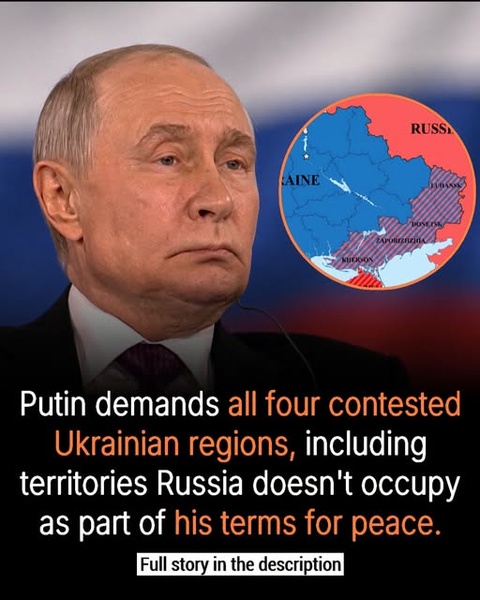
A viral graphic claims that Vladimir Putin is demanding all four contested Ukrainian regions as part of his terms for peace, including territory Russia does not currently occupy.
That claim is substantially accurate. Russia's stated territorial position continues to go beyond the land its forces currently control.
The four regions at issue are Donetsk, Luhansk, Zaporizhzhia and Kherson. Russia claims all four as part of the Russian Federation, although it does not control their full administrative territories.
Russia's demand is for the entire four regions
This is not a new demand created by the latest negotiations.
In June 2024, Putin publicly said Ukraine would have to withdraw its forces from the entire territory of Donetsk, Luhansk, Zaporizhzhia and Kherson within their administrative borders as they existed when they were part of Ukraine. He also demanded that Kyiv abandon its plans to join NATO.
That distinction is important.
Russia is not simply asking Ukraine to recognize the current battlefield line. The Russian proposal has historically called for Ukrainian forces to leave areas within those four regions that remain under Kyiv's control.
The Institute for the Study of War reported on September 6 that Putin had reiterated his unwillingness to make meaningful compromises and that Russia continued to seek control of the entirety of the four oblasts.
How much of those regions does Russia actually control?
Russia controls substantial portions of all four regions, but not all of them.
That is why the graphic's wording — “including territories Russia doesn't occupy” — matters.
For example, Reuters reported in June that Putin claimed Russian forces controlled roughly 85% of Donetsk and 80% of Zaporizhzhia, meaning significant territory remained outside Russian control even by Moscow's own battlefield assessment.
And the situation remains fluid. As of September 8, Reuters reported that Russian forces were pushing toward key Ukrainian defensive cities in Donetsk but had not captured the entire region.
Russia's position has not changed much
One of the strongest pieces of evidence supporting the graphic is that the Kremlin has explicitly said its position remains the same.
In June, Kremlin spokesman Dmitry Peskov said Russia's conditions had not changed since Putin's 2024 proposal: Ukraine would have to withdraw from the four regions and abandon its NATO ambitions.
That means the territorial demand is not merely an interpretation by Ukrainian officials or Western analysts.
It is part of the Russian government's publicly stated negotiating position.
The latest talks have not produced a breakthrough
This is especially relevant because the graphic comes at a moment of renewed U.S.-backed diplomacy.
U.S. envoys Steve Witkoff and Jared Kushner met with Putin in Moscow on September 5 before traveling to Kyiv. The Kremlin called the discussions useful, but there was no breakthrough.
The two sides remain far apart over territory and Ukraine's future security arrangements.
Reuters reported that Russia continues to demand that Ukraine relinquish the four regions and abandon NATO ambitions — conditions Kyiv rejects.
President Volodymyr Zelenskyy subsequently said the territorial issue remained unresolved but welcomed the restart of negotiations and said Ukraine was prepared to discuss security guarantees and other elements of a peace framework.
“All four regions” does not mean Russia currently occupies all four
This is perhaps the most important point to understand.
There are two separate concepts:
Russia's claimed territory:
Donetsk, Luhansk, Zaporizhzhia and Kherson in their full administrative boundaries.
Territory actually controlled by Russian forces:
A smaller portion of those regions, with Ukrainian forces still holding territory inside all or some of their boundaries.
Russia nevertheless treats the entire four regions as Russian territory.
That is why a peace agreement based on Moscow's stated terms would require Ukraine to surrender territory it currently controls.
Ukraine rejects the territorial demand
Ukraine has repeatedly rejected the idea that Russia's territorial annexations should be legitimized.
Zelenskyy's office said in June that Ukraine's position was that occupation cannot be legitimized, while continuing to call for negotiations and a peace that includes security guarantees.
This creates the central obstacle in the negotiations:
Moscow says territorial concessions are necessary for peace. Kyiv says accepting Russian annexations would amount to surrendering Ukrainian territory.
There is more to Putin's terms than territory
The four regions are only part of Russia's demands.
Putin's June 2024 proposal also called for Ukraine to:
- abandon its plans to join NATO;
- adopt a neutral, non-aligned status;
- remain non-nuclear;
- undergo what Moscow describes as “demilitarization” and “denazification”;
- recognize what Russia calls the “new territorial realities”; and
- ultimately have Western sanctions against Russia removed.
The terms surrounding “demilitarization” and “denazification” are particularly contentious because Moscow uses those terms to describe much broader political and military changes inside Ukraine.
The war continues while diplomacy proceeds
The negotiations are occurring against a backdrop of continuing combat.
On September 8, Russian forces launched another major strike on Kyiv following the temporary pause that had been arranged around the U.S. envoys' visit. Reuters reported five people killed and nearly 30 wounded.
At the same time, Russia continues its offensive operations in Donetsk, while Ukraine maintains defenses along the front.
That combination — negotiations alongside active fighting — illustrates how far apart the parties remain.
What the graphic gets right
Accurate:
- Russia continues to claim all four regions.
- Those regions are Donetsk, Luhansk, Zaporizhzhia and Kherson.
- Moscow's stated peace conditions include Ukrainian withdrawal from the full administrative territories of those regions.
- Some of that territory is still controlled by Ukraine.
- Russia has not abandoned the four-region demand.
- The issue remains one of the principal obstacles to a peace agreement.
Needs context:
- The demand is not new; Putin publicly outlined it in 2024.
- “Putin demands” should be understood as Russia's stated negotiating position, not evidence that Ukraine has agreed to those terms.
- The four regions are contested because Russia claims them while Ukraine and most of the international community do not recognize the annexations.
- Russia does not currently control the entirety of the territory it claims.
Bottom line
The graphic's central claim is substantially true.
Russia continues to seek control of all of Donetsk, Luhansk, Zaporizhzhia and Kherson, including portions that remain under Ukrainian control. Putin first laid out the demand publicly in 2024, and the Kremlin has since said its position has not changed.
The current U.S.-backed negotiations have restarted diplomacy, but territory remains one of the biggest unresolved issues, and there is no indication as of September 9, 2026, that Kyiv has accepted Moscow's four-region demand.
Comments (0)
Loading comments...
May You Like

Shocking news from Ohio: an unexpected development ahead of Trump's rally


South Korea–Ukraine Rift Deepens Over North Korean POW Transfer as PURL Draws New Scrutiny












