
Putin’s War Leaves a Trail of Destruction Across Ukraine
October 27, 2026 | Kyiv, Ukraine | International News
A Powerful Image, a Wider Humanitarian Crisis
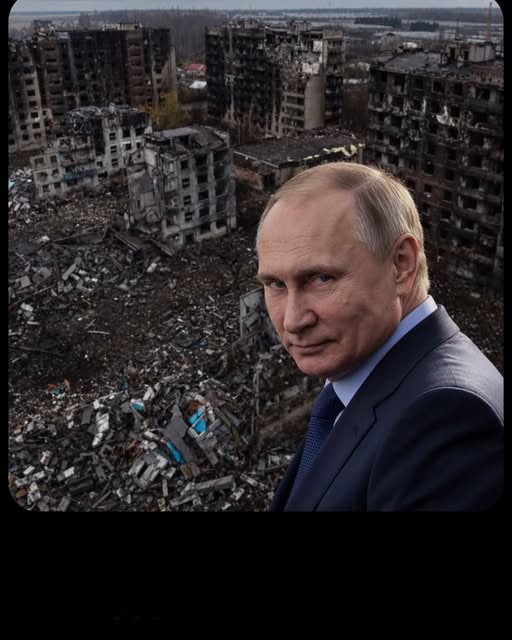
A striking image of Russian President Vladimir Putin against a backdrop of destroyed buildings carries a blunt message: “Putin is a killer, not a humanitarian.” The slogan expresses a political judgment about Russia’s war in Ukraine, where years of fighting have devastated cities, displaced families, and caused extensive civilian suffering.
The image is an advocacy graphic rather than a neutral news photograph. It does not identify the location of the destruction shown or establish when the photograph was taken. Its central accusation should therefore be understood as political commentary, while the broader humanitarian consequences of the war can be assessed through independently documented evidence.
Russia launched its full-scale invasion of Ukraine on February 24, 2022. Since then, fighting and repeated attacks have damaged homes, hospitals, schools, power facilities, and other essential infrastructure. The consequences have extended far beyond the front lines, affecting civilians in major cities and smaller communities throughout the country.
The war has also generated international condemnation and extensive investigations into alleged violations of international humanitarian law. These investigations examine the conduct of the parties to the conflict, including attacks affecting civilians, the treatment of prisoners, and conditions in occupied territories.
Civilian Suffering Continues
The United Nations Human Rights Monitoring Mission in Ukraine reported that 2025 was the deadliest year for civilians since the full-scale invasion began. It verified 2,514 civilian deaths and 12,142 injuries during that year, with the vast majority of casualties in Ukrainian government-controlled territory resulting from attacks launched by Russian armed forces.
The figures illustrate the human cost behind images of ruined neighborhoods. Each damaged apartment block represents families who may have lost their homes, possessions, access to basic services, or loved ones. For many residents, repeated attacks have made ordinary routines increasingly difficult and sometimes impossible.


Damaged residential buildings in Ukraine illustrate the destruction and displacement caused by the continuing war.
The destruction of energy infrastructure has added another layer of hardship. Attacks on power generation and distribution facilities have disrupted electricity, heating, and water supplies. These disruptions are particularly dangerous during winter, when people depend on reliable heating and functioning public services to remain safe.
Humanitarian organizations have continued to provide emergency assistance, medical support, shelter, and help for displaced people. However, access to communities near active fighting can be dangerous, while damaged roads, utilities, and public facilities complicate relief efforts.
Accountability and International Humanitarian Law
The slogan in the image is deliberately forceful, but legal responsibility must be assessed through evidence rather than political language alone. International humanitarian law requires parties to distinguish civilians from combatants, take precautions to limit civilian harm, and avoid attacks that would cause disproportionate civilian losses relative to the anticipated military advantage.
International investigators and human rights organizations have documented serious violations during Russia’s war against Ukraine, including alleged unlawful attacks and abuses against detainees. Such findings contribute to continuing efforts to establish responsibility and preserve evidence for possible legal proceedings.
The existence of documented violations does not mean that every allegation or every image circulating online has been independently verified. The location, date, circumstances, and source of individual photographs must be established before they can support a specific claim about an attack or its perpetrators.
That distinction is important because graphic images can communicate the scale of suffering while also being circulated without adequate context. Responsible reporting must acknowledge documented civilian harm without presenting an unidentified photograph as proof of a particular incident.
The Meaning Behind the Message
The phrase “Putin is a killer, not a humanitarian” reflects anger over the deaths, destruction, and displacement associated with Russia’s invasion. It also challenges efforts to portray Russian policy as humanitarian when the documented effects of the war include widespread civilian suffering.
For Ukrainians who have lost relatives, homes, or access to essential services, debates about responsibility are deeply personal. For the international community, the central questions concern civilian protection, accountability, humanitarian access, and the conditions required for a lasting peace.
Ending the conflict would require more than public statements. It would require decisions affecting military operations, territorial disputes, security guarantees, and the protection of civilians. Any durable settlement would also need to address the consequences of years of destruction and the needs of people hoping to return to their homes.
A Conflict With Lasting Consequences
The image delivers an unmistakable political message, but the underlying humanitarian crisis is not merely a matter of rhetoric. United Nations monitoring has documented extensive civilian casualties, while homes and essential infrastructure have suffered repeated damage throughout the conflict.
The slogan itself is an opinion, not a legal verdict. Nevertheless, the destruction and civilian suffering associated with the invasion remain matters of documented international concern.
Ultimately, the most important issue is the protection of human life. Behind every ruined building are communities facing loss, uncertainty, and the difficult task of rebuilding. Their safety and future depend on reducing violence, respecting international humanitarian law, and establishing conditions for a just and lasting peace.
Comments (0)
Loading comments...
May You Like

FLORIDA AIRBNB NIGHTMARE — 50 TEENS, 7 SHOOTING VICTIMS LINKED TO “SHOTS AT THE DOOR”!

BOMBSHELL NEW JERSEY FLOOD — 112 KM/H WINDS, SEAWATER FLOODING INLAND, 120,000 HOMES AT RISK!

WWE BRONSON REED—STAR COLLAPSES AT COMPANY EVENT, FATAL DRUG REACTION SUSPECTED!










Popular Posts




