Republican Support for Trump’s Iran War Strategy Shows Signs of Strain — What Does the New CNN Poll Reveal?
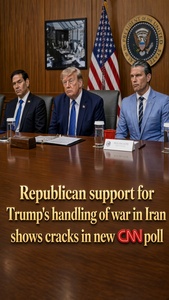
A new CNN poll has raised questions about Republican support for President Donald Trump’s handling of the war with Iran. Although a majority of Republicans continue to approve of his approach, the latest reported figures suggest that support has weakened compared with earlier in the year.
The findings come as the conflict continues to place U.S. foreign policy under scrutiny, with Americans debating the war’s objectives, its potential costs and the risks of prolonged military involvement. The changing numbers have drawn attention to a question facing the administration: how will Republican voters respond if the conflict continues?
Republican Approval Falls in New Poll
According to the reported CNN poll, 60% of Republicans approved of Trump’s handling of the war, down from 73% in March. That represents a decline of 13 percentage points.
Despite the decrease, the figures indicate that approval remains the majority position among Republican respondents. The shift, however, suggests that support for the president’s handling of the conflict is not necessarily fixed.
Public opinion on military action can change as circumstances evolve. Voters may reconsider their views as they receive new information about military objectives, the duration of the conflict, its financial costs and the potential consequences for American personnel.
The poll measures respondents’ opinions at a particular moment. It does not establish exactly why some Republicans have changed their views, and the results should not be interpreted as evidence that the entire party has turned against the president.
Why the Iran Conflict Matters to Trump’s Political Support
Foreign policy can become an important issue for any administration, particularly when military operations continue over an extended period.
Supporters of Trump’s approach may argue that military action is necessary to protect American interests and address security concerns. Others may question whether the objectives are sufficiently clear, how long the conflict could last and what consequences it could have for the United States.
These differences can exist within the same political party. Republican voters may broadly support the president while disagreeing about particular decisions, the pace of military operations or the conditions required to bring the conflict to an end.
For the White House, communicating the purpose of the operation and explaining how progress will be assessed may therefore remain important as public debate continues.
The Wider American Public Remains Concerned
The reported survey also points to broader dissatisfaction with Trump’s handling of the conflict.
According to the figures reported by CNN, only 26% of American adults approved of the president’s handling of the situation in Iran. The poll also found low approval of his handling of foreign affairs overall.
These national figures provide a different perspective from the results among Republicans. Public opinion across the country includes respondents with different political affiliations, priorities and views about the use of military force.
Concerns about the conflict may involve more than the immediate military situation. Americans may also consider the risk to service members, the financial burden of continued operations, the possibility of a wider regional confrontation and the potential effects on the global economy.
However, polling results alone cannot determine which of these concerns matters most to individual respondents.
Questions About the War’s Progress
Another issue shaping the debate is whether Americans believe the United States is achieving its objectives.
The reported CNN findings indicate that many respondents were skeptical about the progress of the war. Such views can influence how people evaluate the administration’s decisions, particularly if the conflict continues without a clearly understood path toward resolution.
Assessing military progress can be complicated. Government officials, military analysts and members of the public may use different criteria when considering whether an operation is succeeding.
Some may focus on immediate military objectives, while others may place greater emphasis on long-term security, diplomatic outcomes or the consequences of continued fighting.
For that reason, public perceptions of success and assessments of military developments are related but distinct questions.
Could Republican Support Change Further?
The decline in approval raises questions about whether Republican opinion will continue to shift. Nevertheless, one survey cannot establish a long-term trend or predict how voters will respond to future developments.
Public attitudes can change as events unfold, and individual polls may produce different results because of their timing, wording and sampling methods. Additional surveys would be needed to determine whether the decline represents a sustained change in Republican opinion.
The political implications will also depend on developments in the conflict itself, including the administration’s stated objectives, the duration of military operations and the prospects for a resolution.
For now, the figures indicate both continued Republican support and a measurable decline from the level reported in March.
The Key Question Facing the Administration
The latest reported poll places Trump’s handling of the Iran war under renewed scrutiny. Republican approval has fallen, while broader public opinion reflects significant concerns about the conflict.
Yet the numbers do not show that Republican support has disappeared, nor do they explain the reasons behind every respondent’s position.
The central question is whether the administration can maintain support as the conflict develops and whether future events will change how Americans evaluate its approach.
As the debate continues, subsequent polling may provide a clearer picture of whether the current shift is temporary or part of a longer-lasting change in public opinion.
Conclusion: The reported decline in Republican approval offers a snapshot of changing attitudes toward Trump’s handling of the Iran war. Whether that change continues will depend on future developments and how voters assess the administration’s decisions.
Comments (0)
Loading comments...
May You Like
Russian Drone Strikes Kyiv Bridge as German Chancellor Arrives in Ukraine
OBAMA STUNS ON INSTAGRAM: MESSAGE MARKING 34-YEAR MILESTONE SPARKS A BUZZ
FIGHT OVER OBAMA’S IRAN POLICY