
Republicans Clash Over Mail Ballots as Courts Block Trump Voting Rule — What the Viral Election Claim Leaves Out
A dramatic political graphic circulating online claims that Republicans are furious after a key state blocked election clerks. The headline hints at a sudden election upheaval, but it omits the state, the court, and the action supposedly taken.
That missing context matters. The image itself does not verify that election clerks have been barred from their jobs, and no specific nationwide prohibition can be established from the claim alone.
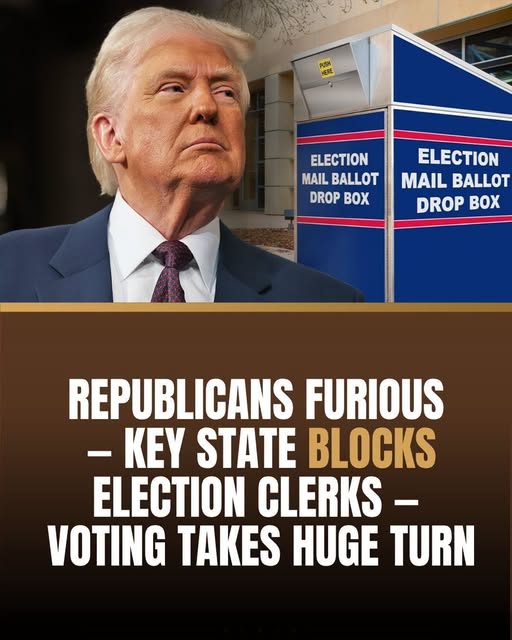
There is, however, a real and consequential fight underway over how Americans vote in the November 3, 2026, midterm elections. Mail ballots, local election authority, and federal intervention have all become points of legal conflict.
One major dispute centers on a Trump administration effort to impose new federal requirements on the handling and mailing of election ballots. State officials argued that the changes would be difficult to implement once election preparations were already underway.
In September, the Supreme Court declined to lift a lower-court injunction blocking key portions of the Postal Service rule for the November election. Existing state mail-voting procedures therefore remained in place.
The decision was politically unusual because several Republican secretaries of state also opposed the last-minute rule. Officials from six Republican-led states warned that sudden changes could confuse voters and administrators alike.
President Donald Trump criticized the court's action. Supporters of tighter rules maintain that consistent verification standards are important, while opponents argue that late changes can threaten lawful voting.
The ruling did not abolish mail voting or order county clerks to stop working. Instead, it limited the implementation of a particular federal policy during the election period.
At the local level, election officials continue to prepare for ballots arriving by mail, at drop boxes, and through in-person voting. Their responsibilities include checking eligibility, processing returns, and reporting results under state law.
In New Jersey, some county clerks have encouraged voters to use authorized ballot drop boxes rather than wait for postal delivery. Their messaging reflects concern about timing and reliability, not proof of widespread postal fraud.
By mid-October, drop boxes accounted for nearly half of the returned mail ballots counted in one New Jersey analysis. That marked a notable change from previous election cycles.
The shift does not mean every state has the same rules. Deadlines, available drop boxes, signature procedures, and ballot-return options differ substantially across the country.
Another flashpoint emerged in California, where the Justice Department asked officials to set aside ballots associated with voters it suspected were noncitizens. State election administrators challenged the accuracy of the federal information.
A federal judge rejected a request to segregate potentially thousands of ballots while voting was already underway, warning that the disruption could interfere with the election. The administration pursued further legal action.
The California dispute concerns a specific set of federal demands and allegations. It should not be confused with the graphic's unverified suggestion that a state generally blocked election clerks.
Other states have seen separate lawsuits about where absentee ballots may be returned. In Georgia, for example, a judge rejected a Republican challenge to a county policy allowing completed ballots to be handed to trained officials at designated early-voting sites.
The competing cases illustrate a broader tension: elected leaders want confidence in election security, while local administrators need stable rules that voters can understand and follow.
More than 19 million mail ballots had reportedly been returned nationwide by October 29, although early-voting figures were still changing. Mail voting remains significant despite the intense political debate.
Voters should rely on their own state or county election office for the applicable deadlines and authorized return locations. A viral graphic cannot substitute for official instructions or a court order.
As Election Day approaches, the real story is less about an unnamed state suddenly stopping clerks and more about the courts, administrators, and voters navigating a high-stakes election. The viral claim remains unsubstantiated; the documented disputes are serious enough without exaggeration.
Comments (0)
Loading comments...
May You Like

DAVENPORT AIRBNB HORROR — 40 OF 50 TEENS TEST POSITIVE FOR DRUGS SUPPLIED BY THE HOST'S MOM!

MINNESOTA NIGHTMARE—UNDERGROUND GAS LEAK, HUNDREDS OF HOMES AT RISK, $300M DAMAGE!

EAST COAST STORM CRISIS—5 MILLION AT RISK OF BLACKOUTS, WATER, AND HEATING FAILURES!








Popular Posts




