
Robert De Niro Explodes at Trump Over Voting Rights: “Keep Your F***ing Hands Off Our Vote!”
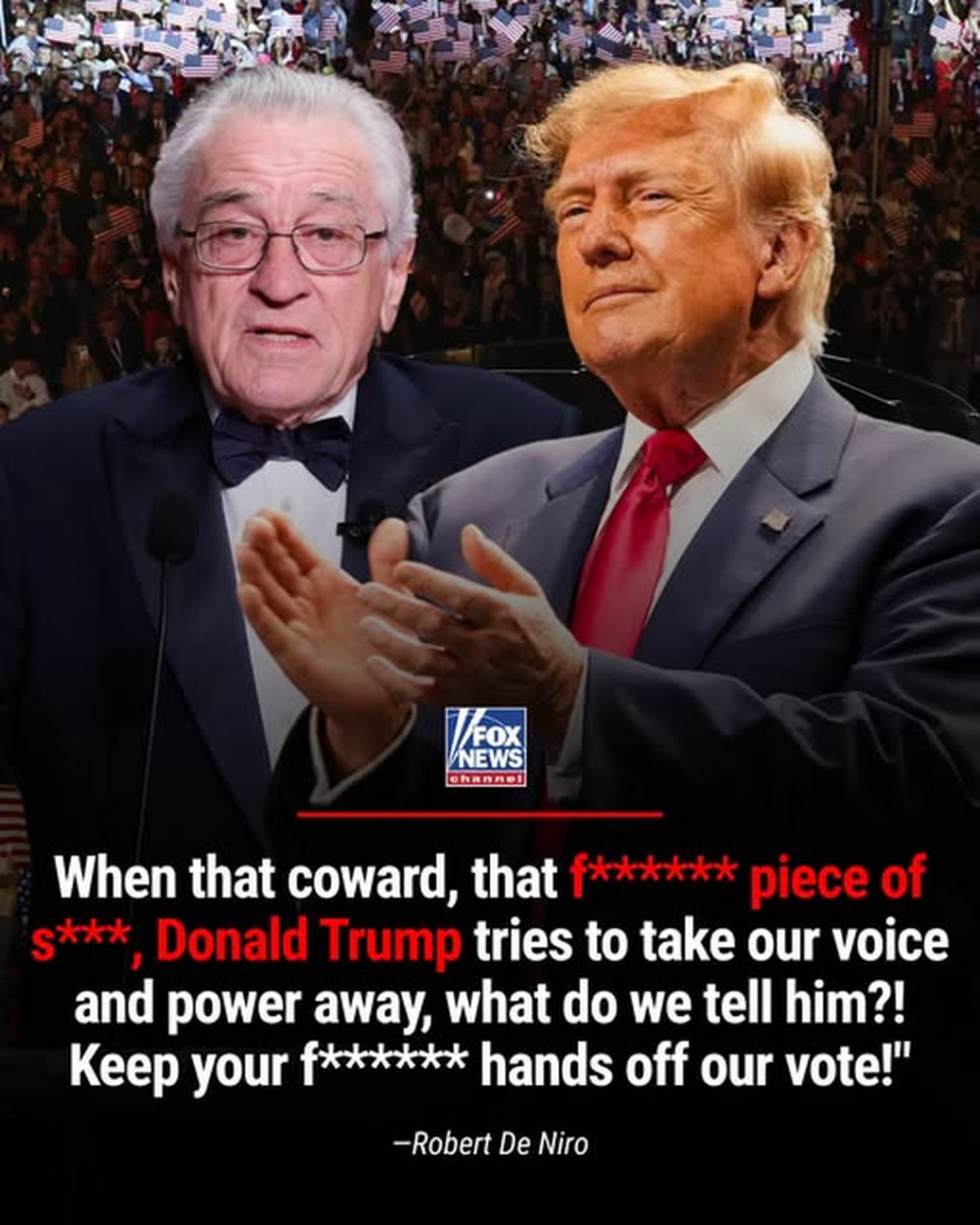
Robert De Niro has delivered a furious message to President Donald Trump, using a string of expletives to accuse the administration of threatening Americans’ political power. Speaking at a voting-rights rally in New York City, the Oscar-winning actor turned his criticism into a call-and-response chant that brought the audience into the confrontation.
“When that coward, that fing piece of s, Donald Trump, tries to take our voice and power away, what do we tell him?” De Niro asked. The crowd was prompted to answer with the rally’s central message: “Keep your f***ing hands off our vote!” The remarks were delivered on October 4, 2026, at the “Hands Off Our Vote” voter-mobilization event.
The speech quickly attracted attention because of its unusually direct language and the prominence of the speaker. De Niro, known for films including Taxi Driver, Raging Bull, and The Irishman, has been an outspoken critic of Trump for years. This time, however, his remarks were aimed not only at the president personally but also at a wider dispute over voting access, election administration, and the balance of power in Washington.
A Rally Focused on the Power of the Vote

The gathering brought together activists, public figures, and supporters concerned about voting rights ahead of the November 3, 2026, midterm elections. The event’s message was straightforward: voters should be able to participate in elections without intimidation or unnecessary barriers, and election rules should not be manipulated to determine political outcomes.
De Niro argued that political power ultimately belongs to the public, not to elected officials who may be tempted to protect their own positions. He described the ability to vote as a fundamental source of democratic authority and warned attendees that powerful people could try to weaken that authority once they had gained office.
AOL+1
His criticism extended beyond Trump. De Niro also attacked Republicans in Congress, accusing them of failing to protect voting rights. He challenged the audience to demand action from lawmakers and repeatedly returned to the same phrase: keep your hands off the vote.
The speech was structured to make the crowd part of the message. Rather than simply delivering a prepared political statement, De Niro posed questions and invited attendees to respond. The repeated chant turned the event into a public demonstration of opposition to policies that the speakers believed could restrict ballot access.

The event also featured actor Mark Ruffalo and other speakers who raised concerns about voting access and the administration’s approach to elections. Their appearances illustrated how celebrity participation has become part of broader political mobilization efforts, particularly when organizers seek to draw public attention to issues that might otherwise remain technical or legalistic.
Why De Niro Says Americans’ Votes Are at Risk
At the center of De Niro’s argument is his belief that the Trump administration’s policies are becoming increasingly unpopular and that political leaders may respond by changing the rules governing elections. He accused the administration of trying to take votes away when it could not win sufficient public support. That was De Niro’s political assessment, rather than an independently established finding that Trump had personally taken away voters’ ballots.
The wider debate involves several separate issues, including proof-of-citizenship requirements for voter registration, access to voter-roll data, mail-in voting, and the responsibilities of federal and state officials in administering elections. These questions have legal and practical consequences because the United States does not run elections through one centralized national system; states and local authorities play major roles in determining procedures and maintaining voter lists.
One prominent issue is the proposed SAVE Act, a congressional measure that would require documentary proof of U.S. citizenship when registering to vote in federal elections. The House passed the proposal, but it had not cleared the Senate as of the reporting surrounding De Niro’s speech. Supporters argue that stronger verification would protect election integrity, while opponents warn that additional documentation requirements could create obstacles for eligible citizens who lack ready access to the required records.
Another source of concern is the federal government’s use of citizenship and eligibility data to review voter rolls. Federal officials have argued that election systems should prevent ineligible people from voting. Critics, however, have raised questions about the accuracy of databases, the treatment of personal information, and the risk that eligible voters could be wrongly flagged or removed.
Those distinctions matter. Allegations of voter suppression, concerns about election security, and proven violations of election law are not interchangeable. De Niro used forceful language to express his concerns, but his speech itself does not establish that every allegation he raised has been legally proven.
The Administration’s Response

The White House responded to De Niro’s remarks with a personal attack on the actor. In a statement reported after the rally, spokesperson Davis Ingle dismissed De Niro as a has-been and accused him of spreading hate and encouraging hostility toward others. The response offered a sharp illustration of how the dispute had moved from voting policy to a public exchange of insults.
The response did not resolve the substantive questions at the heart of the rally: which election rules should be changed, what role the federal government should play in reviewing voter eligibility, and how officials can protect election integrity without disenfranchising eligible citizens.
Trump and his allies have defended stricter election measures as necessary to address concerns about noncitizen voting and the security of elections. Critics counter that safeguards must be based on reliable evidence and implemented carefully, because errors in voter-roll reviews or rushed procedural changes can affect legitimate voters as well.
The disagreement reflects a broader national argument over the limits of federal authority in elections. The Constitution assigns important election responsibilities to states and local jurisdictions, while Congress and federal agencies also have defined roles in regulating federal elections and enforcing voting-rights protections. Disputes over those boundaries often end up in court.
De Niro’s Long-Running Feud With Trump

The intensity of De Niro’s speech did not emerge in isolation. The actor has repeatedly criticized Trump in public appearances and speeches, making the president a recurring target of his political commentary. Trump, in turn, has often responded by attacking De Niro personally. Their exchanges have become part of a wider culture-war conflict involving Hollywood, political activism, and competing views of the presidency.
For De Niro, the voting-rights argument is tied to a larger concern about the direction of American democracy. His speech suggested that political participation should be treated as a safeguard against the concentration of power, rather than merely as a routine activity that takes place on Election Day.
His language was deliberately confrontational. Supporters may see the bluntness as a way to capture attention and communicate urgency. Critics may view the profanity and personal insults as evidence that celebrity political appearances can deepen polarization rather than encourage serious discussion of policy.
Neither reaction, by itself, determines the merits of the underlying election-policy debate. The central questions remain whether particular measures are lawful, whether they solve documented problems, and whether their implementation protects the rights of eligible voters.
Why the Midterm Elections Matter

The rally took place as Americans prepared to vote in the November midterms, when control of the House of Representatives and Senate would be contested. Those elections can significantly affect the president’s ability to advance legislation, secure congressional support, conduct oversight, and negotiate over federal spending.
De Niro urged attendees to vote early, encourage family members and neighbors to participate, and work to change the balance of power in Congress. He concluded with a political call to action: “Take back the House. Take back the Senate. Take back the power. Take back our country.”
The message made clear that the rally was not simply a nonpartisan discussion about election procedures. De Niro explicitly called on voters to oppose Trump and his congressional allies. His speech was political advocacy, and its claims should be evaluated alongside the underlying evidence about election rules and voting access.
At the same time, the controversy underscores why election administration remains such a consequential issue. Rules designed to prevent fraud must be assessed for effectiveness, while policies that risk blocking eligible citizens from voting require serious scrutiny. Reliable evidence, transparent procedures, and judicial oversight are essential to resolving disputes without undermining public confidence.
A Profanity-Filled Warning With a Larger Message
De Niro’s remarks turned a technical debate over election administration into a dramatic public confrontation. By directing his anger at Trump and repeating the demand that officials keep their hands off voters’ ballots, he sought to make the issue immediate and memorable.
But the speech also highlights the difference between political rhetoric and verified fact. De Niro’s accusation that the administration is trying to take away Americans’ votes is his interpretation of its policies; it should not be treated as proof that Trump has unlawfully removed votes or that every proposed election measure amounts to voter suppression.
The lasting significance of the rally will depend less on the profanity than on what happens next: how election policies are implemented, how courts assess legal challenges, and whether eligible Americans can participate in the electoral process without improper barriers.
As the midterms approach, the fundamental question remains: Will the fight over voting rules strengthen public trust in American elections—or deepen the divisions over who gets to shape the country’s political future?
Comments (0)
Loading comments...
May You Like

STAR DIED AT 38, $10M LIFE INSURANCE INCREASED JUST 30 DAYS BEFORE WWE BRONSON REED'S DEATH!

WWE BRONSON REED—STAR COLLAPSES AT COMPANY EVENT, FATAL DRUG REACTION SUSPECTED!

BOMBSHELL NEW JERSEY FLOOD — 112 KM/H WINDS, SEAWATER FLOODING INLAND, 120,000 HOMES AT RISK!
MINNESOTA EMERGENCY — HOUSE EXPLOSION PUTS 2 HUNDRED FAMILIES AT RISK OF FIRE AND WINTER EVACUATION!











Popular Posts



