
Ron Howard’s Blunt Words About Trump Resurface: The Hollywood Criticism That Sparked a Political Firestorm
Ron Howard’s Blunt Words About Trump Resurface: The Hollywood Criticism That Sparked a Political Firestorm
The filmmaker’s sharp assessment of Donald Trump was posted in January 2020. Years later, the quote continues to circulate as a reminder of how celebrity, political identity and public debate collide in the United States.
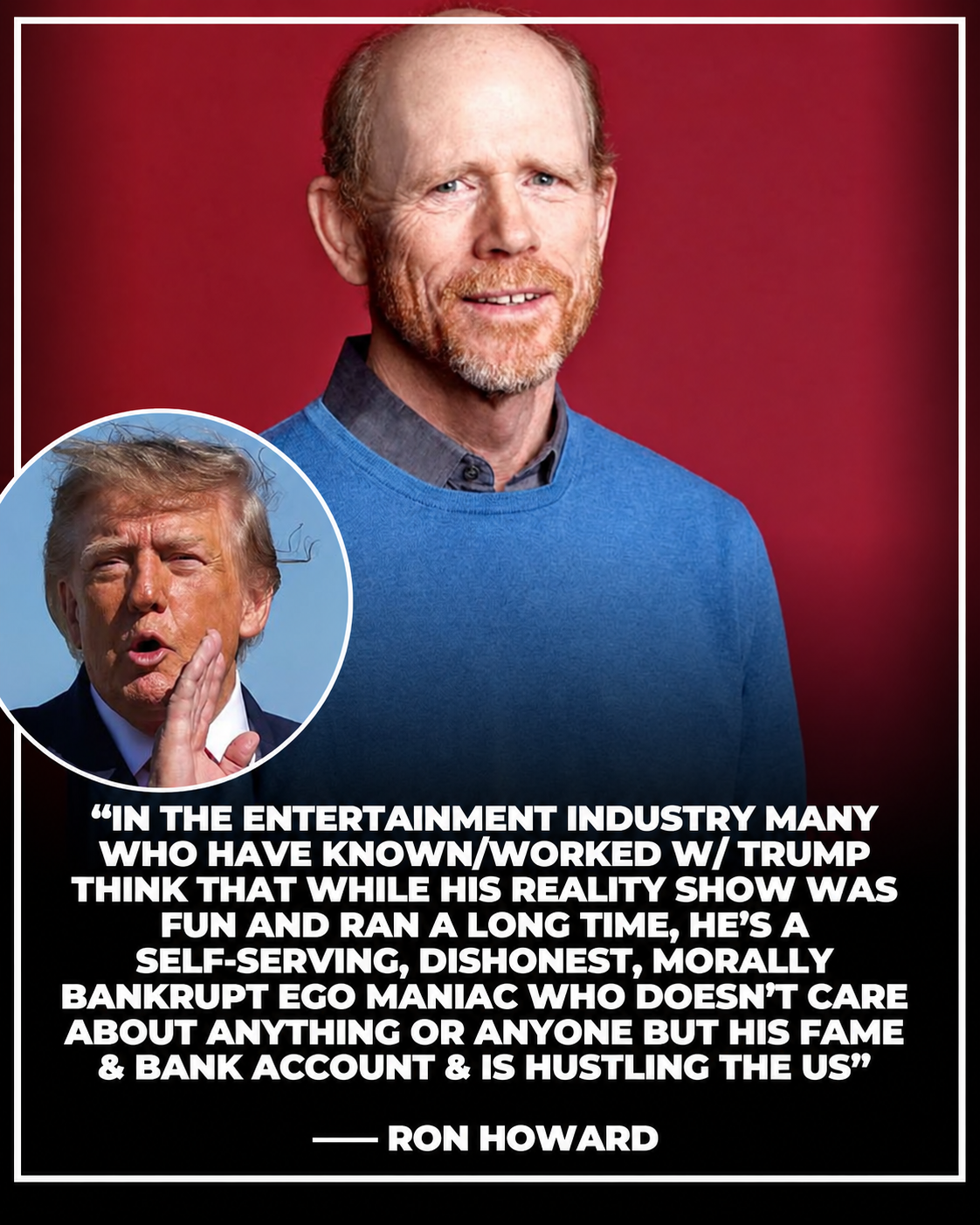
A forceful political quote attributed to filmmaker Ron Howard has resurfaced online, reigniting discussion about Hollywood’s relationship with Donald Trump. The image pairs Howard’s portrait with a photograph of Trump and presents a sharply worded criticism of the former reality-TV star turned political leader.
The quote is not new. News coverage from January 2020 reported that Howard posted the remarks on social media on New Year’s Day, during Trump’s first term in the White House. Its renewed circulation reflects the staying power of political statements in the social-media era.
Howard’s words were direct and personal, describing how some people in the entertainment industry who had known or worked with Trump viewed him. The post argued that the appeal of Trump’s television persona should not be mistaken for evidence of his character or his approach to public office.
The context behind the viral quote
Howard published the post while responding to a social-media user who questioned why Hollywood figures and Democrats appeared so negative about Trump, even when supporters pointed to perceived achievements during his administration. Howard’s reply framed his criticism as a view he believed was shared by people with experience of Trump in the entertainment business.
The exchange quickly attracted attention. Coverage at the time highlighted both the unusually blunt language and the broader argument over whether Hollywood’s criticism of Trump reflected firsthand experience, partisan disagreement or the cultural divide between entertainment figures and conservative voters.

Howard’s post did not mean that every person in entertainment agreed with him. The wording referred to “many” people who had known or worked with Trump, while the industry itself includes a wide range of political views. Viral graphics can flatten that nuance into a simpler, more dramatic message.
Who is Ron Howard?
Howard has spent decades moving between acting, directing and producing. He first became widely known as a child actor and later established himself as a filmmaker behind major studio productions and acclaimed dramas.
His directing credits include “Apollo 13,” “A Beautiful Mind” and “Frost/Nixon,” films that helped cement his reputation beyond his early television career. His work has often involved real events, public figures and the ways individuals respond to pressure, power and historical change.
That career gives Howard a recognizable voice in discussions about the entertainment industry. But his professional standing does not make his political judgments neutral facts; the 2020 post remains an expression of his own assessment and the perspective he attributed to others.
Howard has criticized Trump publicly on more than one occasion. In 2018, he responded to one of Trump’s social-media posts with a rebuke over spelling and what he characterized as frightening or distorted rhetoric. His comments in 2020 therefore fit within a longer record of public disagreement rather than representing an isolated remark.

Trump’s television fame and political brand
Before entering presidential politics, Trump became a familiar television personality through “The Apprentice.” The show presented him as a decisive business figure and turned his catchphrase and on-screen persona into recognizable parts of popular culture.
That television profile later became part of his political appeal. Supporters saw a successful outsider willing to challenge established institutions, while critics argued that the image cultivated for entertainment did not necessarily demonstrate the skills or temperament needed for public leadership.
Howard’s 2020 comment focused on this tension between the entertainment persona and the political figure. It suggested that people who had encountered Trump in professional settings might distinguish the spectacle of a successful television show from their assessment of the man behind it.
Such arguments are common in celebrity politics. A public figure’s fame can make a campaign message instantly recognizable, but familiarity is not the same as agreement. The same background that attracts one voter can prompt skepticism from another.
Why celebrity political statements spread
Actors, musicians and directors have large platforms, and a pointed post can travel far beyond its original audience. A short quote card is easy to share, easy to understand at a glance and likely to provoke strong reactions—qualities that help political content spread online.
But the format also strips away context. It may omit the question that prompted a response, the date of the statement or the fact that the speaker was expressing an opinion. When a years-old quote circulates without a date, readers may mistakenly assume it was made in response to a current event.
That is why the date matters here. Contemporary reporting traces Howard’s statement to January 1, 2020. The renewed appearance of the graphic does not, by itself, establish that he has repeated the same wording recently.
Political audiences also tend to interpret celebrity statements through their existing beliefs. Supporters of Howard may see the quote as a candid warning, while Trump’s supporters may view it as another example of Hollywood hostility. The same post can become evidence for competing narratives.
Hollywood is not a single political bloc
It is tempting to treat “Hollywood” as though it were one political organization, but the entertainment business is made up of millions of workers, executives, performers and creators with different backgrounds and priorities. Publicly visible stars do not necessarily represent the views of everyone who works behind the scenes.
Some entertainers campaign openly, donate to candidates or speak at political events. Others avoid public political commentary because they prefer to keep attention on their work, fear alienating audiences or simply do not want to make their personal beliefs part of their professional identity.
Nor does criticism from a celebrity settle a political debate. Howard’s comments reveal his judgment and contribute to public discussion, but readers should evaluate political leaders through a broad range of evidence, including their policies, actions, public records and credible reporting.
How to read a viral political quote
When a striking quote appears in a graphic, the first step is to look for the original post or contemporaneous coverage. Confirming the wording and date helps distinguish a genuine statement from an altered quote, a misleading crop or an old remark presented as breaking news.
The second step is to separate fact from opinion. It is verifiable that Howard made the post in 2020, and it is fair to describe the language as strongly critical. The claims about Trump’s motives and character, however, are Howard’s assessment and should be attributed to him rather than repeated as objective fact.
Finally, readers should ask what the image leaves out. A dramatic portrait, a second image and large block lettering can create a strong emotional impression, but they cannot supply all the context needed to understand a political exchange.
A quote that continues to reflect a wider divide
Howard’s statement remains memorable because it captures a long-running clash between celebrity culture and political identity. Trump’s career crossed the worlds of business, television and electoral politics, while Howard’s criticism illustrates how some people in entertainment came to see that transition with deep suspicion.
Years after the original post, the quote continues to circulate because the argument behind it has not disappeared. Americans still debate how much weight to give a celebrity’s endorsement or criticism, whether entertainers should use their platforms politically and how public figures’ pasts should shape judgments about their present roles.
The clearest takeaway is also the simplest: the quote is real, but it dates to January 2020. Its renewed circulation is a new moment in the life of an old statement—not evidence that Howard has just issued the same criticism again.
Comments (0)
Loading comments...
May You Like

WWE BRONSON REED DEAD AT 38, STIMULANTS DETECTED, $10M INSURANCE PAYOUT FROZEN!

WWE BRONSON REED—STAR COLLAPSES AT COMPANY EVENT, FATAL DRUG REACTION SUSPECTED!

EAST COAST MEGASTORM—2 MILLION HOUSES DAMAGED, 5 MILLION AT RISK OF BLACKOUTS, WATER FAILURES!
MINNESOTA EMERGENCY — HOUSE EXPLOSION PUTS 2 HUNDRED FAMILIES AT RISK OF FIRE AND WINTER EVACUATION!










Popular Posts



