
Rubio Praises Trump's Iran Nuclear Diplomacy
Rubio Praises Trump's Iran Nuclear Diplomacy as Viral Obama Response Revives Debate Over the 2015 Nuclear Deal
October 31, 2026 | Washington, D.C. | U.S. Politics & Middle East | Fact Check
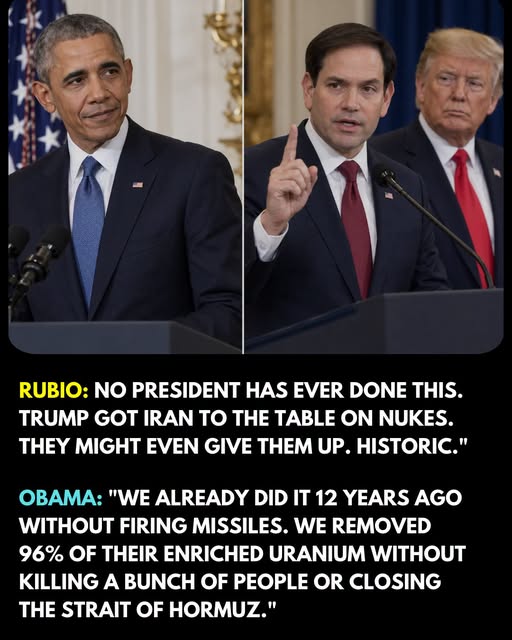
A viral political graphic featuring Barack Obama, Secretary of State Marco Rubio, and President Donald Trump has sparked debate over which administration deserves credit for advancing nuclear negotiations with Iran.
The image portrays Rubio celebrating Trump's ability to bring Tehran to the negotiating table, while attributing a sharp response to Obama defending his administration's earlier diplomatic achievements.
According to the graphic, Rubio suggested that Trump's approach could persuade Iran to abandon nuclear weapons ambitions, describing the potential breakthrough as an unprecedented achievement in American presidential history.
Obama is depicted responding that his administration had already achieved substantial nuclear restrictions through diplomacy, without launching military strikes or disrupting shipping through the Strait of Hormuz.
Fact-check finding: The historical substance of Obama's argument has a documented basis in the 2015 nuclear agreement. However, the graphic provides no original recordings establishing that either politician delivered these exact statements.
Two Competing Approaches to Iran
The comparison reflects a longstanding disagreement between Democratic and Republican administrations over how best to prevent Iran from developing nuclear weapons while maintaining stability across the Middle East.
Obama's administration prioritized multilateral negotiations, international inspections, and sanctions relief in exchange for restrictions on Iran's nuclear program, culminating in the 2015 Joint Comprehensive Plan of Action.
Trump rejected that agreement during his first presidency, arguing that its limitations were inadequate and that stronger economic pressure was necessary to secure a more comprehensive arrangement.
Rubio has similarly criticized the original agreement, particularly its limited treatment of Iran's ballistic missile development, regional activities, and restrictions scheduled to expire over time.
Rubio's Position: Pressure Must Produce Results
Rubio has repeatedly argued that previous administrations recognized the danger of an Iranian nuclear weapon but failed to take sufficiently decisive action to eliminate the threat.
During a May 5 White House briefing, he contrasted Trump's approach with those of earlier presidents, presenting military pressure as a necessary response to Iran's nuclear ambitions.
Rubio also warned that Tehran's ability to threaten international shipping demonstrated the danger of allowing it to acquire additional strategic leverage through nuclear weapons.
In October, Rubio reiterated that preventing Iran from obtaining nuclear weapons remained a central American objective, although he declined to specify publicly what enrichment arrangements Washington might accept.
His documented remarks support the graphic's general portrayal of his position, but they do not authenticate its precise claim that no president had previously brought Iran into nuclear negotiations.
What Obama Actually Said About Diplomacy
Obama's position is supported by his documented remarks defending the nuclear agreement negotiated during his second presidential term, particularly its restrictions on uranium enrichment and international verification.
During an October 24 campaign appearance in Cleveland, Obama criticized Trump's decision to abandon the agreement and argued that diplomacy had constrained Iran's nuclear activities without military intervention.
His comments included a direct defense of the agreement's effectiveness, emphasizing that his administration had achieved its central nuclear objectives without launching missile strikes against Iran.
However, the viral graphic's specific wording about removing 96 percent of Iran's enriched uranium has not been established as a verbatim quotation from that appearance.
Did the 2015 Agreement Really Remove Iran's Enriched Uranium?
The historical record confirms that the agreement achieved substantial reductions in Iran's enriched uranium stockpile, making the underlying numerical argument in the viral graphic broadly credible.
Under the agreement, Iran shipped approximately 11,000 kilograms of low-enriched uranium to Russia, reducing its stockpile by approximately 98 percent rather than the graphic's stated 96 percent.
On January 16, 2016, the International Atomic Energy Agency verified that Iran had completed the nuclear-related measures required for the agreement's implementation, enabling corresponding sanctions relief.
The agreement also restricted enrichment levels, reduced the number of operating centrifuges, and established additional monitoring arrangements intended to increase international confidence in Iran's nuclear activities.
These measures represented a significant diplomatic achievement, although they did not permanently eliminate Iran's nuclear infrastructure or resolve every concern surrounding its longer-term nuclear intentions.
Why the Strait of Hormuz Matter
The graphic's reference to the Strait of Hormuz introduces another dimension to the disagreement: whether military pressure has created economic and security complications that diplomacy previously avoided.
The narrow waterway connects the Persian Gulf to international shipping routes, making it strategically important for countries dependent on Middle Eastern oil and natural gas exports.
Obama's argument emphasizes the economic consequences of military escalation, while Rubio maintains that preventing Iran from developing nuclear weapons requires confronting threats that diplomacy alone may not resolve.
What the Viral Exchange Gets Right and Wrong
The strongest factual element in the graphic is its reference to Obama's earlier nuclear agreement, which demonstrably reduced Iran's enriched uranium stockpile under international verification.
The weakest element is its presentation of two condensed political statements as a direct exchange, without providing original recordings confirming that Rubio and Obama used those exact words.
The claim that Trump accomplished something no previous president had achieved is also historically misleading if interpreted as referring simply to bringing Iran into nuclear negotiations.
Final Fact-Check Verdict
The graphic is partly supported but misleadingly presented. Obama negotiated a nuclear agreement that substantially reduced Iran's enriched uranium stockpile, while Rubio has publicly defended Trump's more confrontational approach.
However, the alleged quotations cannot be fully authenticated as written, and the verified historical reduction was approximately 98 percent, not the 96 percent stated in the image.
Comments (0)
Loading comments...
May You Like

NYC EMERGENCY—MILLIONS FACE EVACUATION RISKS, MACY'S GIANT BALLOONS REMOVED FOR SAFETY!

BANGCHAK REFINERY DISASTER IN THAILAND—120,000 BARRELS A DAY SHUT DOWN, U.S. OIL PRICES SURGE 10%!

TRUMP CALLS GDP FIGURE “FAKE” AFTER GOVERNMENT’S SCHEDULED REVISION

Latest Posts








Popular Posts



