Russia Warned NATO It Could Use Nuclear Weapons Over Kaliningrad — What Would Trigger That Scenario?
Moscow’s warning was conditional: it said Russia could use its full arsenal if NATO tried to isolate or attack the Baltic exclave. NATO says it has no such offensive plan and has rejected the nuclear rhetoric as irresponsible.
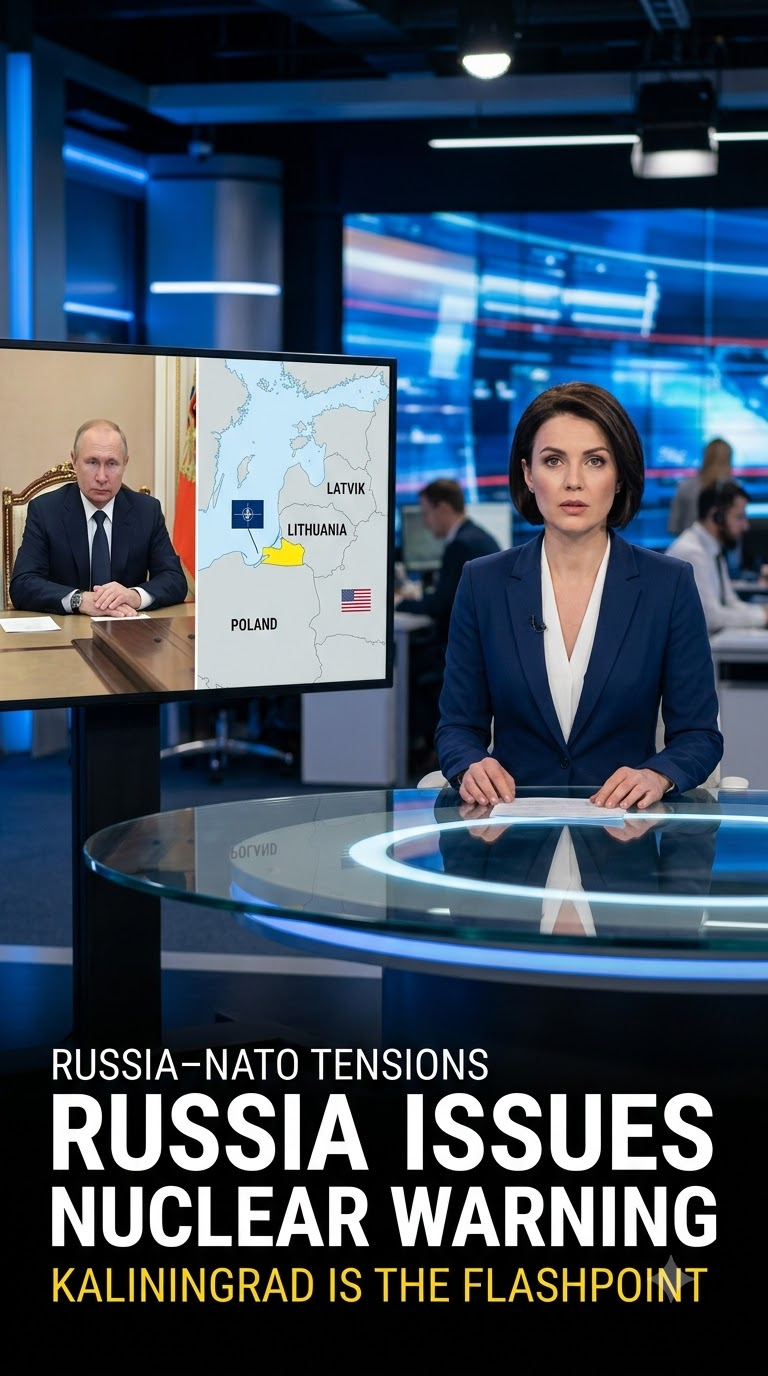
Russia has delivered one of its starkest recent warnings to NATO: if the alliance tries to cut off Kaliningrad from the rest of Russia, Moscow says it could respond with every capability at its disposal, including nuclear weapons.
The language appeared in a diplomatic document sent to NATO and seen by Reuters on September 30. Russia accused the alliance of following a dangerous course that could lead to direct armed conflict and warned that strikes against decision-making centers in NATO countries could occur from the outset of such a conflict.
But the most important detail is what the warning did — and did not — say.
Russia did not announce that it was preparing to launch a nuclear strike now. The threat was conditional, tied specifically to a scenario in which NATO countries tried to isolate or attack Kaliningrad, a Russian territory separated from the rest of the country and surrounded on land by NATO members Poland and Lithuania.
NATO responded that it is a defensive alliance, that its exercises do not threaten Russian territory and that Moscow should stop what the alliance called irresponsible nuclear rhetoric.
Russia said nuclear weapons could be used if NATO attempted to isolate Kaliningrad. NATO says it is not planning an attack or blockade and that its current activities are defensive.
Why Kaliningrad matters so much
Kaliningrad is geographically small compared with Russia itself, but its military value is far larger than its size suggests.
The Russian exclave sits on the Baltic Sea between Poland and Lithuania, both NATO members. It has a population of roughly one million and is slightly larger than Connecticut.
It is also home to major Russian military infrastructure, including elements of the Baltic Fleet, air-defense systems and missile forces. Nuclear-capable Iskander missiles are deployed in the region, giving Moscow a forward military position deep inside NATO’s northeastern flank.
That location gives Russia strategic reach, but it also creates vulnerability.
Unlike most Russian territory, Kaliningrad has no land border with mainland Russia. In a major military confrontation, supplies and reinforcements would have to reach it through the Baltic Sea, by air or through friendly territory. That makes any scenario involving disrupted access especially sensitive for Moscow.
Kaliningrad’s strategic position
A NATO member whose territory borders the Russian exclave and whose defense posture has strengthened since the invasion of Ukraine.
A NATO member that has publicly emphasized the threat posed by Russian military installations in Kaliningrad.
The region hosts naval, missile and air-defense assets capable of affecting operations across the Baltic and parts of northern Europe.
What Russia says NATO is preparing
Russian embassies in several European countries have said Moscow has information that NATO is preparing scenarios involving an air and naval blockade of Kaliningrad.
That is a Russian claim. Public evidence confirming that NATO has decided to impose such a blockade has not been presented.
NATO spokesperson Allison Hart said the alliance had replied to Moscow and stressed that none of its exercises or activities posed a threat to Russian territory.
Secretary General Mark Rutte gave a similarly restrained response. Asked whether Russia’s warning meant the risk of nuclear weapons being used against the Baltic states was now real, he said no and argued that Moscow understood it could not defeat NATO in a direct confrontation.
Rutte also said there was no imminent threat to NATO territory from Russia, while emphasizing that the alliance remained prepared to defend its members.
Russia and NATO are describing the same situation very differently
Russia’s position
Moscow says NATO exercises, military movements and statements about Kaliningrad show a growing threat to the exclave. It warns that an attempt to isolate the region would be treated as an attack on Russian territory.
NATO’s position
The alliance says its activity in the Baltic is defensive, denies that its exercises threaten Russia and argues that Moscow is using irresponsible nuclear rhetoric while continuing its war in Ukraine.
The tension did not begin with this week’s warning
Pressure around Kaliningrad has been building for years, and especially since Russia launched its full-scale invasion of Ukraine in 2022.
NATO has strengthened its eastern flank, while Finland and Sweden joined the alliance, changing the strategic balance around the Baltic Sea.
In May 2026, Lithuania’s foreign minister drew an angry reaction from Moscow after saying NATO needed to demonstrate that it could penetrate what he described as the “small fortress” Russia had built in Kaliningrad and destroy military infrastructure there if necessary.
Then, in mid-August, a Western military source told Reuters that dozens of NATO aircraft took part in an unannounced operation around Kaliningrad. The exercise demonstrated an ability to disrupt the exclave’s radio and radar connections and suppress air defenses in a conflict scenario.
That exercise did not itself constitute an attack or blockade. But from Moscow’s perspective, it added to a pattern of activity that Russian officials have portrayed as preparation for a possible confrontation.
How the pressure built in 2026
Why analysts worry about miscalculation
The immediate danger is not necessarily that either side has decided to start a war.
The larger risk is that one side interprets an exercise, interception, drone incident, infrastructure disruption or military deployment as something more serious than the other side intended.
Nikolai Sokov, a former Russian diplomat and nuclear analyst, told Reuters that Russia and European countries were moving toward a dangerous collision course and that the risk of mutual miscalculation was increasing.
Kaliningrad is unusually exposed to that problem because nearly every military movement around it occurs close to NATO territory, while much of NATO’s effort to protect Baltic airspace, shipping lanes, undersea cables and pipelines takes place near Russian forces.
An incident that might be manageable elsewhere could therefore become more difficult to contain if Moscow interpreted it as the beginning of an attempt to isolate the exclave.
Potential paths to a crisis — not predictions
| Possible incident | Why it could become dangerous |
|---|---|
| A drone or aircraft crosses a border | Both sides operate close to one another, increasing the chance that an accident or disputed incursion is treated as deliberate. |
| Undersea infrastructure is damaged | Europe has already raised concerns about sabotage of cables and pipelines, while Russia denies responsibility for such activity. |
| Shipping or air access is disrupted | Moscow has explicitly linked any attempt to isolate Kaliningrad to the possibility of a much stronger military response. |
| New missile or air-defense deployments | Either side could interpret new systems as preparation for offensive action rather than deterrence. |
Why the nuclear language matters even if no attack is imminent
Nuclear threats are not ordinary diplomatic warnings.
Even when framed as deterrence and tied to a hypothetical scenario, they raise the consequences of misunderstanding because they tell the other side that certain actions might cross a threshold with potentially catastrophic consequences.
Russia has repeatedly invoked its nuclear arsenal during the war in Ukraine. NATO countries, for their part, have sought to support Kyiv while avoiding direct military conflict with Moscow.
The Kaliningrad warning brings that balancing act into one of Europe’s most sensitive geographic areas.
At the same time, NATO’s public response has been designed to avoid treating the Russian message as evidence that nuclear use is imminent. Rutte has urged calm, said there is no current imminent threat to NATO territory and argued that the alliance should continue its existing defensive posture.
What is established — and what remains a claim
| Established | Not established |
|---|---|
| Russia sent NATO a written warning saying it could use nuclear weapons if Kaliningrad were isolated. | That Russia has decided to use nuclear weapons now. |
| Kaliningrad is heavily militarized and sits between Poland and Lithuania. | That NATO has approved or begun an actual blockade of the exclave. |
| NATO has increased military activity and exercises in the Baltic region. | That those activities amount to an offensive plan to seize Kaliningrad. |
| NATO publicly rejected Moscow’s nuclear rhetoric and said its activities are defensive. | That either side currently expects a direct Russia-NATO war to begin imminently. |
The real significance of the warning
The most dramatic reading of the story is that Russia has threatened nuclear war with NATO.
The more precise reading is narrower but still serious: Moscow has explicitly attached nuclear consequences to a specific scenario involving the isolation of Russian territory in the Baltic.
That makes Kaliningrad important not because war there is inevitable, but because the region combines military hardware, vulnerable geography, overlapping exercises, competing threat perceptions and nuclear signaling in a very small space.
NATO says it is not threatening the exclave. Russia says it is warning the alliance not to cross a line.
For now, those positions remain words rather than direct combat.
The danger is what happens if an incident in the Baltic causes one side to believe the other has begun moving from exercises and warnings to the scenario both say they want to avoid.
Comments (0)
Loading comments...
May You Like

Obama Steps Back Into the Political Spotlight as Democrats Target Trump’s Senate Majority

gfnhgmnghnmfgnbvvvvvvvvv

OBAMA STEPS BACK INTO THE POLITICAL SPOTLIGHT