Russian Drone Strikes Kyiv Bridge as German Chancellor Arrives in Ukraine
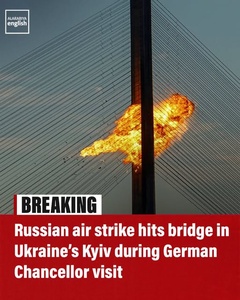
KYIV — A Russian drone struck a major bridge in Kyiv on Sunday, October 4, as German Chancellor Friedrich Merz arrived in the Ukrainian capital for an unannounced visit aimed at demonstrating Germany's support for Ukraine.
Air-raid sirens sounded across the city shortly after Merz's arrival, while Ukrainian air defenses responded to incoming Russian drones. The strike damaged the roadway of Kyiv's Northern Bridge, according to Kyiv Mayor Vitali Klitschko. Two people were reported injured.
The timing immediately drew international attention, although there is no confirmed evidence that the strike was specifically intended to target Merz.
Instead, Ukrainian and Western officials describe the incident as part of a broader escalation in Russian attacks against Kyiv's transportation and critical infrastructure.
A Bridge Hit as Merz Arrived
Merz arrived in Kyiv on Sunday morning with a delegation that included Germany's economy minister and senior business executives.
Almost immediately, the visit unfolded under the threat of another Russian air attack.
The Northern Bridge, which crosses the Dnipro River and connects parts of eastern and western Kyiv, was struck after Russian drones approached the capital. Video footage showed a large explosion and fire on the bridge while vehicles were still nearby.
Klitschko said the strike damaged the road surface and emergency services were sent to the area.
The attack was particularly significant because it was the second consecutive day that the Northern Bridge had been hit, according to reporting from the region.
Kyiv's Bridges Are Becoming a New Battlefield
The incident was not isolated.
Russian forces have increasingly targeted Kyiv's bridges and transportation infrastructure in recent days.
Earlier in the week, Russian drones struck near the supports of the Southern Bridge, disrupting an important transportation connection between the two sides of the capital. Other bridges have also faced restrictions or attacks.
The strategic significance is considerable.
Kyiv sits on both sides of the Dnipro River, making its bridges essential for the movement of commuters, emergency services, supplies and military logistics.
Ukrainian officials have warned that repeated attacks could disrupt connections between the city's eastern and western banks.
By Sunday, several major bridges were operating under restrictions, contributing to serious traffic congestion across the capital.
The Attack Came During a Major Show of German Support
Merz's visit was designed to send a political message.
Germany has become one of Ukraine's most important military supporters, particularly as Kyiv continues to face large-scale Russian drone attacks.
During the visit, Merz announced a new package of assistance worth more than €1.3 billion, including approximately €1 billion in military support and €350 million for repairs to Ukraine's energy infrastructure.
The military package is expected to include long-range weapons, combat drones and satellite-related capabilities.
Germany and Ukraine are also expanding cooperation on drone production, including systems designed to intercept Russia's increasingly sophisticated jet-powered drones.
Merz: Germany Will Not Be Intimidated
The attacks did not cause Merz to cancel his visit.
Instead, the German chancellor used the moment to emphasize continued European support for Ukraine.
Merz said he had traveled to Kyiv because Ukraine needs international support in the coming weeks, warning that if Russia is not stopped, its war machine could eventually threaten Europe.
He also directly called on Russian President Vladimir Putin to stop the war and demonstrate a willingness to negotiate.
The message was unmistakable: Germany intends to continue supporting Ukraine despite the increasing risks surrounding the conflict.
Zelenskyy Shows Merz the Damage
During the visit, Ukrainian President Volodymyr Zelenskyy took Merz to the National Academy of Sciences of Ukraine, which had been damaged in an earlier Russian drone strike.
Zelenskyy described the situation facing Kyiv residents as extremely difficult, with repeated nights of air attacks and damage to civilian infrastructure.
The symbolism was powerful.
Merz had arrived to demonstrate European solidarity, and almost immediately he witnessed the reality of the war directly.
For Kyiv, the visit also provided an opportunity to highlight its urgent need for additional air-defense systems as winter approaches.
Energy Infrastructure Is Becoming a Major Concern
The bridge attacks are occurring alongside a broader Russian campaign against Ukrainian infrastructure.
Energy facilities have become a particular focus as Ukraine prepares for another winter of war.
Germany's additional €350 million for energy repairs is therefore strategically important. Ukrainian officials fear that sustained attacks could damage electricity and heating infrastructure just as temperatures begin to fall.
The objective, according to Ukrainian officials, is not simply to damage individual facilities.
It is to put pressure on the country's ability to maintain essential services.
The Military Cooperation Is Expanding
The new German-Ukrainian agreements go beyond financial assistance.
German companies and Ukrainian partners signed numerous agreements covering air-defense systems, radar equipment, drones and other military technologies.
Reuters reported that the agreements signed during Merz's visit totaled billions of euros and included cooperation involving companies such as Diehl Defence and Siemens Energy.
The countries are also working toward deeper defense-industrial cooperation.
For Ukraine, producing more weapons domestically or jointly with European partners could reduce dependence on deliveries from individual allies.
For Germany, the partnership is becoming part of a broader effort to strengthen Europe's own defense capabilities.
Was Merz Himself the Target?
This is where caution is necessary.
The image and headlines surrounding the incident can make it appear as though Russia deliberately attacked the bridge because the German chancellor was there.
That has not been established.
The strike occurred shortly after Merz arrived, but Russian attacks on Kyiv's bridges had already been underway for several days. The Northern Bridge itself had reportedly been attacked the previous day.
The evidence therefore supports a more measured conclusion:
The attack coincided with Merz's visit, but there is currently no confirmed evidence that Merz was the intended target.
The timing nevertheless made the incident highly significant politically.
Russia Warns Foreign Nationals
The attack also came after Russia warned foreign diplomats and nationals to leave Kyiv because of the risk of further attacks.
Moscow has threatened to intensify strikes following Ukrainian attacks on Russian infrastructure, including oil refineries.
Ukraine, meanwhile, has indicated that it intends to continue striking Russian military and energy targets.
That creates a dangerous cycle in which attacks on infrastructure by one side generate retaliation from the other.
The Diplomatic Track Is Still Alive
Despite the escalation, diplomacy has not completely disappeared.
During Merz's visit, Zelenskyy said the United States had proposed another round of Russia-Ukraine talks, potentially involving Washington, Kyiv and Moscow later in October.
Whether those negotiations can produce meaningful progress remains uncertain.
Russia and Ukraine remain far apart on the central issues of territory, security guarantees and the future status of occupied areas.
At the same time, the continued attacks make any diplomatic breakthrough more difficult.
What Happens Next?
The immediate concern for Kyiv is infrastructure.
Repeated attacks on bridges, transportation routes and energy facilities could create increasing disruption as winter approaches.
For Germany, the challenge is equally significant: provide Ukraine with enough military and financial support to strengthen its defenses without allowing the conflict to expand into a direct confrontation between Russia and NATO.
Merz's visit demonstrated that Germany is prepared to continue backing Kyiv.
The Russian strike demonstrated something equally important:
Even during a high-profile diplomatic visit, Kyiv remains directly exposed to the war.
The attack on the Northern Bridge was not merely a dramatic image.
It was another indication that Russia's campaign against Ukrainian infrastructure is intensifying—and that Europe is preparing to respond with greater military and economic suppo
Comments (0)
Loading comments...
May You Like
Russian Drone Strikes Kyiv Bridge as German Chancellor Arrives in Ukraine

Shocking news from Ohio: an unexpected development ahead of Trump's rally

South Korea–Ukraine Rift Deepens Over North Korean POW Transfer as PURL Draws New Scrutiny