
“Say NO to Greed and Oligarchy”: Inside Bernie Sanders’ Viral Takedown of Google’s Sergey Brin—and the $102 Million Fight Over California’s Wealth Tax
“Say NO to Greed and Oligarchy”: Inside Bernie Sanders’ Viral Takedown of Google’s Sergey Brin—and the $102 Million Fight Over California’s Wealth Tax
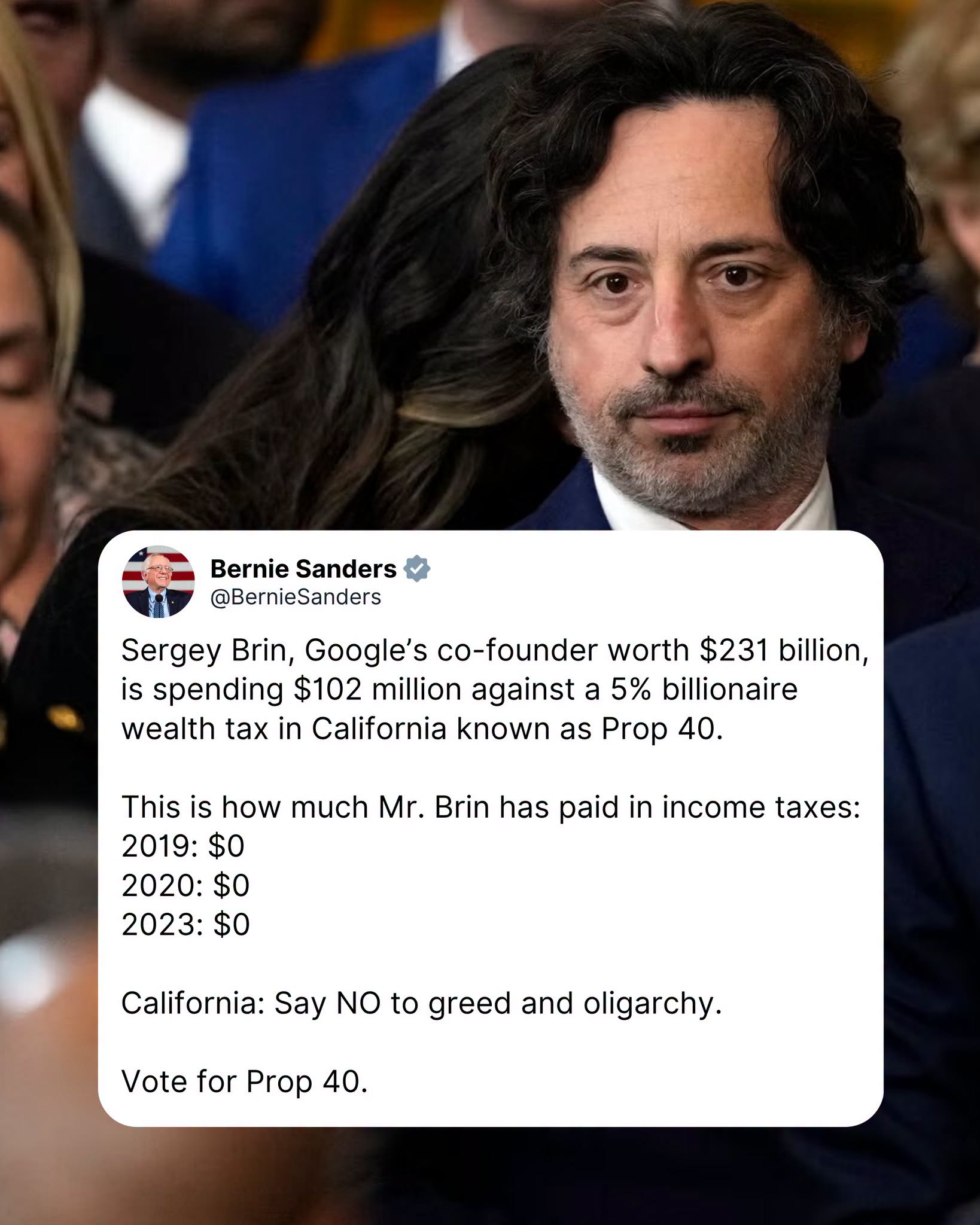
The image is designed to land like a moral indictment: a photograph of a somber, bearded Sergey Brin, the co-founder of Google, overlaid with a screenshot of a tweet from Senator Bernie Sanders. The message is direct, data-driven, and designed to expose what Sanders sees as the defining hypocrisy of the American billionaire class:
“Sergey Brin, Google’s co-founder worth $231 billion, is spending $102 million against a 5% billionaire wealth tax in California known as Prop 40. This is how much Mr. Brin has paid in income taxes: 2019: $0. 2020: $0. 2023: $0. California: Say NO to greed and oligarchy. Vote for Prop 40.”
The post, shared widely across social media in the final days of the 2026 midterms, is not a generic complaint about inequality. It is a specific, targeted attack on a single billionaire—and a direct appeal to California voters to pass a landmark tax that would fundamentally reshape the state’s relationship with its wealthiest residents.
This is the story behind the tweet, the numbers that support it, the fierce opposition it has generated, and the broader debate about wealth, taxes, and democracy that will be decided at the ballot box.
The Verdict: A Real Claim, Supported by the Data
Unlike many viral political headlines, this one is grounded in verifiable reporting and public records. Sanders' claim that Brin has spent $102 million to oppose Proposition 40 is accurate. Campaign finance filings show that Brin has donated a total of $102 million to Building a Better California, a political action committee and advocacy organization opposing the state’s billionaire tax and supporting other pro-business policies. This makes him the single largest donor to the anti-tax effort, which has collectively raised more than $187 million, compared to roughly $32 million raised by supporters of the measure.
The claim that Brin paid $0 in California state income tax in 2019, 2020, and 2023 is also supported by a working paper from economists Jasper Boll, Emmanuel Saez, and Gabriel Zucman. The paper found that Brin and fellow Google co-founder Larry Page each owed California just **13.3 cents** in income tax on what they received from Alphabet in those years—because the company paid them a salary of $1 each, they did not report selling stock, and the company did not pay dividends until 2024.
The tweet is not an exaggeration. It is a precise, if brutal, summary of a system in which a man worth hundreds of billions can pay virtually nothing in state income tax while spending nine figures to defeat a tax that would affect him directly.
What Is Proposition 40?
Proposition 40, which appeared on California’s November 3, 2026 ballot, is a first-in-the-nation proposal: a one-time, 5 percent tax on the wealth of Californians worth more than $1.1 billion. The tax would apply to roughly 200 of the state’s wealthiest residents, based on their net worth as of December 31, 2026, provided they were residents of California as of January 1, 2026.
The revenue would be substantial. Supporters argue the tax could generate about $100 billion over five years for state programs. Under the measure, 90 percent of the revenue would go to California’s healthcare program, with the remaining 10 percent directed toward education, food assistance, and administration.
For Brin specifically, the stakes are enormous. With a net worth estimated at nearly $260 billion, he could owe approximately **$13 billion** if the measure passes—a sum that, while staggering, would still leave him with a mere $247 billion.
The Opposition: A Billionaire-Funded Campaign
The fight over Proposition 40 has become the most expensive ballot measure campaign in the country, and Brin is not alone. Other tech billionaires, including former Google CEO Eric Schmidt and PayPal co-founder Peter Thiel, have also donated to the opposition effort. Governor Gavin Newsom has come out against the tax, arguing it would erode the state’s tax base and reduce revenue for social services.
Brin has framed his opposition in deeply personal terms. “I fled socialism with my family in 1979 and know the devastating, oppressive society it created in the Soviet Union,” he told The New York Times in April. “I don’t want California to end up in the same place”.
Critics, however, have dismissed this framing as fear-mongering. A Los Angeles Times commentary argued that the billionaires' campaign “rests on conjecture and fear-mongering,” noting that the measure is a one-time levy on assets, not a wholesale transformation of the economy.
The Broader Context: A National Test Case
The significance of Proposition 40 extends far beyond California. As The New York Times noted, the measure is a test of whether a wealth tax—a once-radical idea—can gain a foothold in the United States. If it passes, it could serve as a model for other states and eventually for federal policy. If it fails, it could deal a significant setback to the progressive movement’s efforts to address wealth inequality through taxation.
The debate has also exposed divisions within the Democratic Party. While progressive figures like Sanders have championed the measure, many Democrats across the country have kept their distance, wary of its popularity and the potential problems with a federal version of a wealth tax. Groups representing teachers, doctors, and firefighters have warned that the measure could harm the state budget in the long run if it drives entrepreneurs away.
The Bottom Line
The viral graphic is right about one thing: Sergey Brin is spending $102 million to defeat a tax that would cost him $13 billion, and he has paid virtually nothing in state income tax in recent years. It is a stark illustration of the lengths to which the ultra-wealthy will go to protect their fortunes—and the extent to which the current tax system allows them to do so.
But the story is bigger than a single tweet. It is a story about a state—and a country—grappling with the consequences of extreme wealth concentration. It is a story about a senator who has spent his career fighting that concentration, and a billionaire who has become its most visible symbol. And it is a story about a ballot measure that, whatever the outcome on November 3, will shape the debate over wealth and democracy for years to come.
📸 Suggested Images
-
The Tweet: A screenshot of Sanders’ post on X, showing the full text and the “Say NO to greed and oligarchy” call to action.
The Donor: A photo of Sergey Brin, with a graphic overlay showing his $102 million in political contributions and his estimated $13 billion tax liability.
The Ballot Measure: A photo of a California ballot or a “Vote for Prop 40” sign, illustrating the stakes of the election.
The Wealth Gap: A chart or infographic comparing the net worth of California’s billionaires to the state’s spending on healthcare and education, highlighting the inequality at the heart of the debate.
The Opposition: A photo of Governor Gavin Newsom or other opponents of Prop 40, with a caption noting their arguments against the tax.
Comments (0)
Loading comments...
May You Like

THANKSGIVING NIGHTMARE: OVER 1M BLACKOUTS, NEARLY 2M WATER ALERTS!

NYC EMERGENCY—MILLIONS FACE EVACUATION RISKS, MACY'S GIANT BALLOONS REMOVED FOR SAFETY!

BANGCHAK REFINERY IN THAILAND SHUT DOWN, U.S. OIL PRICES JUMP 10%!

Latest Posts







Popular Posts





