Schumer Loses the Shutdown Fight: Senate Passes Trump-Backed Funding Bill
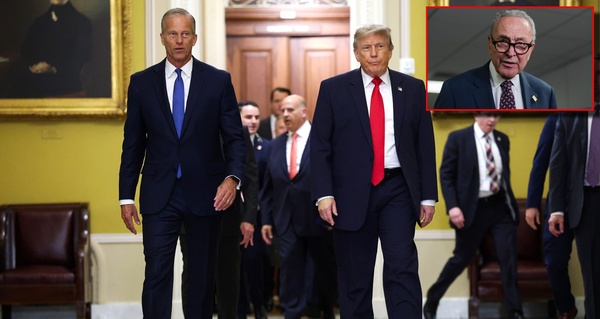
A viral political graphic declaring “SCHUMER LOSES! Senate Will Pass It — Trump Gets His Way” refers to a real and consequential Senate showdown over government funding in March 2025.
The dramatic wording is broadly rooted in what happened, but it oversimplifies the political calculation behind the vote.
Senate Democratic Leader Chuck Schumer ultimately helped clear the way for a Republican-backed spending bill that President Donald Trump supported. The Senate passed the measure 54-46, and Trump signed it into law the following day, preventing a partial government shutdown.
But Schumer did not describe the decision as surrendering to Trump. He argued that allowing the government to shut down would give the Trump administration even greater power to restructure the federal government.
Schumer Faced a Brutal Choice
The confrontation came as funding for the federal government was about to expire at midnight on March 14, 2025.
House Republicans had already passed H.R. 1968, a six-month continuing resolution funding the government through September 30. The House vote was 217-213.
Senate Democrats strongly opposed the legislation.
Their preferred approach was a much shorter funding extension that would have given lawmakers additional time to negotiate a bipartisan agreement.
Schumer initially argued that Republicans did not have the votes to overcome the Senate filibuster.
Then he changed course.
Why Schumer Decided to Let the Bill Advance
On March 13, Schumer announced that he would vote to advance the Republican bill.
His reasoning was unusual but straightforward: he believed a government shutdown could actually give Trump more power, not less.
Schumer called the Republican measure a bad bill but said a shutdown would be worse because Trump and Elon Musk's Department of Government Efficiency could use the disruption to accelerate changes to federal agencies and the workforce.
“As bad as the CR is,” Schumer argued, allowing Trump to gain still more power through a shutdown was the worse option.
That decision immediately triggered an extraordinary backlash within the Democratic Party.
Ten Senate Democrats Helped Break the Deadlock
Schumer needed Democratic votes to overcome the 60-vote threshold required to end debate and move toward final passage.
On March 14, the Senate voted 62-38 on the procedural step, with 10 members of the Democratic caucus joining Republicans.
The final passage vote was 54-46.
All but two members of the Democratic caucus opposed final passage, while Republican Sen. Rand Paul was the only Republican to vote against it.
That distinction is important.
The headline “Schumer loses” makes it sound as if Schumer personally lost a vote.
More accurately, Schumer made a strategic decision to allow a bill he opposed to advance because he believed the alternative was worse.
What Was in the Bill?
The legislation largely maintained existing spending levels but made significant changes in the allocation of federal dollars.
The roughly $1.7 trillion measure cut non-defense spending by about $13 billion while increasing defense spending by approximately $6 billion.
The bill also gave the Trump administration substantial discretion over how some funds could be managed.
That became one of the Democrats' central objections.
They argued that simply maintaining topline funding levels did not prevent the administration from using executive authority to reduce or redirect federal programs.
Schumer and other Democrats therefore viewed the bill as much more consequential than an ordinary temporary spending measure.
Why Democrats Were So Angry With Schumer
The backlash was immediate.
House Democrats were furious that their Senate counterparts had helped Republicans avoid a shutdown without winning major concessions.
Progressive activists accused Schumer of surrendering one of the few tools Democrats had available to challenge Trump's early second-term agenda.
The Washington Post reported that the vote left Democrats deeply divided, with Schumer becoming the primary target of anger from activists and fellow lawmakers.
The political criticism was particularly intense because Democrats had spent days arguing that Republicans were responsible for bringing the country to the brink of a shutdown.
Then Schumer effectively helped Republicans get the votes they needed.
Trump Ultimately Got the Funding Bill He Wanted
This is where the viral graphic's central claim has some factual basis.
The legislation was supported by Trump.
After passing the Senate, it went to the president's desk, and Trump signed it on March 15. The law funded the federal government through September 30, 2025.
So the sequence really was:
Trump backed the Republican funding plan → Schumer decided Democrats should allow it to advance → the Senate passed it → Trump signed it.
From a purely political perspective, Republicans won the immediate funding battle.
But saying “Trump got his way” needs qualification.
Trump Didn't Get Everything He Wanted
The bill was not a sweeping rewrite of federal spending.
It largely maintained spending levels inherited from the Biden administration, with relatively modest changes to the overall spending topline.
Trump also did not receive every policy concession Democrats had been fighting over.
The legislation's most important immediate effect was simply to prevent a shutdown and fund the government through the end of the fiscal year.
In other words, Republicans won the shutdown confrontation, but the larger battle over federal spending, agency cuts and Trump's use of executive power continued.
The Political Calculation Behind Schumer's Vote
Schumer's supporters argued that he had made the least-bad choice.
Their argument was essentially:
A shutdown would not stop Trump. It could actually empower him.
Trump's administration was already pursuing sweeping federal workforce reductions and restructuring efforts.
A shutdown would also have created uncertainty for federal employees, contractors and people dependent on government services.
Schumer therefore concluded that Democrats could do more to oppose Trump while the government remained operational than during a shutdown in which the administration could determine which functions continued.
That was a defensible strategic argument.
But it was also politically costly.
The Democrats Who Opposed Schumer Saw It Differently
Critics argued that Democrats were giving up leverage.
Their position was that if Republicans controlled the House, Senate and White House, Democrats' strongest remaining tool was their ability to deny the 60 votes necessary to overcome the filibuster.
By supplying those votes, Schumer's faction allowed Republicans to pass their preferred funding measure without extracting significant concessions.
The Washington Post described the resulting situation as a profound test of Democratic leadership and strategy.
This explains why the viral image resonated with Schumer's opponents.
From their perspective, the minority leader had been presented with an opportunity to block Trump's agenda and instead chose to facilitate the legislation.
The Government Shutdown Was Avoided
Whatever one thinks of Schumer's strategy, one result is indisputable:
There was no partial government shutdown in March 2025.
The Senate passed the bill hours before the deadline, and Trump signed it the next day.
That meant federal agencies continued operating rather than entering a shutdown.
For federal workers and millions of Americans who rely on government programs, that was a significant immediate consequence.
What the Viral Graphic Gets Right
The image is based on a genuine political defeat for Schumer's preferred strategy.
It correctly captures several important facts:
- Schumer initially opposed the Republican funding approach.
- He eventually supported allowing it to advance.
- Senate Democrats supplied enough votes to overcome the filibuster.
- The Senate passed the Republican-backed measure.
- Trump supported the bill.
- Trump signed it into law.
- The legislation prevented a government shutdown.
So this was not a fabricated political story.
What the Graphic Leaves Out
The missing context is crucial.
Schumer did not suddenly decide that Trump's spending plan was good.
He explicitly called the bill bad.
His argument was that a shutdown would give Trump even greater opportunities to reshape government and eliminate programs without congressional oversight.
The graphic also doesn't explain that the bill largely preserved existing spending levels rather than implementing Trump's entire fiscal agenda.
And it does not mention that Schumer's decision was based on a calculation about which outcome would do less damage, rather than an endorsement of Trump's policies.
The Bigger Political Consequence
The March 2025 vote exposed a fundamental problem for Democrats in the early months of Trump's second term.
They had enough Senate votes to make Republican legislation difficult to pass, but not enough votes to govern.
That left them with a difficult question:
When does blocking Trump help Democrats, and when does it simply create a crisis that Trump can exploit?
Schumer answered that question one way.
Many Democrats answered it differently.
The resulting conflict became one of the first major tests of Schumer's leadership as Senate minority leader.
And the backlash demonstrated how difficult it would be for Democrats to maintain unity while confronting an administration determined to move quickly.
The Bottom Line
The viral graphic's headline — “SCHUMER LOSES! Senate Will Pass It — Trump Gets His Way” — is sensationalized, but it describes a real outcome.
The Senate did pass the Trump-backed Republican funding bill, 54-46.
Schumer did help clear the procedural path for passage.
Trump did sign the legislation into law.
But the political story is more complicated than a simple Schumer defeat.
Schumer believed a shutdown would give Trump even more power, and he chose what he considered the lesser of two bad options.
That decision prevented a shutdown — but it also triggered one of the fiercest internal Democratic battles of Trump's early second term.
The bill passed. Trump signed it. But Schumer's “loss” was actually a calculated choice to avoid what he believed would be an even bigger loss.
Comments (0)
Loading comments...
May You Like
OBAMA STUNS ON INSTAGRAM: MESSAGE MARKING 34-YEAR MILESTONE SPARKS A BUZZ
OBAMA STEPS BACK INTO THE POLITICAL SPOTLIGHT
Obama Steps Back Into the Political Spotlight as Democrats Target Trump’s Senate Majority