Schumer Warns SAVE America Act Could Strip Millions
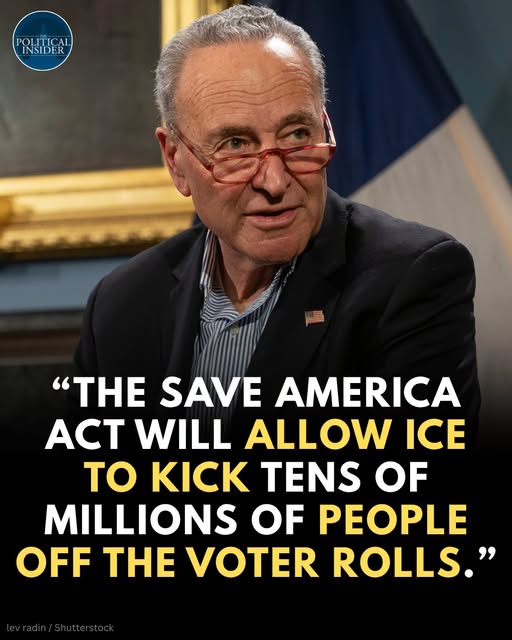
WASHINGTON — Senate Democratic Leader Chuck Schumer is warning that the Republican-backed SAVE America Act could result in millions of Americans being removed from voter rolls, escalating an already fierce partisan battle over voting rights ahead of the 2026 midterm elections.
Schumer has repeatedly attacked the legislation, arguing that its proof-of-citizenship requirements and proposed use of government databases could create barriers for eligible voters. In March, he said Republicans were seeking to remove “tens of millions” of Americans from voter rolls without adequate notification or an easy way to re-register.
But the claim requires important context: the SAVE America Act does not literally authorize ICE to purge tens of millions of voters. Rather, Democrats are warning that the legislation, combined with federal efforts to use immigration and citizenship databases to verify voter eligibility, could lead to eligible citizens being wrongly removed or forced to provide additional documentation.
What Is the SAVE America Act?
The Safeguard American Voter Eligibility Act, commonly known as the SAVE America Act, is a Republican-backed voting bill strongly supported by President Donald Trump.
Among its central provisions is a requirement that people registering to vote in federal elections provide documentary proof of U.S. citizenship.
Under the legislation considered by the Senate, applicants would generally have to present citizenship documentation in person to election officials. Acceptable documentation could include a U.S. passport or a birth certificate meeting the bill's requirements.
Republicans argue that the legislation is designed to ensure that only U.S. citizens participate in federal elections.
They point to the existing federal prohibition on noncitizens voting and say stronger verification procedures would protect election integrity.
Democrats counter that noncitizen voting is already illegal and extremely rare, and that the proposed requirements could create significant obstacles for otherwise eligible Americans.
Schumer's “Tens of Millions” Warning
Schumer has made the potential impact on voter registration a central argument against the bill.
During Senate debate, he said the legislation could allow federal authorities to remove tens of millions of people from voter rolls and argued that affected voters might not learn that their registration had been challenged until they attempted to vote.
Democratic lawmakers have also raised concerns about sharing voter-registration information with the Trump administration and federal agencies.
The rhetoric has produced a sharp Republican response.
Republicans argue that if a person is legally eligible to vote, the legislation would not prevent that person from voting simply because a database is being checked.
The fundamental dispute is therefore not whether American citizens should be permitted to vote. Both parties agree on that principle.
The dispute is how citizenship should be verified — and what happens when government databases contain inaccurate or incomplete information.
Fact-Check: Does the Bill Give ICE Power to Remove Voters?
This is where the viral graphic's wording becomes misleading.
Schumer has used language suggesting that the legislation could allow authorities to “kick” large numbers of people off voter rolls, but the SAVE America Act itself is primarily a voter-registration and citizenship-documentation bill.
It should not be described as a law giving ICE unlimited authority to remove tens of millions of voters.
FactCheck.org reported that Schumer warned the legislation could disenfranchise more than 20 million Americans, while Republicans disputed that prediction. Election experts said the bill could make registration more difficult for an unknown number of eligible voters, but there was no reliable evidence establishing that tens of millions of citizens would actually be removed from the rolls.
That distinction matters.
Schumer's warning represents a political projection about the consequences of the legislation, not an established figure showing that tens of millions of eligible voters would definitely lose their registration.
The Database Fight Is Real
At the same time, concerns about federal voter-roll verification are not purely hypothetical.
The Trump administration has separately sought to use federal databases, including the Department of Homeland Security's SAVE system, to help verify citizenship information associated with voter registrations.
On Sept. 5, a federal appeals court upheld a lower-court ruling preventing the administration from using the SAVE database for nationwide voter verification ahead of the November midterms. The court raised concerns about the legality of the data-sharing effort, potential inaccuracies and the risk that eligible voters could be incorrectly flagged.
That case is separate from the SAVE America Act, but the two controversies have become politically intertwined.
Democrats see them as parts of a broader Republican effort to increase federal involvement in determining who remains eligible to vote.
Republicans argue that federal verification is necessary to protect election integrity.
Why Democrats Are So Alarmed
Democrats say the potential problem is not only intentional removal of voters.
They are also concerned about administrative errors.
Government databases can contain outdated names, mismatched records, incorrect citizenship information or other discrepancies. Critics argue that even a small error rate could affect large numbers of legitimate voters when millions of records are being reviewed.
An incorrect match could force a citizen to provide additional documentation or challenge a decision before being allowed to vote.
The concern becomes especially serious close to Election Day, when there may be little time to correct registration problems.
The recent federal appeals court ruling specifically highlighted concerns about inaccuracies and the potential exposure of private information belonging to millions of Americans.
Republicans Say the Goal Is Simple: Citizens Vote
Republicans reject the characterization of the legislation as voter suppression.
Their argument is that citizenship is already a legal requirement for voting in federal elections and that the government should have a reliable mechanism for verifying it.
Republican Sen. John Barrasso, for example, attacked Schumer's characterization of the bill, arguing that if noncitizens were actually appearing on voter rolls, that would demonstrate precisely why stronger verification procedures are necessary.
Supporters also emphasize that the legislation does not make noncitizens eligible to vote.
Instead, they say, it strengthens the procedures used to determine who is eligible.
That distinction is central to the Republican defense of the bill.
A Much Larger Battle Over the 2026 Election
The fight over the SAVE America Act has become part of a broader confrontation over election administration ahead of the November 2026 midterms.
The Trump administration has pursued multiple changes involving voter registration, mail ballots, federal election data and election oversight.
Axios reported in August that Trump's broader election agenda included efforts involving voter-roll reviews, proof-of-citizenship requirements, mail-ballot procedures and federal access to voter data.
Several of those initiatives have faced lawsuits.
That has transformed election administration into one of the biggest legal and political battles of the 2026 election cycle.
The Bill Faces Major Political Obstacles
Despite Trump's support and Republican backing, the legislation has faced strong Democratic opposition in the Senate.
Schumer has called the measure a form of voter suppression and pledged to fight it.
Republicans, meanwhile, have portrayed Democratic opposition as resistance to basic election-security requirements.
The result is a debate in which both sides are framing the same legislation in dramatically different terms.
For Republicans, it is about ensuring that only eligible citizens vote.
For Democrats, it is about whether new documentation and database requirements will make it harder for legitimate Americans to vote.
The Real Stakes
The most dramatic claim circulating online — that ICE will simply remove “tens of millions” of Americans from voter rolls — should therefore be treated cautiously.
There is no evidence that ICE has been given blanket authority to purge tens of millions of eligible voters under the SAVE America Act.
But there is a genuine and consequential dispute over whether federal citizenship verification could result in eligible voters being incorrectly flagged, removed or forced to overcome additional administrative barriers.
That distinction is likely to remain at the center of the political fight.
As the 2026 midterms approach, the argument over the SAVE America Act is becoming about much more than voter identification.
It is becoming a fundamental dispute over who controls America's voter rolls, how citizenship is verified, how much power the federal government should have over election administration, and how much risk of disenfranchisement is acceptable in the pursuit of election security.
And with both parties treating control of Congress as critically important, that battle is unlikely to cool down before voters head to the polls.
Comments (0)
Loading comments...
May You Like

South Korea–Ukraine Rift Deepens Over North Korean POW Transfer as PURL Draws New Scrutiny

TRUMP’S OHIO WARNING UNDER THE SPOTLIGHT