Seven U.S. States Have Written the Death Penalty into Law for Sexual Crimes Against Children
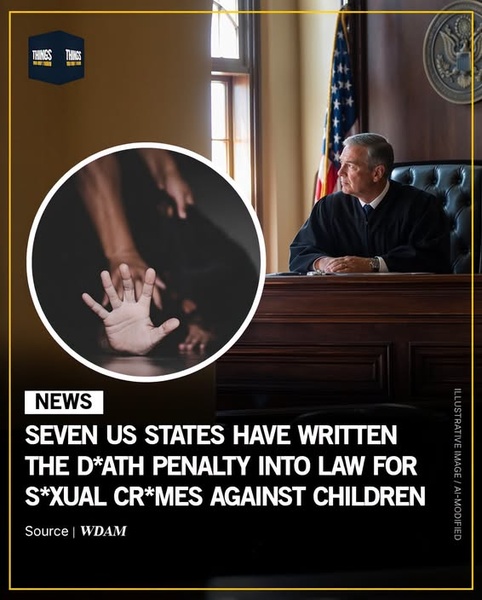
A growing number of Republican-led states are defying U.S. Supreme Court precedent by enacting laws that authorize the death penalty for the rape of a child, seeking to force the nation's highest court to revisit its 2008 ruling that such punishments are unconstitutional. Mississippi's recent passage of such a law makes it the seventh state to join this movement, which critics warn could endanger the very children it purports to protect.
WASHINGTON – The image circulating online captures a real and accelerating trend: seven U.S. states have now written the death penalty into law for certain sexual crimes against children.
Florida led the charge in 2023, followed by Tennessee and Idaho in 2024, then Oklahoma and Arkansas in 2025, and Alabama and Mississippi in 2026. At least five more states have proposed similar bills.
The movement represents a coordinated, explicit effort to challenge the U.S. Supreme Court's 2008 ruling in Kennedy v. Louisiana, which held by a 5–4 vote that the Eighth Amendment's ban on cruel and unusual punishment bars the death penalty for the rape of a child where the crime did not result, and did not intend to result, in the victim's death.
The Mississippi Law: A Direct Challenge
On April 8, 2026, the Mississippi Legislature enacted Senate Bill 2821, creating the new offense of "capital sexual battery" and authorizing the death penalty for the sexual abuse, or attempted sexual abuse, of a child under 12 that results in "injury to the child's sexual organs". Governor Tate Reaves approved the legislation, which took effect July 1, 2026.
The new bill contains language which directs that a death sentence may be imposed "notwithstanding existing case law" holding such a sentence unconstitutional and expressly references Kennedy, instructing the court to apply the death penalty. The text adds that if the U.S. Supreme Court does not overturn its precedent, a prisoner sentenced to death would be automatically resentenced to life without parole.
State Representative Jansen Owen (R) told WDAM that this legislation was introduced at the suggestion of the White House as part of a coordinated national effort to create circumstances for the Supreme Court to revisit Kennedy.
| State | Year Passed | Key Provision |
|---|---|---|
| Florida | 2023 | Death penalty for child sexual battery |
| Tennessee | 2024 | Expanded aggravating circumstances for child rape |
| Idaho | 2025 | Death penalty for certain child sexual offenses |
| Oklahoma | 2025 | Death penalty for child rape |
| Arkansas | 2025 | Death penalty for child sexual abuse |
| Alabama | 2026 | "Child Predator Death Penalty Act" |
| Mississippi | 2026 | "Capital sexual battery" |
The Rationale: 'Worst of the Worst Crimes'
Supporters argue that the most heinous crimes against children deserve the harshest possible punishment.
"This is the worst of the worst crime. It deserves the worst of the worst punishments," said Alabama Rep. Matt Simpson, a former prosecutor sponsoring the legislation.
Sen. April Weaver of Alabama, who carried the bill in the Senate, echoed the sentiment: "I believe there's a special place in hell for people who do this to our children. And today, we're one step closer to having a special place for them in Alabama, and that's on death row in the death chamber at Holman Prison".
The push has been fueled by high-profile cases. The Alabama legislation won approval after a headline-making case of an alleged child sex trafficking ring in Bibb County, where prosecutors said at least 10 children, some as young as 3, were subjected to rape and torture in an underground bunker.
The Legal Strategy: Forcing a Supreme Court Showdown
Proponents are explicit about their goal: they want to create a test case that will reach the U.S. Supreme Court and overturn Kennedy v. Louisiana. They point to the 2022 reversal of Roe v. Wade as a precedent for overturning established constitutional rulings.
Republican Sen. April Weaver has compared the strategy to state abortion bans that were considered unconstitutional until the Supreme Court in 2022 overturned Roe v. Wade and again allowed states to prohibit abortion.
Getting the Supreme Court to revisit the constitutionality issue will require getting a test case to the high court. Simpson hopes that will happen if enough states pass similar legislation.
The Concerns: Protecting Children or Endangering Them?
Opponents argue that such laws are not only unconstitutional but could actually harm the children they are designed to protect. The Kennedy majority relied in part on an amicus brief filed by child welfare and anti-sexual assault organizations that identified three primary dangers:
-
Worsens underreporting: Child sexual abuse is already deeply underreported — an estimated 88% of female rape victims under 18 did not disclose their abuse to authorities. Fear of consequences for the perpetrator, especially when the abuser is a family member, is a key reason.
Gives perpetrators incentive to kill: Equating child rape with murder gives perpetrators a lethal incentive to kill their victims to eliminate the only witness to their crime.
Retraumatizes victims: Capital proceedings can retraumatize child victims over years and decades.
"The court recognized that these statutes do more harm to children than help them. They actually place them in grave danger of being killed," said Robin M. Maher, executive director of the Death Penalty Information Center.
What the Viral Graphic Gets Right
| What the Image Suggests | What Actually Happened |
|---|---|
| Seven states have written the death penalty into law for sexual crimes against children | Yes — seven states have passed such laws |
| The laws are designed to challenge Supreme Court precedent | Yes — states are explicitly seeking to overturn Kennedy v. Louisiana |
| The movement is growing | Yes — at least five more states have proposed similar bills |
The Bottom Line
The image captures a real and consequential movement: seven states have now enacted laws authorizing the death penalty for child sexual offenses, explicitly defying U.S. Supreme Court precedent and seeking to force a reconsideration of Kennedy v. Louisiana.
Supporters argue that the "worst of the worst" crimes deserve the ultimate punishment. Critics warn that such laws could worsen underreporting, give perpetrators an incentive to kill their victims, and retraumatize the children they are meant to protect.
For now, the laws remain unconstitutional under current Supreme Court precedent. But with more states joining the push and a conservative majority on the Court, the legal battle over the death penalty for child rape is far from over.
Comments (0)
Loading comments...
May You Like

Shocking news from Ohio: an unexpected development ahead of Trump's rally

Russian Drone Strikes Kyiv Bridge as German Chancellor Arrives in Ukraine

FIGHT OVER OBAMA’S IRAN POLICY