
Justice Jackson Called Sex-Based Exclusion ‘Discrimination’ — but Viral Graphic Leaves Out Key Context
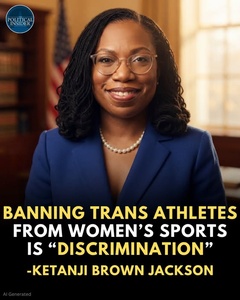
Justice Ketanji Brown Jackson argued that excluding a transgender girl from a girls’ team involves sex discrimination in a legal sense, but she also expressly agreed that Title IX permits sex-separated athletic teams.

A viral graphic claims Supreme Court Justice Ketanji Brown Jackson said that “banning trans athletes from women’s sports is discrimination.” That wording substantially simplifies what Jackson actually wrote and argued.
The controversy stems from West Virginia v. B.P.J. and Little v. Hecox, two cases challenging state laws restricting transgender girls and women from participating on female school athletic teams.
During January oral arguments, Jackson questioned Idaho’s attorney about why the law should not be considered a classification based on transgender status when it specifically prevented transgender women from joining women’s teams.
That question did not amount to a ruling that every restriction on transgender participation is unlawful discrimination. Supreme Court justices routinely test competing legal arguments by questioning attorneys during oral argument.
When the Supreme Court ruled on June 30, 2026, a six-justice majority upheld the Idaho and West Virginia laws against constitutional challenges involving the Equal Protection Clause.
Justice Brett Kavanaugh wrote for the majority that states may determine eligibility for girls’ and women’s sports according to biological sex when pursuing interests in competitive fairness and safety.
On the separate Title IX question, however, the result was broader: all nine justices agreed that the West Virginia athlete’s Title IX claim failed, although they disagreed significantly about the reasoning.
Jackson explicitly wrote that she agreed with her colleagues that B.P.J.’s Title IX claim failed under the arguments presented in the case and the rules governing sex-separated athletics.
She nevertheless described sorting B.P.J. according to sex assigned at birth as “discrimination on the basis of her sex assigned at birth,” using discrimination as a technical legal description.
Crucially, Jackson immediately added that the same principle applies to other athletes sorted by sex and that, in athletics, federal regulations permit this particular form of sex discrimination.
Jackson therefore did not argue that separating male and female sports teams is automatically illegal. Her opinion explicitly acknowledged that the sexes “may generally be separated” in athletics under existing Title IX regulations.
Her broader disagreement concerned how Title IX should be interpreted outside athletics and whether the majority unnecessarily defined “sex” exclusively as biological sex within its reasoning about the statute.
Jackson also joined Justice Sonia Sotomayor’s partial dissent, which challenged the majority’s Equal Protection analysis and argued that West Virginia’s categorical rule deserved more individualized factual examination.
Sotomayor focused particularly on athletes who suppressed male puberty, arguing that courts should examine whether an individual transgender athlete actually possesses the competitive advantages that states cite to justify exclusion.
The majority rejected that individualized approach, concluding that states need not evaluate each transgender athlete separately and that legislatures may establish sex-based eligibility rules applying across female athletic categories.
The Court found that competitive fairness and safety qualify as important governmental interests and that limiting female teams by biological sex was sufficiently related to those interests under constitutional scrutiny.
The ruling also stopped short of ordering every state to ban transgender athletes. It decided that federal law and the Constitution permit such restrictions, not that every jurisdiction must adopt them.
The underlying cases involved West Virginia high-school athlete Becky Pepper-Jackson and Idaho college athlete Lindsay Hecox, who challenged laws preventing them from competing on female teams according to their gender identities.
The issue remains politically contested. Supporters of restrictions emphasize competitive fairness and safety for female athletes, while opponents argue categorical bans unnecessarily exclude transgender students from school activities.
The most accurate summary is therefore narrower than the viral graphic: Jackson called the exclusion sex discrimination in a legal sense, but explicitly acknowledged that sex-separated athletics are generally permissible under Title IX.
Comments (0)
Loading comments...
May You Like

Jack Smith Defends His Integrity as Trump Investigations Face Renewed Political Firestorm

Russian Drone Strikes Kyiv Bridge as German Chancellor Arrives in Ukraine














