
Sheriff Seizes 650,000 Ballots — What the Viral California Election Graphic Gets Right and Wrong
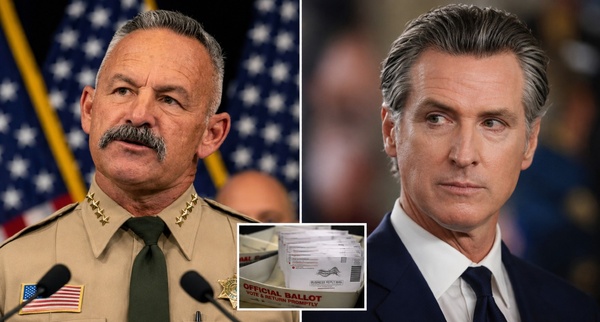
Verdict: TRUE on the seizure, MISLEADING on what it implies.
A viral graphic claims that a California sheriff has seized 650,000 ballots and that the state's election has taken a “huge turn.” The underlying seizure is real — but the graphic leaves out the most important part of the story: the ballots were not seized because 650,000 fraudulent votes were discovered.
The case involves Riverside County Sheriff Chad Bianco, who ordered the seizure of roughly 1,000 boxes containing more than 650,000 ballots from the November 2025 California special election on Proposition 50, a redistricting measure.
The controversy has now reached the California Supreme Court, which heard arguments in August over whether Bianco had the legal authority to take the ballots from the county registrar. As of September 10, 2026, the court has not yet issued a final ruling.
The 650,000-ballot seizure really happened
The dramatic number in the graphic is not fabricated.
On February 26, 2026, Bianco's Riverside County Sheriff's Department seized approximately 1,000 boxes of election materials connected to the November 2025 special election. The materials contained more than 650,000 ballots. Bianco said he was investigating whether the ballots had been properly counted.
The election concerned Proposition 50, a congressional redistricting measure backed by California Democrats after Republican-led redistricting efforts in states including Texas.
Riverside County approved Proposition 50 by roughly 80,000 votes, while the measure passed statewide by more than 3.3 million votes.
So the viral graphic is correct about the extraordinary seizure.
But that is only half the story.
Where did the fraud allegation come from?
The sheriff's investigation was triggered by claims from a local group calling itself the Riverside Election Integrity Team.
The group claimed it had discovered a discrepancy of 45,896 ballots — essentially arguing that far more ballots had been counted than had been properly recorded as cast.
Bianco said his investigation would physically examine the ballots and compare them with the official vote totals.
But Riverside County's registrar disputed the premise almost immediately.
Registrar of Voters Art Tinoco told the county Board of Supervisors that the apparent 45,896-ballot discrepancy resulted from the group's use of raw, incomplete election data, including handwritten records that had not yet incorporated every category of ballot.
According to the registrar's figures, the actual difference was only 103 ballots, representing approximately 0.016% of the ballots involved.
That distinction is crucial.
There is no established finding that 45,896 fraudulent ballots — let alone 650,000 fraudulent ballots — existed.
The 650,000 figure refers to the number of ballots taken into the sheriff's custody for investigation.
California officials fought back
California Attorney General Rob Bonta strongly objected to the sheriff's investigation.
Bonta argued that California law establishes specific procedures for election challenges, recounts and custody of voted ballots, and questioned whether the sheriff had sufficient legal grounds to seize the election materials.
The dispute became so serious that the California Supreme Court intervened.
On April 8, the state's high court ordered Bianco and those acting for him to pause the investigation and preserve the seized materials while the legal dispute proceeded.
The court subsequently took up Bonta's case as well as a separate challenge brought by Riverside County voters represented by the UCLA Voting Rights Project.
The Supreme Court case is now the real “huge turn”
The most important development behind the latest versions of the viral graphic is not a discovery of massive election fraud.
It is the legal battle over whether a sheriff can seize and examine ballots in this manner.
On August 24, the California Supreme Court heard oral arguments in two related cases involving Bianco.
The justices appeared skeptical of his legal theory. One justice described a key part of the sheriff's argument as “bizarre,” questioning how Bianco could remove ballots from the legally designated election custodian during an investigation and then simply return them when a prosecution might begin.
Bianco's attorneys maintain that the ballots are being preserved as potential criminal evidence rather than subjected to an official election recount. His written filings argue that his department is trying to determine whether physical ballots and official records can be reconciled, not alter or overturn the certified election result.
The opposing side argues that allowing a sheriff to bypass California's established election procedures could undermine the chain of custody and public confidence in elections.
The court has yet to resolve that dispute.
The sheriff's political future also changed
There's another important piece the viral graphic doesn't mention.
Bianco was running for governor of California while conducting the investigation. He ultimately did not make the November general election.
In California's top-two primary, Democrat Xavier Becerra and Republican Steve Hilton advanced. Bianco finished fourth statewide with about 10.2% of the vote, behind Becerra, Hilton and Democrat Tom Steyer.
That means Bianco is no longer running for governor in the November election.
His ballot investigation, however, remains before the state Supreme Court.
What the viral graphic gets right
Correct:
- A Riverside County sheriff really did seize more than 650,000 ballots.
- The ballots came from the November 2025 California special election.
- The sheriff said he was investigating alleged irregularities.
- The controversy has reached the California Supreme Court.
- The court has questioned whether the seizure was legally authorized.
Misleading or unsupported:
- The seizure does not mean 650,000 fraudulent ballots were discovered.
- There is no established evidence that 45,896 fraudulent votes were counted.
- Riverside's registrar said the alleged 45,896 discrepancy was based on incomplete/raw data and that the actual discrepancy was 103 ballots.
- The California Supreme Court has not ruled that election fraud occurred.
- The court has also not yet issued a final ruling declaring Bianco's seizure lawful or unlawful.
Why this case matters
This is an unusually consequential fight because it goes beyond the Riverside election.
At issue is a fundamental question: Who has authority over voted ballots once an election has been completed?
Bianco argues that law enforcement must be able to preserve physical ballots when investigating suspected criminal activity.
Election officials and challengers argue that allowing individual law-enforcement officials to take custody of ballots outside the normal election system could disrupt chain-of-custody protections and create a precedent in which election results are repeatedly subjected to ad hoc investigations.
The California Supreme Court's eventual ruling could therefore have implications well beyond Riverside County.
Bottom line
The headline “Sheriff Seizes 650,000 Ballots” is real.
The suggestion that the seizure itself represents a dramatic discovery that California's election was fraudulent is not supported by the evidence currently available.
The central dispute has shifted from “Were hundreds of thousands of fraudulent ballots found?” to a much more precise legal question:
Did Riverside County Sheriff Chad Bianco have the authority to seize and investigate those ballots in the first place?
As of September 10, 2026, that question remains unresolved by California's highest court.
Comments (0)
Loading comments...
May You Like

Obama Steps Back Into the Political Spotlight as Democrats Target Trump’s Senate Majority














