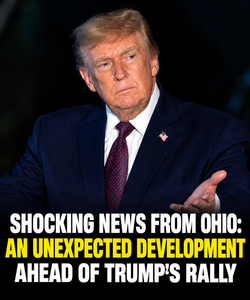
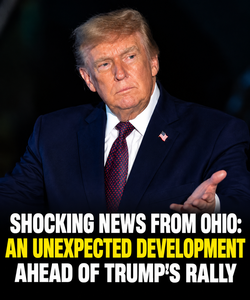
Shocking news from Ohio: an unexpected development ahead of Trump's rally
SPRINGFIELD, Ohio — A major factory shutdown in southwestern Ohio has delivered a painful blow to nearly 1,400 workers just days before President Donald Trump arrived in the Dayton area to rally Republican voters ahead of the November midterm elections.
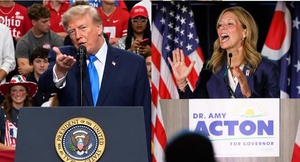
The layoffs at the former Navistar truck plant in Springfield became an unexpected backdrop to Trump's October 3 campaign appearance in nearby Vandalia, where he was campaigning for Republican Senate candidate Jon Husted and other GOP candidates.
The timing has turned the plant closure into a potent political symbol in a state where Republicans are trying to defend their congressional majority and where economic concerns are increasingly shaping the campaign.
One important correction to the image: the number was not 1,900. The latest reporting puts the layoffs at nearly 1,400 workers, with state notices covering about 1,341 employees.
A Factory That Had Been a Springfield Institution
For generations, the Springfield facility was an important part of the area's industrial economy.
The plant's history stretches back more than a century, and truck manufacturing at the site dates back decades. Workers eventually produced trucks for International/Navistar as well as medium-duty Chevrolet models under a contract with General Motors.
But that manufacturing relationship has now come to an end.
International Motors, the company formerly known as Navistar, stopped operations at the Springfield facility on September 30.
About 1,400 workers lost their jobs as a result.
For a community that has already experienced decades of manufacturing decline, the closure represents far more than another corporate restructuring.
The Timing Was Especially Political
The plant's final day came only three days before Trump's October 3 rally in nearby Vandalia.
That coincidence put the factory workers' economic frustrations directly alongside Trump's campaign message.
Trump has been arguing that his economic policies are creating jobs and strengthening American industry.
But workers leaving the Springfield plant were facing a very different reality.
The Associated Press reported that the layoffs were large enough to effectively wipe out about a year's worth of job growth in the greater Dayton area.
That makes Springfield an important test of whether Trump's economic message is reaching the working-class voters who helped return him to the White House.
One Former Trump Voter Is Now Campaigning for Democrats
Among the workers affected is Kyle Bos, a 30-year-old UAW member and father of two, with another child expected in January.
Bos told the AP that rising grocery prices had already changed his family's financial situation.
Then came the factory closure.
Bos said he had voted for Trump three times but now plans to spend the final weeks before the election canvassing for Democratic candidates.
“Something has to change politically in this country,” Bos said, according to the AP.
His story does not prove that thousands of Ohio workers are abandoning Trump.
But it illustrates the political danger for Republicans: some voters who supported Trump because they wanted economic change are now judging his administration by their own household finances and employment prospects.
The Layoffs Were Not Simply a Trump Decision
It would also be misleading to say that Trump's policies directly caused the Springfield plant to close.
The immediate circumstances were more complicated.
Reporting indicates that much of the plant's production depended on a General Motors contract for medium-duty Chevrolet trucks. That contract expired September 30, while GM was discontinuing those models. International Motors also decided to sell the facility.
That means the closure was the result of corporate and market decisions that had been developing independently of the Trump rally.
However, the political debate is about something broader.
Trump campaigned heavily on rebuilding American manufacturing, using tariffs and other policies to encourage companies to produce more domestically.
Workers in Springfield are now asking whether those policies are delivering the economic security they were promised.
Tariffs Did Not Save This Plant
The Springfield experience is particularly uncomfortable for Trump's economic message because the administration has emphasized tariffs as a way to protect American manufacturing.
Yet the former Navistar plant continued to struggle despite the tariff environment.
According to AP reporting, the factory's former owner chose to offload the facility, while tariffs did not generate enough additional demand to prevent the shutdown.
That does not mean tariffs have had no impact anywhere in the U.S. economy.
It means the Springfield case demonstrates the limits of using tariffs alone to guarantee that an individual factory remains open.
There Is a Potential Second Act for the Plant
The story, however, is not necessarily ending with an abandoned factory.
A Canadian company called Roshel, which manufactures armored and commercial vehicles, has acquired the former Navistar facilities.
The company has said it intends to expand employment substantially over time, potentially more than doubling the workforce in phases.
But there is an important caveat: the timing and scale of the reopening remain uncertain, meaning the displaced workers cannot immediately assume their old jobs will return.
For Springfield, that offers a possible path from industrial decline to a new manufacturing era.
For the workers, however, the transition could take time.
Dayton's Manufacturing Problem Is Much Bigger
The factory closure also reflects a much larger transformation of the Dayton region.
The area once had a massive industrial base.
Since 1990, the Dayton area has lost roughly half of its 90,000 manufacturing jobs, according to AP reporting. Globalization, the North American Free Trade Agreement and the rise of Chinese manufacturing contributed to the long-term erosion of industrial employment.
At the same time, the region is attempting to reinvent itself around aerospace, defense, technology and research.
Wright-Patterson Air Force Base remains a major economic anchor, while newer companies and development projects are bringing investment into the region.
But those new industries do not necessarily replace the economic security once provided by large unionized factories.
Trump Says Ohio's Economy Is Doing Well
At the October 3 rally in Vandalia, Trump promoted Republican candidates and defended his administration's economic record.
He also argued that Ohio's economy was benefiting from investment and new development.
Republican Senate candidate Jon Husted similarly pointed to Ohio's employment performance, saying the state now has record employment and low unemployment.
But the political problem is obvious.
Macroeconomic statistics can look strong while individual communities experience economic pain.
A worker who has just lost a long-term manufacturing job may not feel reassured by statewide employment figures.
That gap between economic statistics and personal experience could become one of the most important issues in the midterm elections.
Ohio Is Becoming a Critical Political Test
Ohio was once considered a decisive presidential swing state.
Trump won it comfortably in 2024, and Republicans currently control statewide politics.
But the 2026 Senate race is much more competitive.
Republican Sen. Jon Husted is facing former Democratic Sen. Sherrod Brown, and polling has shown a close contest. Trump's rally was intended in part to energize Republican voters and strengthen Husted's campaign.
That makes the Springfield layoffs politically significant.
Democrats can point to workers who say the economy is failing to deliver for them.
Republicans can argue that the plant's closure resulted from long-running industrial and corporate decisions rather than a single presidential policy.
Voters will decide which explanation they find more convincing.
The $5,000 Proposal Also Became a Flashpoint
Another issue discussed by workers was Trump's proposal for a potential $5,000 payment tied to Republican election success.
Bos described the proposal as insulting rather than helpful, according to AP reporting.
That reaction illustrates a broader political challenge.
For workers worried about permanent employment, healthcare, mortgages and the cost of groceries, a one-time payment may not address the underlying problem.
What they want is economic stability.
This Is Not Proof of a “Trump Collapse”
It would be premature to conclude from Springfield that Trump's working-class coalition has collapsed.
The workers at one factory do not represent all Ohio voters.
Trump remains highly influential among Republican voters, and his rally in Vandalia drew enthusiastic supporters. The Republican Party also retains significant advantages in Ohio.
But the Springfield shutdown creates a difficult political image:
A president campaigning on American manufacturing arrived in Ohio just days after nearly 1,400 manufacturing workers lost their jobs.
That contrast is likely to be used heavily by Democrats during the final weeks of the campaign.
What Happens Next?
The immediate future for the laid-off workers depends partly on what happens to the Springfield facility under Roshel.
If the Canadian company successfully restarts manufacturing and expands employment, the plant could eventually become an example of industrial revival rather than decline.
But for workers who lost their jobs on September 30, that recovery has not happened yet.
Politically, the consequences could arrive much faster.
Trump has promised that his policies will strengthen American industry and improve workers' economic position.
Democrats are now asking Ohio voters to judge that promise against what happened in Springfield.
The factory closure does not establish that Trump caused the layoffs.
But it does create a powerful political question for the president and the Republican Party:
If American manufacturing is truly coming back, how long will workers in places like Springfield have to wait to feel it?
With the midterms approaching, Ohio may provide one of the clearest answers.
Comments (0)
Loading comments...
May You Like
gfnhgmnghnmfgnbvvvvvvvvv

Russian Drone Strikes Kyiv Bridge as German Chancellor Arrives in Ukraine