“Shoot at Two of Our Ships, Lose Three of Yours”: U.S. Delivers Stark Warning to Iran
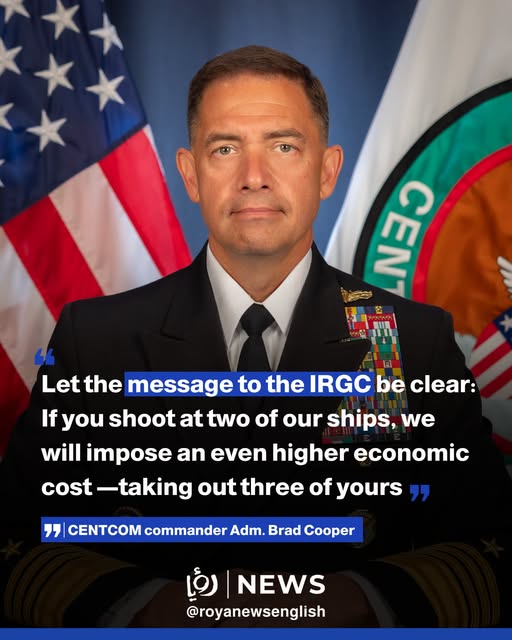
U.S. Central Command says American forces struck three Iranian crude-oil carriers after the IRGC launched ballistic missiles toward two U.S. Navy warships, as Adm. Brad Cooper warned that Washington could impose an even greater economic cost on Tehran.
A stark message from U.S. Central Command (CENTCOM) is drawing attention after American forces struck three Iranian oil carriers following what the Pentagon described as an Iranian attack on two U.S. Navy warships.
The statement, attributed to CENTCOM Commander Adm. Brad Cooper, reads:
“Let the message to the IRGC be clear: If you shoot at two of our ships, we will impose an even higher economic cost — taking out three of yours.”
The quote in the viral graphic is authentic. It appears in an official CENTCOM release dated Sept. 5, 2026.
Three Iranian oil carriers targeted
According to CENTCOM, U.S. forces struck three Iranian crude-oil carriers after the Islamic Revolutionary Guard Corps (IRGC) launched ballistic missiles toward two U.S. Navy vessels operating in regional waters.
CENTCOM said an American aircraft carrier and a guided-missile destroyer successfully evaded multiple attacks and that no U.S. personnel were harmed.
The three Iranian vessels were identified as:
- M/T Downy — permanently disabled off Kharg Island.
- M/T Stark 1 — permanently disabled near Jask.
- M/T Kylo, also known as Noxen — completely destroyed in the Gulf of Oman after its crew was ordered to abandon the ship.
CENTCOM said the vessels were connected to what it described as a multibillion-dollar shadow network that finances the IRGC and its regional proxies.
Not three Iranian warships
One important detail is missing from the viral graphic.
The three vessels targeted by the United States were oil carriers, not Iranian Navy warships.
And CENTCOM's description also does not mean that all three were sunk.
Two — the Downy and Stark 1 — were described as permanently disabled. The Kylo/Noxen was described as completely destroyed after being struck in multiple critical locations.
That distinction matters when describing the incident.
Cooper's warning goes beyond the viral quote
Adm. Brad Cooper's statement did not stop at the “two ships, three of yours” line.
He added that the United States would not hesitate to defend American forces and, if necessary, destroy Iran's limited and exposed oil fleet.
That language represents a significant escalation in the economic dimension of the confrontation.
Rather than limiting retaliation to military installations, Washington is openly warning that Iranian oil-shipping assets could become targets if attacks on U.S. forces continue.
The confrontation is taking place amid a wider U.S.-Iran campaign
The latest incident is not an isolated exchange.
CENTCOM's official record shows continuing U.S. military operations against Iranian targets throughout 2026, including strikes on IRGC targets and enforcement actions against vessels attempting to reach Iranian ports.
CENTCOM has also described its broader Operation Epic Fury as an effort to dismantle Iran's security apparatus and target locations posing an imminent threat.
The oil-shipping dimension is particularly important because Iranian petroleum exports are a critical source of revenue for Tehran.
Earlier CENTCOM operations also involved disabling commercial oil tankers that Washington said were attempting to violate its blockade of Iranian ports.
What the viral graphic gets right — and what it leaves out
What is confirmed:
The quote attributed to Adm. Brad Cooper is genuine and was published by CENTCOM on Sept. 5.
What is confirmed:
CENTCOM says U.S. forces struck three Iranian crude-oil carriers after Iran launched ballistic missiles toward two U.S. Navy warships.
What needs clarification:
The three targets were oil carriers rather than Iranian warships.
What also needs clarification:
Two vessels were permanently disabled, while the third was completely destroyed. Saying that the U.S. “sank three Iranian ships” would go beyond what the official statement says.
What remains important to watch:
Whether Iran responds with additional attacks against U.S. military or commercial maritime interests could determine whether this latest exchange becomes another isolated escalation or part of a broader confrontation.
Why the statement matters
The significance of Cooper's warning goes beyond the three vessels already targeted.
Iran's oil fleet is one of the country's most important economic assets. A sustained campaign against oil carriers could put additional pressure on Tehran while simultaneously raising the risks surrounding commercial shipping in the Gulf region.
For Washington, the message is straightforward: attacks against U.S. naval forces will carry consequences.
For Tehran, the warning is equally clear: the next round of escalation may affect not only military assets, but also the economic infrastructure that helps fund the Iranian state and the IRGC.
The latest exchange therefore adds a new layer to an already dangerous confrontation — one in which military action, oil revenue and maritime security are becoming increasingly intertwined.
Comments (0)
Loading comments...
May You Like

South Korea–Ukraine Rift Deepens Over North Korean POW Transfer as PURL Draws New Scrutiny

FIGHT OVER OBAMA’S IRAN POLICY