Should Only U.S. Citizens Be Allowed to Vote in American Elections?
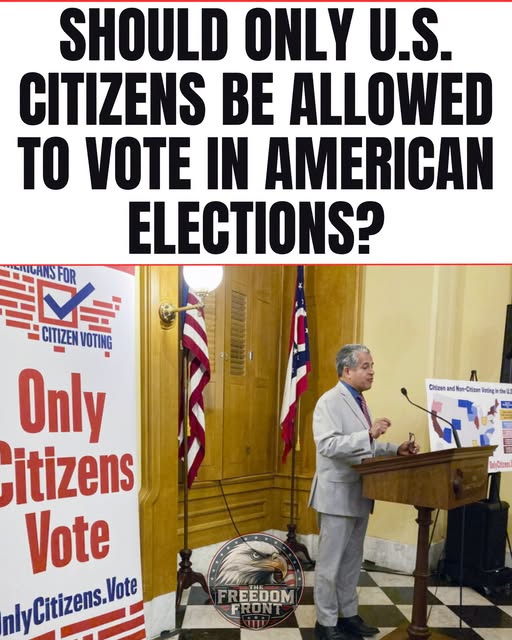
A striking campaign image featuring the "Only Citizens Vote" slogan and the web address OnlyCitizens.Vote is igniting debate across social media. While the question seems straightforward, the answer is layered with federal law, state authority, and history.
WASHINGTON – A viral graphic asking a seemingly simple question—"SHOULD ONLY U.S. CITIZENS BE ALLOWED TO VOTE IN AMERICAN ELECTIONS?"—is dominating online conversations. The image promotes the "Only Citizens Vote" message, advocating for a citizenship requirement for all elections.
The debate comes amid heightened national focus on election integrity and immigration policy. But while the question may seem clear-cut, the reality is anything but. The answer depends entirely on which "American elections" we are talking about.
What the Law Actually Says
For federal elections—presidential, Senate, and House races—the law is crystal clear. The Illegal Immigration Reform and Immigrant Responsibility Act of 1996 explicitly prohibits noncitizens from voting in federal elections. This is not a matter of debate or state discretion; it is a federal crime. Under U.S. Code § 611, any alien who votes in a federal election can face fines, imprisonment, and deportation.
However, the Constitution does not explicitly establish a citizenship requirement for voting in all elections. According to Article I, Section 2, and the 17th Amendment, eligibility for voters in federal elections is based on state qualifications: voters must have "the qualifications requisite for electors of the most numerous branch of the State legislatures". This has led some legal scholars to argue that a federal citizenship requirement for voting could be unconstitutional, as the Constitution leaves voter qualifications to the states.
For state elections, the landscape is more complex. Federal law does not prohibit noncitizens from voting in state or local elections, and states have the authority to determine who may vote in their own contests. Currently, no state allows noncitizens to vote in statewide elections. But some municipalities have taken a different approach.
Where Noncitizens Can Vote Today
Despite the federal ban, noncitizen voting exists in limited forms across the country. As of 2025, several jurisdictions permit noncitizens to cast ballots in certain local elections:
| Location | Allowed Elections | Status |
|---|---|---|
| San Francisco, CA | School board elections | Active |
| Oakland, CA | School board elections (proposed) | Pending |
| Some cities in Maryland | Municipal elections | Active |
| Some cities in Vermont | Municipal elections | Active |
| Washington, D.C. | All non-federal elections | Active |
Notably, New York City enacted a law in 2021 allowing noncitizens to vote in local elections, but it was ruled unconstitutional by a state judge in 2022. These jurisdictions maintain separate ballots for municipal elections to ensure noncitizens cannot vote in state or federal races.
A Historical Perspective
The debate over noncitizen voting is not new. According to academic research, noncitizens could legally vote in 40 U.S. states at some point between 1776 and 1926. This practice emerged during the American Revolution when voting rights were tied to race, gender, and property rather than citizenship. Alien suffrage was viewed as a way to foster citizenship and integrate "Americans in waiting" into the political process.
However, the practice gradually ended in the early 20th century as laws were tightened and citizenship became a prerequisite for voting in most jurisdictions. The 1996 federal ban on noncitizen voting in federal elections effectively codified this shift.
The "Only Citizens Vote" Movement
The graphic's accompanying web address, "OnlyCitizens.Vote," connects to a coalition of activists pushing for stricter citizenship verification requirements. The Only Citizens Vote Coalition has joined forces with the American Legislative Exchange Council (ALEC) to draft model legislation requiring citizenship for voting in "all public elections".
Supporters of the movement argue that only citizens should have a say in the nation's future and that noncitizen voting—even in local elections—poses a risk to election integrity. They point to the flood of illegal immigration and concerns that noncitizens may be misled into voting illegally.
However, critics argue these efforts are part of a broader anti-immigrant agenda. The Coalition has been described as a group of "anti-immigrant and election-denying activists" by some observers. The Department of Justice has also warned states against removing voters from rolls in a discriminatory manner, emphasizing that removal efforts must comply with federal law.
The SAVE Act and Federal Proposals
In 2024 and 2025, the SAVE Act (Safeguard American Voter Eligibility Act) emerged as a major legislative proposal requiring proof of citizenship for voter registration in federal elections. Supporters argue it would protect election integrity, while opponents argue it would disenfranchise eligible voters and is potentially unconstitutional.
Legal critics note that the Constitution does not impose a citizenship requirement for voting; instead, it leaves qualifications to the states. The Justice Department's guidance emphasizes that states must comply with federal law and avoid discriminatory practices when maintaining voter rolls.
The Bottom Line
| What the Graphic Asks | The Reality |
|---|---|
| Should only citizens vote in American elections? | It depends on the election type |
| Noncitizens are voting illegally | Noncitizens cannot vote in federal elections; some local voting is legal |
| This is a settled issue | The debate is ongoing and politically charged |
The question is not as simple as it first appears. In federal elections, only citizens can legally vote—and that has been federal law since 1996. In state elections, no state allows noncitizen participation. But in a handful of local jurisdictions, noncitizen residents can vote in certain municipal contests, a practice with deep historical roots in American democracy.
The "Only Citizens Vote" campaign reflects deep anxieties about immigration, election integrity, and who belongs in the American political community. Whether that concern is about protecting the democratic process or excluding immigrants is the heart of the debate that will continue to shape American politics for years to come.
Comments (0)
Loading comments...
May You Like

Obama Steps Back Into the Political Spotlight as Democrats Target Trump’s Senate Majority