Six States Now Allow Death Sentences for Certain Child-Rape Convictions — Setting Up a Supreme Court Showdown
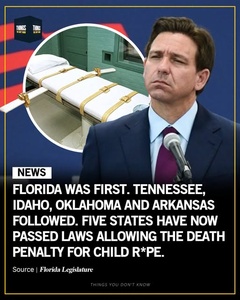
Florida, Tennessee, Idaho, Oklahoma, Arkansas and now Alabama have enacted laws challenging a 2008 Supreme Court precedent that prohibits capital punishment for child rape when the victim survives.
WASHINGTON — A growing group of Republican-led states is attempting to dramatically expand capital punishment by allowing prosecutors to seek death sentences for certain sexual crimes against children when the victim is not killed.
The movement began with Florida in 2023 and has since expanded to Tennessee, Idaho, Oklahoma and Arkansas, with Alabama becoming the sixth state to enact comparable legislation.
The laws represent an unusually direct challenge to the U.S. Supreme Court because existing constitutional precedent says the death penalty cannot be imposed for child rape when the crime does not result in death.
That precedent comes from Kennedy v. Louisiana, the Supreme Court’s landmark 2008 decision striking down Louisiana’s law authorizing capital punishment for the rape of a child.
In a 5–4 decision, the Court concluded that imposing death for a crime against an individual in which the victim was not killed violated the Eighth Amendment prohibition against cruel and unusual punishment.
Florida lawmakers nevertheless deliberately challenged that precedent in 2023 by authorizing death or life imprisonment for adults convicted of capital sexual battery against children younger than 12.
Florida’s statute is unusually explicit about its purpose. The legislature wrote directly into the law that it considers Kennedy v. Louisiana “wrongly decided” and wants the Supreme Court to reconsider it.
The statute even anticipates losing that constitutional battle. If the Supreme Court ultimately maintains Kennedy, Florida law directs courts to replace affected death sentences with life imprisonment.
Republican Gov. Ron DeSantis signed the legislation in May 2023, and the capital-sexual-battery provisions apply to qualifying crimes committed on or after October 1 of that year.
Tennessee followed in 2024 with legislation permitting capital punishment for adults convicted of rape of a child, aggravated rape of a child or especially aggravated rape of a child under specified circumstances.
Tennessee’s sentencing structure varies by offense. For an adult convicted of aggravated rape of a child, for example, the authorized punishments include death or life imprisonment without possibility of parole.
The expansion accelerated during 2025, when three additional states—Idaho, Oklahoma and Arkansas—enacted laws making certain non-homicide sexual offenses involving children death-eligible.
Idaho enacted HB 380, making aggravated lewd conduct involving a child age 12 or younger potentially punishable by death. Gov. Brad Little signed it March 26, 2025.
The Idaho legislation passed unanimously in the state House and nearly unanimously in the Senate before taking effect July 1, according to the Death Penalty Information Center’s legislative review.
Arkansas enacted SB 375, creating the offense of capital rape for specified sexual activity involving a child age 13 or younger and expanding eligibility for capital punishment.
Gov. Sarah Huckabee Sanders signed the Arkansas legislation April 16, 2025, and the measure became effective August 5 after passing both legislative chambers by wide margins.
Oklahoma adopted SB 599, covering specified offenses including rape, rape by instrumentation, forcible sodomy and lewd molestation involving children younger than 14.
The Oklahoma legislation became effective November 1, 2025, completing the five-state group described in the viral graphic.
But the movement did not stop there. Alabama lawmakers subsequently approved legislation permitting capital punishment for adults convicted of certain rape or sexual-torture offenses against children younger than 12.
Alabama Gov. Kay Ivey signed the measure in 2026, making Alabama the sixth state with a recent law challenging the constitutional boundary established by Kennedy.
Supporters openly acknowledge that Supreme Court litigation is part of their strategy. Alabama lawmakers said they hoped multiple states adopting similar legislation could encourage the justices to reconsider the 2008 precedent.
That strategy resembles other constitutional campaigns in which states deliberately enacted laws conflicting with existing Supreme Court precedent to create cases capable of reaching the justices again.
Supporters argue sexual violence against young children can produce devastating lifelong consequences and contend states should be permitted to reserve their harshest punishment for particularly aggravated cases.
Opponents raise several different objections, beginning with the constitutional problem: unless the Supreme Court overturns or substantially narrows Kennedy, the 2008 ruling remains controlling federal constitutional law.
That means passing a state statute and constitutionally carrying out an execution under that statute are not the same thing. Courts remain bound by applicable Supreme Court precedent.
Critics also argue that capital punishment could create unintended incentives in abuse cases, particularly when perpetrators are relatives or other people personally known to child victims.
The Death Penalty Information Center has warned that making rape and murder potentially subject to the same maximum punishment could remove a sentencing distinction that otherwise discourages perpetrators from killing victims.
Opponents additionally point to wrongful-conviction risks and argue that the prospect of executing defendants could make already difficult child-abuse prosecutions even more legally complex.
Supporters dispute those concerns and emphasize that prosecutors would still need to prove guilt while sentencing procedures would require additional findings before a defendant could receive capital punishment.
The constitutional question, however, remains unavoidable. Kennedy v. Louisiana specifically addressed the death penalty for raping a child who survived and found that punishment constitutionally disproportionate.
The composition of the Supreme Court has changed substantially since that 2008 decision, which helps explain why state lawmakers believe a renewed challenge could produce a different constitutional interpretation.
But whether the current Court would overturn Kennedy cannot be assumed. A suitable case would first need to move through state and federal litigation before the justices could reconsider the precedent.
That process could take years, particularly because capital cases ordinarily involve extensive trial proceedings, sentencing litigation and multiple layers of appellate review.
The new statutes therefore have two functions: they establish state sentencing policy while simultaneously attempting to generate the legal confrontation necessary for Supreme Court reconsideration.
NCSL confirms that states have increasingly expanded their definitions of capital crimes to include certain offenses not involving a victim’s death, despite the existing Kennedy precedent.
Florida remains especially explicit about that objective: its statute essentially invites either the Florida Supreme Court or U.S. Supreme Court to reconsider the constitutional holdings preventing execution.
If the U.S. Supreme Court ultimately overturns Kennedy, states could gain substantially greater constitutional latitude to impose capital punishment for specified non-homicide offenses involving children.
If the Court reaffirms Kennedy, these state laws cannot override the federal constitutional limitation merely because individual legislatures disagree with the justices’ interpretation of the Eighth Amendment.
The viral graphic therefore captures a genuine national trend but now understates its size: Florida was first, Tennessee followed, Idaho, Oklahoma and Arkansas joined in 2025, and Alabama has since become the sixth state.
The larger story is consequently not that executions for these offenses are suddenly constitutionally authorized nationwide. It is that six states have deliberately created laws designed to challenge the Supreme Court’s existing rule.
What happens next will depend on litigation—and ultimately whether the Supreme Court chooses to revisit one of the most consequential constitutional limits on capital punishment established this century
Comments (0)
Loading comments...
May You Like

TRUMP’S OHIO WARNING UNDER THE SPOTLIGHT

South Korea–Ukraine Rift Deepens Over North Korean POW Transfer as PURL Draws New Scrutiny

Shocking news from Ohio: an unexpected development ahead of Trump's rally