
South Korea Prepares for Possible Strait of Hormuz Deployment After Trump Criticizes Seoul for Refusing to Help in Iran War
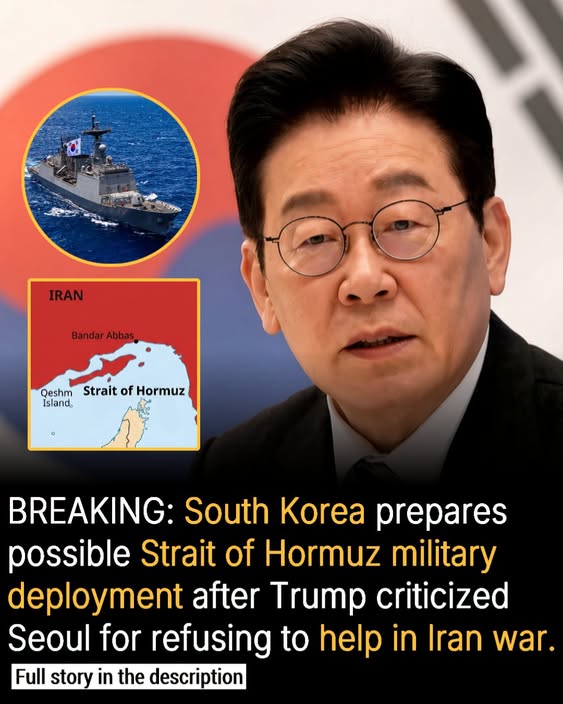
The South Korean military is making "concrete preparations" to deploy naval forces to the strategic Strait of Hormuz , a significant shift in policy that appears to be driven by sustained pressure from U.S. President Donald Trump . While Seoul maintains that no final decision has been made , the reported deployment package — including P-8 maritime patrol aircraft, an explosive ordnance disposal team, and a logistics support ship — marks a potential reversal of its previous stance to only consider such action after the U.S.-Iran war ended .
SEOUL/WASHINGTON – A dramatic shift appears to be unfolding in the strategic waters of the Middle East. The South Korean military has reportedly begun "concrete preparations" to deploy troops to the Strait of Hormuz . This move comes as President Donald Trump has publicly and repeatedly criticized Seoul for refusing to join U.S.-led efforts against Iran, even linking the issue to the U.S. troop presence on the Korean Peninsula.
A Forced Pivot Under U.S. Pressure
The reported preparations represent a major policy reversal for the South Korean government. Previously, Seoul maintained that it would only consider a deployment to the Strait of Hormuz after hostilities between the United States and Iran had ended .
However, this position appears to have been overridden by relentless pressure from President Trump. In recent weeks, Trump has repeatedly accused South Korea of failing to contribute to the U.S.-led coalition against Iran, despite receiving significant U.S. military and economic support .
In a recent Fox News interview, Trump stated, "We are spending billions of dollars to help NATO and other countries, like South Korea... We help them, but when it came time for them to help us, I asked 'would you like to participate?' and they all said 'No, thank you.'" He added, "Take South Korea. We have 40,000 troops there. I asked them, 'Can you help us a little bit with Iran?' and they said they'd rather not." Trump has repeatedly emphasized, "I will remember this" .
'Concrete Preparations' and a Strategic Asset Package
Amid this diplomatic pressure, SBS News reported on September 3 that the South Korean military is making concrete preparations to deploy naval forces to the region . The anticipated deployment package is notably non-combat-focused and includes:
-
P-8 Poseidon maritime patrol aircraft: This would mark South Korea's first-ever deployment of maritime patrol aircraft to the region, tasked with monitoring threatening submarines and surface vessels .
A Navy logistics support ship: Possibly the 23,000-ton Soyang-class, this vessel would provide rear-guard logistical support .
An Explosive Ordnance Disposal (EOD) team: This team, drawn from the elite Naval Special Warfare Flotilla (UDT/SEAL), could conduct joint operations with foreign navies .
The Legal and Political Hurdles in Seoul
Despite the momentum, any actual deployment faces a complex domestic approval process in South Korea. A final decision requires:
-
A decision by the National Security Council (NSC) .
A resolution by a Cabinet meeting .
Formal consent from the National Assembly .
The presidential office in Seoul has been careful to manage expectations. On September 4, a spokesperson stated that no final decision has been reached and the review is ongoing . They emphasized that the government would follow "due procedures," and any contribution must not "compromise its defense readiness" on the Korean Peninsula .
One official highlighted that "military contributions could mean not only combat forces but also noncombatant and search forces," and that a comprehensive review of all such "options" is underway . This careful phrasing reflects Seoul's balancing act: signaling commitment to its alliance with the U.S. while managing its domestic political landscape and diplomatic relations with Iran.
Linking Alliance to Trade and Security
The pressure from President Trump is not occurring in a vacuum. It is part of a broader pattern of transactional diplomacy . Observers note that Trump has linked South Korea's refusal to contribute to the Iran conflict with other issues, including the cost of the U.S.-South Korea alliance and trade negotiations .
On August 16, Trump ordered a significant reduction in the scale of the Ulchi Freedom Shield (UFS) joint military exercises with South Korea, a move seen as retaliation for Seoul's perceived lack of cooperation on Iran . This demonstrates his willingness to use the security alliance as leverage.
If it proceeds, this would be the first time South Korea has deployed military assets to the Strait of Hormuz, and the first significant overseas troop dispatch since the 2003 deployment to Iraq .
The Bottom Line
| What the Graphic Suggests | The Reality |
|---|---|
| South Korea is definitely deploying to the Strait of Hormuz. | Uncertain. Reports of "concrete preparations" are confirmed, but a final decision requires parliamentary approval and is still under review . |
| The deployment is solely a South Korean initiative. | It appears heavily driven by U.S. pressure and public criticism from President Trump . |
| The deployment would be a combat mission. | The reported assets (patrol aircraft, EOD team, supply ship) are primarily support and defensive . |
| The decision is final. | No. Seoul maintains that "no decision has been reached" and the review is ongoing . |
Comments (0)
Loading comments...
May You Like

gfnhgmnghnmfgnbvvvvvvvvv

OBAMA STEPS BACK INTO THE POLITICAL SPOTLIGHT













