
SOUTH PARK DESTROYS TRUMP
South Park’s Trump Deepfake Returns in Explosive Season 29 Finale Scene — But the Billionaire Satire Goes Much Further
A single scene at the end of a new South Park episode has reignited the debate over how far political comedy can go. This time, the target is Donald Trump, and the tool is a deliberately outrageous digital likeness that makes the distinction between animation, parody and manipulated video impossible to ignore.
The installment, titled “Billionaire Weenietown,” aired on Comedy Central on September 30, 2026. It is the second episode of the animated show's twenty-ninth season, which has also used the satirical name “South America” as part of its running political commentary.
While much of the online attention has focused on the closing Trump sequence, the main story actually belongs to Butters Stotch. The character becomes furious about the new data centers that extremely wealthy newcomers are building near his home and the disruptions they bring to his everyday life.
South Park turns that contemporary concern into a literal infestation. A miniature community of wealthy figures appears in Butters' backyard, making a complicated argument about concentrated power look like a bizarre neighborhood pest problem.
The show's central joke is that the most influential people in technology and business do not simply control money. They also want to control the conversation, competing for attention through podcasts, public arguments and relentless commentary about subjects far beyond their expertise.
As Butters looks for a way to remove his unwanted neighbors, the plot links sprawling technology infrastructure to questions about who bears the costs of digital expansion. In the episode, the disruption feels immediate and personal rather than like an abstract debate about server farms.
The data-center material has a recognizable real-world backdrop. New facilities can demand substantial amounts of electricity, water and land, and communities have increasingly argued about the effects of this infrastructure. The series compresses those concerns into a comically exaggerated story rather than offering a technical analysis.
Butters also confronts a familiar problem in South Park's world: adults who are supposedly in charge are distracted by their own biases. Conversations about technology become tangled with claims about vaccines, podcasts and political identity, leaving his practical frustrations unresolved.
One running gag concerns the way wealthy personalities attempt to shape their own reputations. The miniature billionaires decide that controlling the narrative may be easier than changing their behavior, a joke aimed at the relationship between great wealth, publicity and the news business.
The cartoon's target is therefore broader than any single entrepreneur. Its point is that money can purchase access, platforms and influence, while ordinary people are left to absorb the inconvenience of decisions made far away from them.
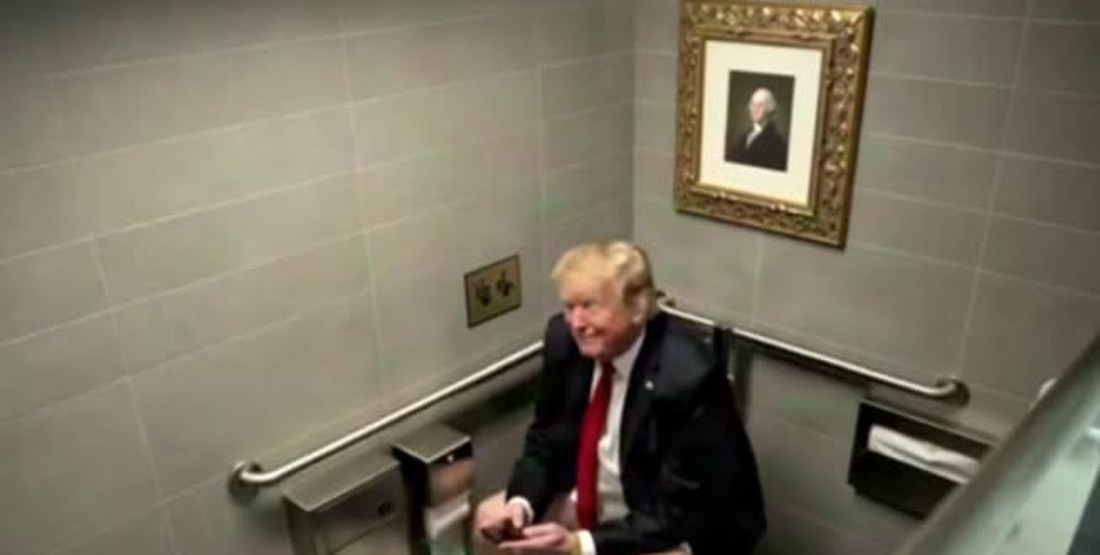
Near the conclusion, the comedy abruptly changes visual style. The animated setting gives way to a digitally fabricated depiction of Trump in a public restroom, using the realistic appearance of a political figure in an obviously impossible and grotesque situation.
The sequence is satire, not documentary footage. It does not show a genuine recording of the president, and it should not be circulated without that context. The creators are using a synthetic image precisely because its manufactured nature is part of the joke.
Rather than relying on a lengthy speech, the ending uses shock, recognizable visual cues and a brief piece of political audio. Contemporary reporting described the soundtrack as incorporating an advertisement associated with Trump's own political messaging before the scene veers into absurdity.
The abrupt shift is calculated to leave viewers discussing the final image long after the episode ends. It also reframes the earlier billionaire satire, connecting the episode's obsession with wealth and spectacle to its treatment of the president.
There is an additional irony in the use of synthetic imagery. AI tools are themselves part of the broader debate over the data centers criticized in the episode, creating a tension between the show's message and one of the technologies used to deliver its final punch line.
South Park has never treated elected officials as figures who must remain beyond ridicule. Since its debut in 1997, the series has relied on shock humor, cultural references and crude exaggeration to test the boundaries of television satire.
The difference today is the visual credibility of fabricated video. A cartoon caricature usually announces itself immediately, but a deepfake can appear realistic for a moment. That gives a joke a different kind of power—and creates a responsibility for viewers and publishers to identify it as fiction.
Supporters of the show may see the ending as an example of political comedy exercising its freedom to mock the powerful. Critics may regard it as needlessly graphic or degrading. Those are differing judgments about the same fictional sequence, not evidence that the depicted event actually occurred.
The episode's larger argument is easy to overlook amid the viral reaction. It asks what happens when billionaires become both the architects of new technology and the loudest personalities explaining why everyone else should accept its consequences.
By making Butters the center of that story, the creators keep the stakes grounded in everyday frustration. He is not fighting a policy war in Washington; he is trying to live in a neighborhood where powerful outsiders have started changing the rules.
Ultimately, “Billionaire Weenietown” is more than a Trump joke. The deepfake ending may be its most memorable moment, but the full episode uses that provocation to conclude a wider satire about money, influence, technology and the absurd ways public debate can be hijacked by the people with the most power.
Comments (0)
Loading comments...
May You Like

BANGCHAK REFINERY IN THAILAND SHUT DOWN, U.S. OIL PRICES JUMP 10%!

NYC EMERGENCY—MILLIONS FACE EVACUATION RISKS, MACY'S GIANT BALLOONS REMOVED FOR SAFETY!

I-75 THANKSGIVING NIGHTMARE — MAIL TRUCK CRASH RAISES OVERPASS COLLAPSE FEARS!

Latest Posts






Popular Posts





